

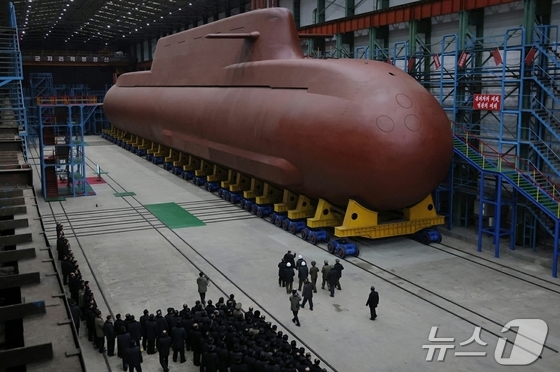
North Korea has unveiled its 8,700-ton nuclear-powered submarine in a dramatic show of force. Analysts say the move could accelerate discussions between South Korea and the United States over South Korea’s own nuclear submarine program.
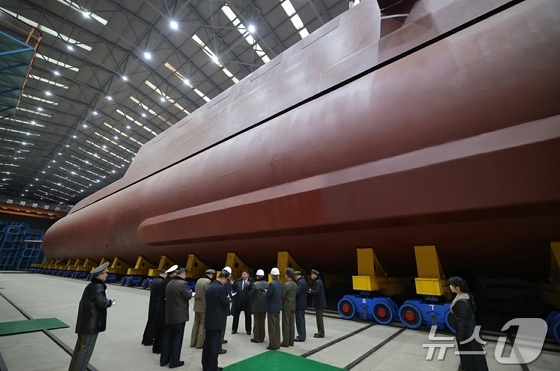
North Korea’s state-run Rodong Sinmun reported on Thursday that Kim Jong Un, general secretary of the Workers’ Party, inspected the construction site of what it described as a nuclear-powered strategic guided missile submarine. The report included the first full images of the submarine under construction, marking the first time North Korea has fully disclosed the appearance of its nuclear-powered submarine.
The unveiling coincided with recent momentum following a South Korea–United States summit, where both sides agreed to pursue South Korea’s nuclear submarine program and to begin formal working-level discussions in early 2024. Analysts interpret the disclosure as an attempt by North Korea to demonstrate a faster pace of submarine constructionas a form of strategic counteraction.
Kim Jong Un’s public display of the submarine is widely viewed as an effort to underscore the strategic challenges facing the United States. Unlike conventional diesel submarines, nuclear-powered submarines can operate submerged for extended periods and conduct long-range missions. Once deployed, the United States would likely treat them as strategic assets requiring continuous monitoring and response.
If the unveiled submarine is designed to carry strategic missiles, the United States would need to view it not only as a regional threat but as part of a broader strategic challenge. This could compel Washington to maintain a constant presence of nuclear submarines in surrounding waters, including the East Sea, or to establish equivalent surveillance and response systems.
Analysts say this development highlights the strategic importance of South Korea’s nuclear submarine acquisition plans. South Korea’s proposed nuclear submarines would not carry nuclear weapons but would serve as conventionally armed attack submarines focused on tracking, surveillance, and anti-submarine operations. They would function as tailored deterrents aimed specifically at countering North Korea’s nuclear submarine capability.
Professor Park Won Gon from Ewha Womans University said that if North Korea successfully operationalizes its 8,700-ton nuclear submarine, the United States would likely need to deploy its own nuclear submarines on a permanent basis in specific areas for monitoring. He noted that because the United States operates its nuclear submarine fleet globally, being confined to a single region could pose a significant strategic burden.
He added that if South Korea builds nuclear submarines and assumes the role of tracking, surveilling, and potentially neutralizing North Korea’s nuclear submarines, the United States could maintain strategic flexibility without permanently stationing forces in Northeast Asia. He said this could become a key argument in persuading United States policymakers.
Experts note that non-proliferation offices within the United States Department of State, along with the National Nuclear Security Administration, apply extremely strict standards to the overseas transfer of nuclear-related technology and materials. Combined with the congressional approval process, the introduction of nuclear submarines remains a politically and legally complex issue.
Currently, South Korea and the United States are pursuing a separate agreement for the introduction of South Korea’s nuclear submarines, similar to the Australia–United Kingdom–United States security partnership framework.
On December 18, South Korea launched a government-wide task force involving 10 ministries, including the National Security Office and the ministries of national defense and foreign affairs, to advance the nuclear submarine initiative. Seoul aims to make significant progress before the United States midterm elections in November 2024. A United States working-level delegation is scheduled to visit South Korea early next year.
Some analysts caution that Kim Jong Un’s decision to openly reveal the nuclear submarine could ultimately backfire by narrowing North Korea’s operational scope.
Um Hyo Sik, Secretary-General of the Defense Security Forum, said the public disclosure could prompt heightened monitoring by the United States and the international community, potentially constraining North Korea’s operational flexibility.