

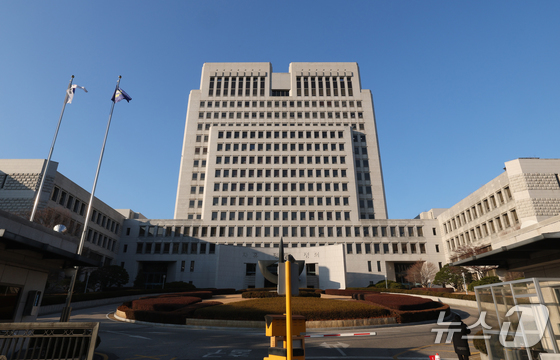
The Supreme Court has ruled that actions such as delivering a letter praising Kim Jong Il to North Korean officials do not violate the National Security Law.
On Wednesday, legal sources reported that the Supreme Court’s second division, presided over by Justice Eom Sang-pil, upheld the lower court’s not guilty verdict for Mr. Kim, chairman of the Inter-Korean Sports Exchange Association, who was charged with violating the National Security Law.
Mr. Kim, who was involved in sports exchanges with North Korea, was indicted for violating the National Security Law after writing a birthday congratulatory letter to Kim Jong Il on February 16, 2010, and delivering it to a North Korean official. He also sent a wreath to the mourning altar at the North Korean embassy in China following Kim’s death in December of the following year.
While serving as chairman of the Inter-Korean Sports Exchange Association, he also faced charges of embezzling 67 million KRW (approximately 46,260 USD) in funds provided by Gyeonggi Province and commercial banks for purchasing soccer equipment.
Additional charges included illegally exporting 500 pairs of soccer shoes worth 60 million KRW (about 41,430 USD) to North Korea without government approval, as well as exporting unreported foreign currency in violation of the Foreign Exchange Transactions Act.
The central issue was whether Mr. Kim’s actions of sending a congratulatory letter for Kim Jong Il’s birthday and delivering a wreath to the North Korean embassy constituted acts of praise or encouragement for an anti-state organization, which is prohibited by the National Security Law.
The first trial sentenced Mr. Kim to 18 months in prison and a two-year suspension of qualifications.
The court determined that Mr. Kim’s references to Kim Jong Il as General, his birthday as the day of birth, and North Korea as the homeland indicated that the letter’s content praised and encouraged activities of an anti-state organization.
Moreover, sending a wreath despite the government’s prohibition on such actions related to Kim Jong Il’s death was viewed as an act of sympathy towards North Korea.
The first trial court stated that the defendant praised a dictator, misappropriated funds intended for North Korean projects, provided goods to North Korea without proper authorization, and exported foreign currency without customs declaration.
It further emphasized that actions violating South Korean law cannot be justified solely on the grounds of inter-Korean exchange and cooperation, warning that tolerating such behavior could send a dangerous message that might undermine the country’s democratic order.
In contrast, the second trial court acquitted Mr. Kim of all National Security Law violations, only acknowledging some embezzlement charges and imposing a fine of 10 million KRW (about 6,900 USD).
The second trial court noted that the handwritten letter primarily requested expedited production of soccer shoes at a Pyongyang factory for North Korean national team players to use in World Cup matches, with minimal references to Kim Jong Un or the North Korean regime.
The court added that while the language used regarding Kim Jong Un might seem excessive, considering his absolute status in North Korea, the nature of a birthday congratulatory letter, and the overall context, it was merely ceremonial rhetoric typical in inter-Korean exchanges. They concluded that these actions did not pose a risk to South Korea’s national security or democratic order.
Regarding the delivery of a wreath despite government prohibition, the court stated that violating an administrative ban alone does not necessarily indicate a clear danger.
The Supreme Court upheld the lower court’s ruling, affirming the decision to dismiss the appeal.