

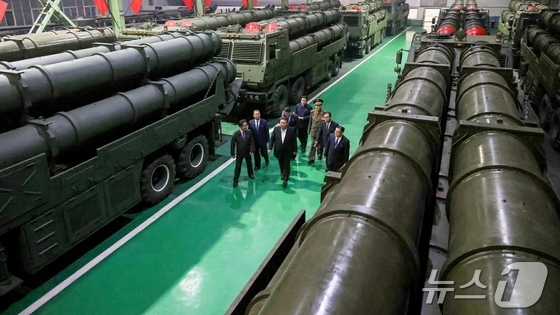
Kim Jong Un, the Supreme Leader of North Korea, has been ramping up his military-focused activities as the year draws to a close, conducting frequent visits to defense industry facilities and weapon development and testing sites. His inspections cover both cutting-edge nuclear strategic weapons and conventional armaments, leading analysts to speculate that these moves telegraph the broad strokes of a new national defense strategy to be unveiled at the upcoming 9th Workers’ Party Congress in early next year.
Military experts suggest that North Korea’s defense doctrine, slated for confirmation at the 9th Party Congress, will likely adopt a dual-track approach. This strategy aims to integrate state-of-the-art weaponry, particularly nuclear capabilities, with a robust conventional force structure.
As part of his year-end agenda, Kim has been making regular inspections of military production facilities, referred to as critical defense industry enterprises. These visits primarily focus on assessing the production status of Short-Range Ballistic Missiles (SRBMs). During these tours, Kim personally scrutinizes manufacturing processes, production volumes, and operational sustainability. He has emphatically stressed that the modernization and production targets to be set forth at the 9th Party Congress must be embraced without reservation.
North Korean state media coverage of Kim’s factory tours prominently features the assembly, processing, and storage conditions of completed missiles, underscoring the regime’s readiness for sustained missile operations.
While Pyongyang has consistently touted its SRBMs as nuclear-capable, recent developments suggest a shift in emphasis, possibly influenced by lessons from the Ukraine conflict. Instead of highlighting the nuclear potential of SRBMs, North Korea has pivoted to showcasing its mass production capabilities for these missiles. This change in focus may reflect a strategic reassessment that in actual combat scenarios, overwhelming conventional firepower could prove more decisive than a limited nuclear arsenal.
Simultaneously, Kim has overseen the construction of North Korea’s first nuclear-powered ballistic missile submarine and observed training exercises for new nuclear-capable strategic cruise missiles. These actions indicate a prioritization of developing advanced nuclear delivery systems rather than retrofitting existing conventional platforms for nuclear roles.
This month also saw North Korea’s inaugural test launch of a new high-altitude, long-range surface-to-air missile system, believed to be Pyongyang’s answer to the Terminal High Altitude Area Defense (THAAD). Analysts speculate this system is being developed to counter potential U.S. and South Korean nuclear and ballistic missile threats.
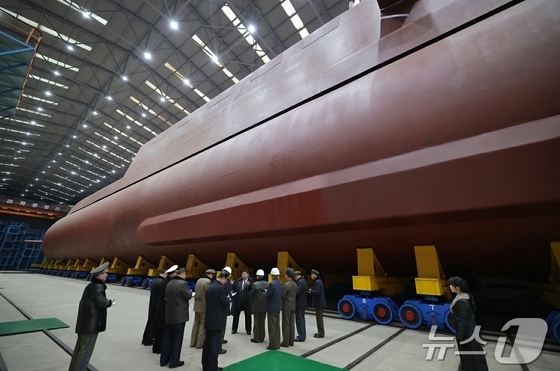
The emergence of nuclear submarines with extended submerged endurance and low-observable cruise missiles, coupled with new air defense systems, suggests that North Korea is orienting its nuclear capabilities more towards deterrence than offensive operations.
Defense experts point out that a key attribute of nuclear submarines is their second-strike capability – the ability to launch retaliatory nuclear attacks from concealed deep-sea locations following a homeland nuclear strike. Similarly, cruise missiles, deployable from both land and sea platforms, offer high value as surprise attack or counterstrike weapons, enhancing overall deterrence. In contrast, conventional SRBMs, primarily land-based, have limited deterrent value due to their vulnerability to U.S.-Republic of Korea (ROK) surveillance and early warning systems.
In summary, North Korea appears to be pursuing a two-pronged approach to bolster its defense posture: developing a credible nuclear second-strike capability against the U.S. while amassing a large conventional arsenal for potential concentrated attacks against South Korea.
This strategic direction aligns with Kim’s recent statements. During a September visit to an electronic weapons research facility, he indicated that the 9th Party Congress would articulate a parallel development policy for nuclear and conventional forces in the defense sector.
On that day, the Rodong Sinmun reported Kim’s inspection of a military factory on December 28, where he lauded the 600mm super-large multiple rocket launcher (classified as an SRBM) as a formidable weapon system boasting high precision and devastating firepower. Kim asserted that this system, capable of overwhelming enemies with concentrated and sudden strikes, would become a primary offensive asset for the Korean People’s Army.