

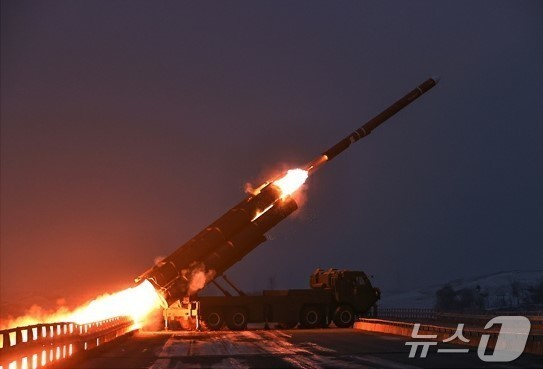
South Korean military has criticized North Korea’s recent provocative actions, including the launch of cruise missiles on December 28, as acts that undermine peace and stability on the Korean Peninsula. The U.S. ally has also called for a resumption of dialogue.
During a regular press briefing on Monday, Defense Ministry spokesperson Jeong Bit-na addressed North Korea’s recent activities. She noted that Pyongyang’s public announcement of a Defense Ministry statement and details about its nuclear-powered submarine construction on December 25, followed by multiple cruise missile launches on the 28th, clearly demonstrate the regime’s intent to bolster its nuclear capabilities. Jeong emphasized that these actions pose a significant threat to peace and stability in the region.
The spokesperson urged North Korea to respond positively to Seoul’s sincere efforts to resume dialogue aimed at peaceful coexistence on the Korean Peninsula. She called on Pyongyang to participate in maintaining a stable situation in the region. Jeong reaffirmed that South Korean forces will maintain robust capabilities and a strong readiness posture while supporting the government’s diplomatic initiatives to ease military tensions and establish lasting peace on the peninsula.
North Korea’s state-run newspaper, Rodong Sinmun, reported that a long-range strategic cruise missile launch exercise was conducted at sea on December 28 under the direct observation of Supreme Leader Kim Jong Un.
In response to this development, South Korea’s Joint Chiefs of Staff (JCS) issued a statement confirming that, in close coordination with U.S. forces, they had been monitoring signs of North Korean missile activity. The JCS detected multiple cruise missiles launched from the Pyongyang area at approximately 8:00 a.m. South Korean and U.S. intelligence agencies are currently conducting a detailed analysis of the missiles’ specifications.
This latest provocation follows a series of aggressive moves by North Korea. On December 24, Pyongyang conducted a test launch of a new anti-aircraft missile system, dubbed the North Korean Terminal High Altitude Area Defense (THAAD). The following day, North Korea’s Defense Ministry, via the state-run Korean Central News Agency, threatened to consider countermeasures in response to the U.S. Navy’s nuclear-powered submarine USS Greenville’s port call in Busan.
Furthermore, on December 25, North Korean state media revealed that the country is constructing an 8,700-ton nuclear-powered ballistic missile submarine. Defense analysts believe this vessel is equipped with advanced internal systems, including a compact nuclear reactor for propulsion. This development has led experts to assess that North Korea’s nuclear submarine program may be nearing the launch stage, marking a significant advancement in the regime’s naval capabilities.