

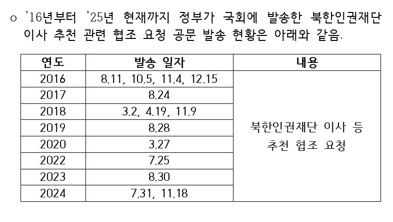
The government has failed to send a single recommendation letter for board members of the North Korean Human Rights Foundation to the National Assembly last year.
According to the Ministry of Unification on Monday, the last time the ministry sent a recommendation letter for the North Korean Human Rights Ambassador was on November 18, 2024, following the 2016 enactment of the North Korean Human Rights Act.
Over the years, the Ministry of Unification has sent a total of 14 recommendation letters: three during the Park Geun-hye administration (February 25, 2013 – December 8, 2016), one during Hwang Kyo-ahn’s acting presidency (December 9, 2016 – May 9, 2017), six during the Moon Jae-in administration (May 10, 2017 – May 9, 2022), and four during the Yoon Suk Yeol administration (May 10, 2022 – December 14, 2024).
Since then, during the terms of acting presidents Han Duck-soo, Choi Sang Mok, and Lee Joo-ho (December 14, 2024 – June 4, 2025), and following the inauguration of the Lee Jae-myung administration, no recommendation letters have been sent to the National Assembly.
Similarly, the Advisory Committee for the Promotion of North Korean Human Rights, which should be formed through National Assembly recommendations, has been inactive since its first term expired in January 2019 due to delays in recommendations. In its place, the Ministry of Unification’s advisory body, the North Korean Human Rights Promotion Committee, has been handling tasks such as preparing for the establishment of the North Korean Human Rights Foundation.
According to Article 12 of the North Korean Human Rights Act, the North Korean Human Rights Foundation should have up to 12 board members, including a chairperson. The board comprises two individuals recommended by the Minister of Unification and others recommended by the National Assembly.
When the National Assembly recommends board members, they must be evenly split between the ruling party and other negotiating groups, with the Minister of Unification making the final appointments.
A Ministry of Unification official explained that last year’s complex political situation following the state of emergency made it difficult to advance issues related to the Human Rights Foundation, especially in the latter half of the year when related bills were being discussed in the National Assembly.
The government specified in the 123 National Tasks finalized last September that it would promote the establishment of the North Korean Human Rights Foundation in a way that balances the enhancement of North Korean residents’ human rights with the development of inter-Korean relations and peace establishment. However, the administration has been reducing its emphasis on North Korean human rights policies, including renaming the planned National North Korean Human Rights Center to the Korean Peninsula Peace and Coexistence Center.
Critics argue that the Lee Jae Mung administration, which favors a conciliatory approach toward North Korea, is deliberately avoiding the sensitive issue of human rights that provokes strong reactions from Pyongyang.
In fact, Democratic Party lawmaker Lee Jae-jung proposed a bill on July 16 to rename the North Korean Human Rights Foundation to something like the Inter-Korean Cooperation Foundation.
Minister of Unification Chung Dong-young also stated before the National Assembly’s Foreign Affairs Committee that he believes the 2016 enactment of the North Korean Human Rights Act was inappropriate, and expressed that he sees no need to recommend board members for the foundation.