

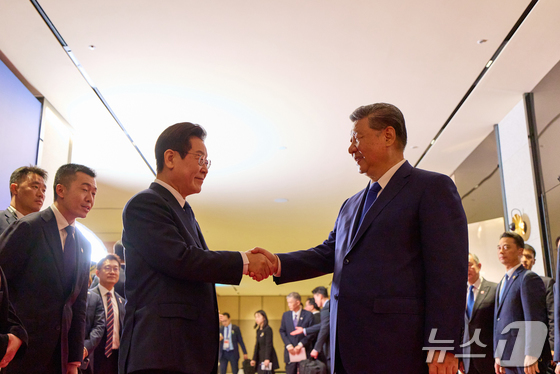
President Lee Jae Myung will make a state visit to China on January 4 at the invitation of President Xi Jinping. This meeting, coming just two months after their initial encounter at the Asia-Pacific Economic Cooperation (APEC) summit in Gyeongju, is expected to be a pivotal moment for fully restoring South Korea-China relations and expanding cooperation on economic and peace initiatives for the Korean Peninsula.
With a summit between President Lee and President Xi scheduled for Monday, expectations for improved bilateral relations have soared. China’s unusual decision to extend a state visit invitation in January, typically a quiet month for international diplomacy, underscores the significance of this meeting. Reports suggest that both nations are in the final stages of negotiating over ten Memorandums of Understanding (MOUs).
All eyes are on whether President Xi will address longstanding issues, such as lifting restrictions on Korean cultural exports, colloquially known as the Korean Wave ban. Additionally, discussions on resuming engagement with North Korea, China’s potential mediatory role, and progress on sensitive topics like nuclear-powered submarines and structures in the Yellow Sea are key points of interest.
President Lee and Xi’s January 5 Summit to Finalize Details of Over Ten MOUs
The Blue House announced on January 4 that President Lee will embark on a four-day trip to Beijing and Shanghai from January 4 to 7, following President Xi’s invitation. This marks the first state visit by a South Korean president to China in nearly nine years, since former President Moon Jae-in’s visit in 2017. It also represents the leaders’ first meeting since their summit at the APEC conference in Gyeongju last November.
President Lee’s itinerary begins with a dinner meeting with South Korean expatriates in China on the first day. On Monday, he is set to attend a South Korea-China Business Forum, engaging with key economic figures from both nations to foster expanded economic exchanges and cooperation.
The core agenda for January 5 includes an official state welcome ceremony, the summit between President Lee and President Xi, an MOU signing ceremony, and a state dinner.
While specific details of the summit agenda remain undisclosed, discussions are expected to cover strengthening political goodwill for fully restoring relations, enhancing practical cooperation in civilian sectors based on mutual benefits, improving communication for peace on the Korean Peninsula, and managing sensitive issues like the Yellow Sea structures.
Sources indicate that the two countries are not planning to adopt a joint communique or official documents. Instead, they are focusing on achieving substantial outcomes through the signing of over ten MOUs across various sectors, including economy, industry, climate, and transportation.
On Tuesday, President Lee will meet with China’s second and third-ranking political figures. He will first meet with Zhao Leji, Chairman of the Standing Committee of the National People’s Congress, followed by a luncheon with Li Qiang, Premier of the State Council and China’s second-highest-ranking official.
In these meetings, President Lee is expected to discuss ways to enhance people-to-people relations with Chairman Zhao and explore new models for bilateral economic cooperation based on mutual benefits with Premier Li.
Following these high-level meetings, President Lee will travel to Shanghai, a symbol of China’s economic prowess. There, he is scheduled to dine with the Shanghai Party Secretary and discuss cooperation between local governments of both countries.
The Shanghai Party Secretary position, previously held by former President Jiang Zemin, current President Xi, and Premier Li, is considered a crucial stepping stone in Chinese leadership.
On Wednesday, the final day of his visit, President Lee will participate in the South Korea-China Venture Startup Summit, supporting exchanges among young entrepreneurs in sectors such as content creation, healthcare, infrastructure, and energy.
To conclude his trip, President Lee will visit the Shanghai Provisional Government Office, commemorating the 150th anniversary of independence activist Kim Gu’s birth and the centennial of the provisional government, honoring the sacrifices of independence fighters.
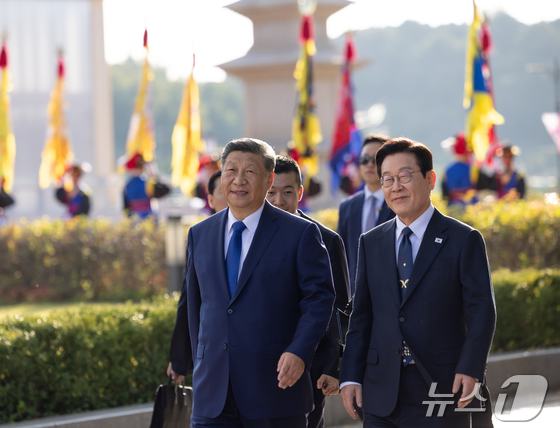
Blue House Cautiously Optimistic Amid Challenges, Yet Hopeful for Progress… Focus on Complex Issues: China’s Ban on Korean Content, Nuclear Submarines, North Korea
Analysts predict that President Lee will prioritize achieving tangible results that directly impact national interests during his China visit, marking the beginning of a new phase in practical diplomacy this year.
While President Xi’s invitation for a state visit so soon after their initial meeting signals a clear intent to improve relations, both countries face complex challenges. As a result, the Blue House remains cautiously optimistic.
Prior to his departure, President Lee received comprehensive briefings from key advisors on discussions with Chinese officials, meticulously preparing for the summit and meetings with senior Chinese leadership.
Attention is focused on the scope of practical outcomes, particularly the signing of MOUs in economic and industrial sectors. There’s also keen interest in whether China will ease its restrictions on Korean cultural exports during President Lee’s visit.
Discussions on security issues surrounding the Korean Peninsula are also high on the agenda. While China has expressed concerns about South Korea’s plans to introduce nuclear submarines, Seoul emphasizes that this is a defensive measure in response to North Korea’s pursuit of nuclear-capable submarines. The ongoing issue of structures in the Yellow Sea is under close coordination, with hopes for potential resolutions.
President Lee is expected to outline South Korea’s position on improving relations with North Korea and seek China’s active mediation. With North Korea recently pivoting from its close alignment with Russia to actively restore its traditional alliance with China, President Lee will likely emphasize how the E·N·D Initiative can contribute to peace and stability on the Korean Peninsula and in Northeast Asia, aiming to secure China’s support.
To facilitate these practical outcomes, President Lee has consistently sent conciliatory messages to China. He has directed authorities to respond proactively to anti-China protests and clearly articulated South Korea’s stance on the Taiwan issue, a particularly sensitive topic for China, just before his visit.
In a recent interview with China’s state-run CCTV, President Lee stated that the agreements made between South Korea and China at the time of diplomatic normalization remain the core principles governing our bilateral relations and are still valid. He respects the One China principle and can clearly state that peace and stability in Northeast Asia, including the Taiwan Strait, are of utmost importance.
National Security Office Director Wi Seong-lac emphasized that President Lee’s visit aims to restore strategic dialogue channels between South Korea and China, reinforcing the political foundation of bilateral relations. He added that they will promote mutually beneficial cooperation aligned with evolving economic structures, striving for tangible results that demonstrate to citizens of both countries the full restoration of relations.