As North Korea’s Workers’ Party prepares for its 9th Congress, a call emerged on Wednesday for South Korea to officially establish the signing of a peace treaty and the creation of a peace regime as domestic policy priorities.
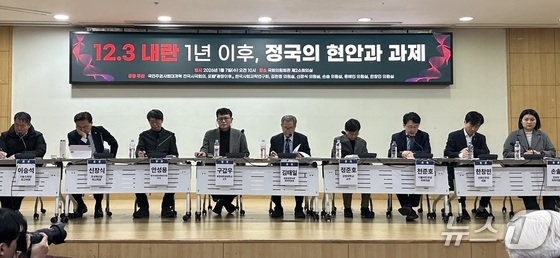
During a discussion title, One Year After the December 3 Incident: Current Political Issues and Challenges, held at the National Assembly Members’ Office Building, Professor Koo Kab-woo from the University of North Korean Studies emphasized that a peace treaty and peace regime are crucial for resolving Korean Peninsula issues and represent the only means to prevent nuclear conflict.
Professor Koo stressed the importance of South Korea formally adopting these peace initiatives as agenda items to signal intent to North Korea before the party congress. He also highlighted the need for legal and institutional reforms to foster peaceful coexistence, suggesting revisions to the National Security Act, amendments to Articles 3 and 4 of the Constitution, and restructuring the National Security Council (NSC).
From a security standpoint, Koo advocated for quiet deterrence enhancement through reinstating the September 19 inter-Korean military agreement, suspending U.S.-South Korea joint military exercises, and exploring inter-Korean cooperation projects. He proposed prioritizing peace regime establishment over denuclearization and utilizing various dialogue formats, including bilateral, trilateral, four-party, and six-party talks.
Koo emphasized the importance of internationalizing the peace regime concept, calling for cooperation among South Korea, North Korea, the U.S., China, Japan, and Russia. He noted that while some bilateral summits occurred around China’s Victory Day and the Asia-Pacific Economic Cooperation (APEC) summit last year, only China held talks with all other parties, highlighting the absence of inter-Korean, U.S.-North Korea, Japan-North Korea, South Korea-Russia, Japan-Russia, and U.S.-Russia summits.
Regarding China, Koo observed a trend of avoiding explicit denuclearization rhetoric while maintaining support for parallel denuclearization and peace regime efforts. He assessed that China and Russia share concerns about the emerging international order, the U.S. and China are forging a new cooperative system, and China-Japan relations are highly strained. Koo warned that Sino-Japanese tensions could become another flashpoint, potentially exacerbating the Taiwan issue.
Characterizing the current global and inter-Korean landscape as a new imperialist era, Koo referenced the National Security Strategy of a potential second Trump administration. He argued that this new American-led imperialism stems from the convergence of AI-driven capitalism and the decline of U.S. unipolar dominance.
Koo pointed out that the divided Koreas have aligned with opposing sides in the Russia-Ukraine and Israel-Hamas conflicts, warning that this dynamic could escalate nuclear tensions on the peninsula. He added that Russia’s hints at tactical nuclear weapon use have prompted North Korea to expand its nuclear posture, reinforcing its commitment to nuclear armament.
The Korean Peninsula Peace Regime refers to a state where war is officially ended among relevant nations, including North and South Korea, ensuring legal, institutional, and practical peace on the peninsula. Since the Korean Armistice Agreement on July 27, 1953, efforts have persisted to transition from an armistice to a peace regime.
Notably, discussions resumed during the 2018-2019 inter-Korean and U.S.-North Korea summits, with the 2018 Singapore Statement between North Korea and the U.S. including a commitment to joint efforts for establishing a lasting peace regime on the Korean Peninsula.