

@@@
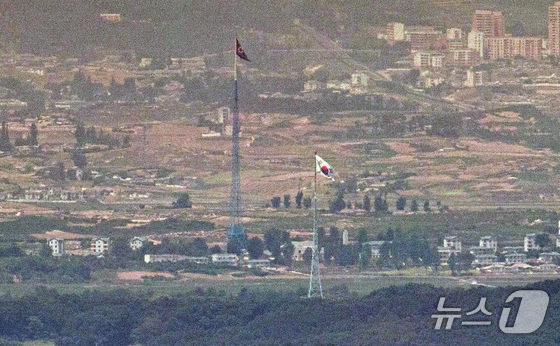
The Demilitarized Zone (DMZ) as seen from the border area in Paju, Gyeonggi Province. The North Korean flag and the South Korean flag are flying side by side in the villages of Gijeong-dong and Daeseong-dong. 2024.6.6 / News1
Tensions between the two Koreas recently spiked following North Korea’s allegations of a South Korean drone incursion. However, the situation appears to be de-escalating after Seoul’s swift denial and the launch of a joint military-police investigation. Pyongyang seems to be avoiding further escalation for now, while maintaining readiness to act depending on the investigation’s outcome. As of Monday, both sides appear to be in a state of managed confrontation, closely monitoring the South’s investigative findings.
On January 10, North Korea’s General Staff issued a strongly-worded statement accusing South Korea of violating its southern border with an unmanned aerial vehicle (UAV). The statement characterized this as a breach of sovereignty and a military provocation, warning of severe consequences and inescapable responsibility for what it deemed unacceptable behavior.
Analysis of the drone debris and specifications released by North Korea suggests that, contrary to Pyongyang’s claims of it being a military reconnaissance drone, the device appears to be a commercially available Chinese product. Reports have even identified it as a specific model: the Skywalker Titan 2160, manufactured by China’s Skywalker Technology.
In response to North Korea’s announcement, the South Korean government promptly refuted the accusations. Officials stated that the type of drone described is not in the South Korean military’s inventory and that no UAV operations were conducted on the dates claimed by North Korea (January 4 and September 27 of the previous year). President Lee Jae Myung ordered a comprehensive investigation, extending into civilian sectors.
Kim Yo-jong, a key figure in North Korea’s leadership, commented that South Korea made a prudent choice, but it will closely monitor the investigation results. This statement indicates that Pyongyang is adopting a wait-and-see approach. On January 11, Kim, who oversees foreign affairs for the Workers’ Party, noted that the South Korean military’s denial was a wise choice for survival and expressed approval of the government’s swift response.
She emphasized the need for a detailed explanation regarding the alleged border-crossing drone, suggesting that North Korea’s next moves will depend on the outcome of Seoul’s investigation. This stance also implies that Pyongyang may not wish to escalate tensions further over this particular issue.
Notably, on Monday, North Korea refrained from issuing any additional statements or taking further action related to the drone incident. This marks a shift from its previous approach, where it had prominently featured drone-related reports in the Workers’ Party’s official newspaper, Rodong Sinmun, to inform the public.
Some analysts speculate that North Korea may not have intended to escalate this issue into a major conflict from the outset. They argue that Pyongyang was likely aware of the drone’s commercial origin. The fact that North Korea only recently raised an incident from last September as a point of contention supports this view.
Experts suggest that North Korea’s decision to highlight the drone issue may be linked to its need for internal unity ahead of the 9th Workers’ Party Congress, held every five years. Simultaneously, it could be signaling a lack of immediate interest in improving inter-Korean relations.
The South Korean government is expected to release the investigation results promptly, with significant interest in potential legal ramifications.
The Ministry of National Defense has confirmed the initiation of a joint military-police investigation as per President Lee’s directive. Military officials have pledged to share findings transparently and aim to manage the situation through an expedited inquiry.
Sources indicate that the military is conducting an internal review of its drone-operating units. Concurrently, law enforcement is focusing on identifying the source of the alleged drone deployment, particularly in the areas cited by North Korea (Ganghwa Island and Paju), through evidence collection and closed-circuit television (CCTV) analysis. Investigators are considering all possibilities, including potential involvement from defector groups, pro-North Korean organizations, or politically neutral civilian entities.
The Ministry of Unification stated its commitment to monitoring the investigation results while continuing efforts to reduce tensions and build trust between the two Koreas.
If the drone’s origin is confirmed, the government is actively considering legal measures for potential prosecution. Officials are reviewing the applicability of relevant legislation, including the Aviation Safety Act and the Inter-Korean Relations Development Act. Current aviation laws prohibit civilian drone operations in controlled airspace and flights that could compromise national security.
The outcome of the joint military-police investigation and subsequent official statements are expected to be a critical juncture in shaping North Korea’s future stance. The key question is whether Pyongyang will use this as an opportunity to save face or as a pretext for further pressure tactics.
Some critics argue that the South Korean government’s response to North Korea’s claims appears overly conciliatory. They view the decision to launch an investigation, involving even the president, as potentially kowtowing to Pyongyang’s demands.