

Recent reports confirm North Korea has restructured key organizations responsible for Kim Jong Un’s personal security and regime protection over the past three years. Analysts suggest external events may have influenced these personnel changes.
The Ministry of Unification reported on Tuesday that three out of four commanders of Kim’s security and escort units have been replaced. This was verified during last year’s parade marking the 80th anniversary of the Workers’ Party founding.
The head of the Party Central Committee’s Escort Bureau, an elite unit tasked with the Kim family’s security and privacy, has changed from Han Soon-cheol to Song Jun-seol. The State Affairs Commission’s Security Bureau, which manages Kim’s security and protocol at formal events, is now led by Ro Kyung-chul, replacing Kim Cheol-kyu.
The Escort Command, responsible for Pyongyang’s defense and securing Kim’s travel routes, is now under Ra Cheol-jin, succeeding Kwak Chang-sik. Kim Yong-ho remains as head of the Guard Bureau, overseeing internal security at Kim’s offices and residences.
The exact timing and reasons for these leadership changes remain undisclosed.
However, intelligence suggests the changes occurred between August 2023 and early 2024, based on the last known public appearances of the former officials.
Hong Min, a senior researcher at the Korea Institute for National Unification, suggests these changes reflect a need for new operational concepts in Kim’s security and Pyongyang’s defense, likely prompted by external threats. The nature of the changes provides insights into the specific areas of concern.
The retention of Kim Yong-ho as Guard Bureau chief indicates that Party headquarters security was not a primary focus of the reorganization.
Hong noted a marked shift in Kim’s security protocols starting April 2023, with further enhancements observed in late 2024.
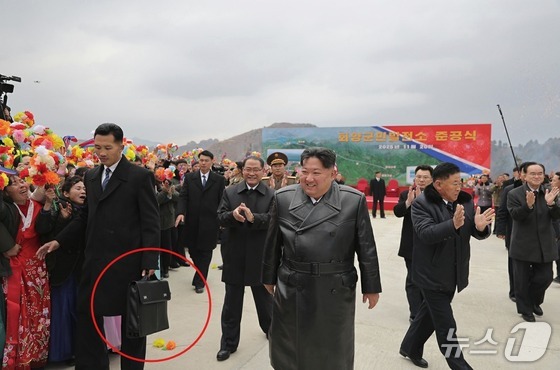
A significant change was first spotted on April 16, 2023, during a housing project ceremony in Pyongyang, where Kim’s close protection detail carried black bags, a departure from their usual unarmed appearance.
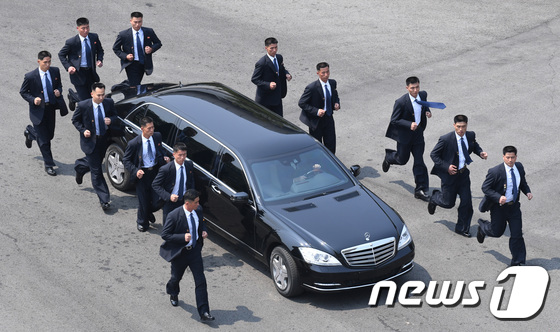
Previously, security personnel maintained a distance from Kim without visible equipment. The new approach involves 4-5 officers closely surrounding Kim with briefcase-like items, as shown in state media.
Hong theorizes that the attempted attack on Japanese Prime Minister Fumio Kishida on April 15, 2023, may have catalyzed these changes, particularly as a counter-measure against improvised explosive devices.
Late 2024 saw a significant boost in North Korea’s electronic warfare and anti-drone capabilities, coinciding with the deployment of North Korean troops to Russia in October.
The replacement of the Escort Command chief during this period likely reflects a need for enhanced drone defense and electronic warfare expertise to bolster Pyongyang’s air defenses.
The public debut of Kim’s daughter, Ju-ae, in November 2022 may have also factored into the security reshuffle.
Hong suggests that coordinating the movements of both Kim and his daughter likely necessitated new security protocols, though these changes fall under family security measures rather than successor protection.