

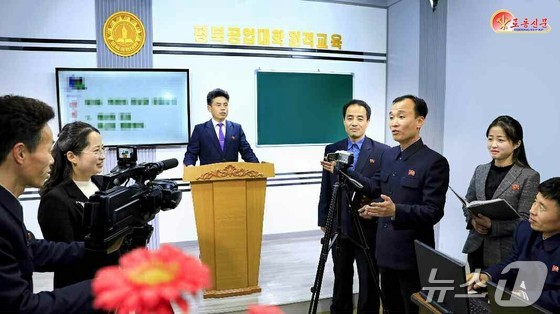
North Korea claims to have developed a remote education system incorporating artificial intelligence (AI). The country appears to be enhancing education for students and workers by utilizing a university remote system similar to online universities in South Korea.
The Workers’ Party’s official newspaper, Rodong Sinmun, reported on Monday that educators at Kim Chaek University of Technology’s Department of Remote Education have established an advanced remote education system. This system integrates AI and computer technology with educational sciences, including instructional technology and educational psychology, based on comprehensive research into global development trends.
The Intelligent Instruction Management system automatically assesses students’ learning outcomes and provides appropriate learning materials tailored to individual cognitive processes. It also features a ‘learner model’ that emulates expert instructors and accurately identifies students’ learning progress.
This system automatically analyzes what students have learned, identifies knowledge gaps, and determines reasons for misunderstandings, while providing targeted learning resources.
For tens of thousands of workers, the system includes learning attitude analysis and an automated learning report generation feature. These tools analyze learning behaviors, offer encouragement, and regularly produce and distribute progress reports. The system also incorporates an automated Q&A function to address student inquiries and an intelligent testing mechanism for performance evaluation.
Furthermore, the system includes an automated evaluation of translation assignments that grades students’ translation work. It also automatically analyzes experimental reports, practical assignments, and departmental design projects submitted by students.
The newspaper reported that the university is continuing its research efforts to standardize and regulate this system, aiming to facilitate its adoption by other educational institutions.
North Korea legislated the remote education system during the 3rd session of the 14th Supreme People’s Assembly in April 2019. This established a legal framework requiring key universities to implement remote education systems. Workers can now attend classes from any location, provided they have access to a computer or mobile device connected to the national network.
The remote education law mandates that local people’s committees, relevant institutions, enterprises, and organizations create conditions for students to access necessary facilities, such as libraries, for remote learning. It also requires these entities to equip remote learning sites with essential technology and resources.