The government is reportedly considering prioritizing the restoration of the no-fly zone as part of the September 19 inter-Korean military agreement.
Sources indicate that the administration is exploring the possibility of proactively proposing the reinstatement of the no-fly zone to North Korea. However, agreements concerning land and maritime areas are not currently under consideration, and the specifics of the proposal, including its method and timing, remain undetermined.
The Lee Jae Myung administration has consistently advocated for a proactive and phased restoration of the September 19 military accord since taking office. The recent drone incident appears to have accelerated discussions on this matter.
Following North Korea’s claim on January 10 that a South Korean drone had violated its airspace, tensions escalated. This prompted calls within South Korea for establishing mechanisms to manage potential aerial conflicts and resume dialogue between the two nations.
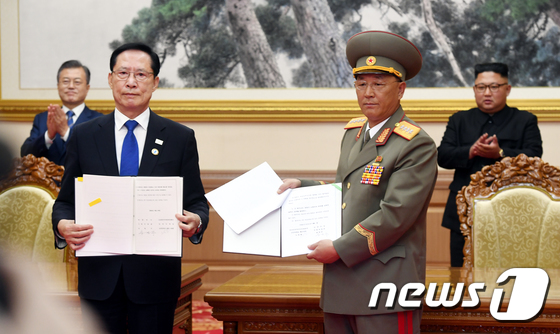
The September 19 agreement, signed by both Koreas during the Moon Jae-in administration in 2018, was designed to prevent military clashes in border regions. Key provisions include halting military exercises near the Military Demarcation Line (MDL), establishing no-fly zones, creating buffer zones in the West Sea, and removing guard posts from the Demilitarized Zone (DMZ).
The agreement specifically outlines no-fly zones for various aircraft types. For fixed-wing aircraft such as fighter jets and reconnaissance planes, the zones extend 40 kilometers (about 24.9 miles) in the east and 20 kilometers (about 12.4 miles) in the west from the MDL. Helicopters are restricted within 10 kilometers (about 6.2 miles), while drones face limits of 15 kilometers (about 9.3 miles) in the east and 10 kilometers (about 6.2 miles) in the west. Balloons are prohibited within a 25-kilometer (about 15.6 miles) range.
However, as denuclearization talks faltered and tensions rose on the peninsula, North Korea frequently violated the agreement’s terms. In response, the Yoon Suk Yeol administration partially suspended the accord in 2023, before fully halting its implementation in June 2024. Currently, neither Korea adheres to the agreement.
The Yoon administration has since signaled its intent to restore the September 19 agreement as part of broader efforts to promote peace on the Korean Peninsula. During his Liberation Day address last August 15, President Yoon stated that to prevent accidental clashes and build military trust between the Koreas, it will work to restore the September 19 agreement proactively and in phases.
The critical factor remains North Korea’s willingness to engage. Analysts question whether Pyongyang, currently maintaining a hostile two-state policy towards Seoul, will respond positively to South Korea’s proactive proposal.
In response to these developments, the Blue House has stated that the government is exploring various strategies to reduce military tensions and foster trust between North and South Korea.