

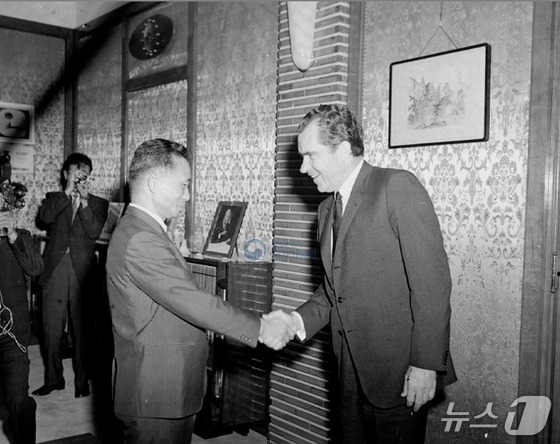
In the early 1970s, cracks began to appear in the Cold War system. The confrontation between the Eastern and Western blocs, centered on the U.S. and the Soviet Union, eased, and the trend of détente, which emphasized management and coordination rather than military conflict, became the mainstream of the international order. This change spread to surrounding regions, including Europe and East Asia, and the divided Korean Peninsula was also affected.
The improvement in relations between the U.S. and China was a turning point in international politics. The U.S. and China held ambassador-level talks in Warsaw, Poland, and made unofficial contacts through third-country channels such as Pakistan. In July 1971, U.S. National Security Advisor Henry Kissinger secretly visited Beijing and met with Premier Zhou Enlai, where President Richard Nixon’s visit to China was agreed upon. In February 1972, a U.S.-China summit that broke the Cold War mold was held.
The dramatic changes in international politics also impacted the Korean Peninsula. In July 1969, President Nixon announced the so-called Nixon Doctrine, which aimed to reduce the defense burden on allied countries. This was interpreted as a signal that allies should take greater responsibility for their own defense. The U.S. decided to reduce about 20,000 U.S. troops in Korea and implemented this gradually from 1971. Anxiety about changes in the security environment spread throughout Korean society.
South and North Korea Initiated Dialogue Through Behind-the-Scenes Contacts… Producing the First Official Agreement Document Since the Division
Faced with dramatic changes in the political situation, the Park Chung-hee regime attempted to change its North Korea policy. While clearly stating the premise of a change in attitude from the North, it employed a non-confrontational approach for the first time. In his August 15 Declaration of 1970, President Park stated that if North Korea abandoned its forceful unification policy and proved this through actions, artificial barriers between the two Koreas could be gradually removed from a humanitarian perspective and to lay the groundwork for unification.
Immediately after this declaration, behind-the-scenes contacts between the two Koreas intensified. On August 12, 1971, when the South officially proposed Red Cross talks, the North accepted two days later on January 14. Subsequently, from September of that year until August 1972, 25 preliminary meetings were held. Dialogue for discussing humanitarian issues expanded to include discussions on political and military tension reduction. In May 1972, Lee Hu-rak, the director of the Korean Central Intelligence Agency, visited Pyongyang, followed by a return visit to Seoul by North Korean Deputy Premier Park Sung-chul, continuing high-level contacts.
On July 4, 1972, the two Koreas simultaneously announced the July 4 South-North Joint Communiqué in Seoul and Pyongyang. The joint statement, signed by Director Lee and Kim Young-ju, the director of the Organization and Guidance Department of the Workers’ Party of Korea, consisted of seven articles and presented independence, peace, and grand national unity as the basic principles for unification.
In the joint statement, the two Koreas specified the exclusion of foreign powers, opposition to the use of force, national unity transcending differences in ideology and systems, and the pursuit of peaceful unification. They also promised to stop mutual slander and armed provocations, expand exchanges to restore national ties, and achieve early results in Red Cross talks. It also included the installation of a direct telephone line between Seoul and Pyongyang and the establishment of a South-North Coordination Committee to implement the agreement. This was the first official document in which the two Koreas agreed on common principles and directions for action regarding the unification issue since the division.
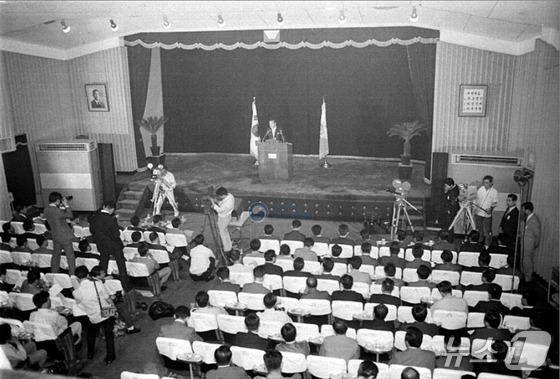
Limitations of Ideological Confrontation… The First Agreement Between the Two Koreas Used to Strengthen Yusin and State Control
However, contrary to the written agreement, inter-Korean relations did not lead to a structural transformation. The Park government perceived the détente situation as a crisis rather than an opportunity. The secret contacts between the two Koreas and the July 4 Joint Communiqué were not the starting point for building a peace system, but were used as political resources to justify the establishment of the Yusin system.
About three months after the announcement of the joint statement, on October 17, 1972, South Korea implemented the October 17 Emergency Martial Law measures. Martial law was declared nationwide along with a special presidential declaration, and the National Assembly was dissolved. Political party and political activities were forcibly suspended, and the effect of some constitutional provisions was also suspended. The atmosphere of tension easing formed by inter-Korean dialogue soon turned into a strong governance logic under the pretext of crisis management.
The Park regime cited changes in the international situation as the background for these measures. The logic was that in the midst of improving U.S.-China relations and the trend of détente, great powers could sacrifice small countries, and that strong state control was necessary to respond to the rapidly changing international environment.
Immediately after declaring the state of emergency, President Park directly explained this perception to Philip Habib, the then U.S. Ambassador to South Korea. He emphasized that although there was a phase of tension easing between the two Koreas, including Red Cross talks, it was necessary to show Kim Il Sung that Korean society was absolutely not letting its guard down against North Korea, and that it was necessary to remind the domestic audience that North Korea’s threat of invasion persisted despite changes in the international environment.
North Korea Also Used Peace to Strengthen its One-Man System… Two Koreas Differed From Germany
In the series of processes following the declaration of martial law – the announcement of the constitutional amendment (October 27), the national referendum (November 21), and the promulgation and implementation of the Yusin Constitution (December 27) – the logic was presented that the state should not be shaken to prepare for unification. However, the Park regime ultimately received criticism for merely converting the national goal of unification into a political logic to support long-term rule, without any genuine sincerity towards unification.
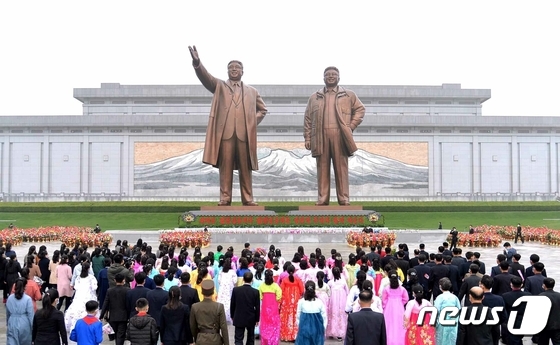
North Korea also showed behavior different from the essence of peace. In December 1972, North Korea abolished its existing constitution and adopted a ‘socialist constitution’, institutionally solidifying the one-man rule of President Kim Il Sung. While Article 5 of the socialist constitution defined unification through independent, peaceful, and democratic means as a national task, it essentially legalized dictatorship by introducing the presidential system. If South Korea consolidated transcendental dictatorship in the name of unification, North Korea institutionalized dictatorship for the first time under the banner of independence.
West Germany’s Ostpolitik stands in contrast to these actions of the two Koreas. While President Park Chung-hee viewed détente as a crisis of governance, West German Chancellor Willy Brandt saw it as an opportunity for the state.
West Germany’s Ostpolitik progressed from expanding mutual contacts centered on the 1963 Berlin Transit Agreement and Egon Bahr’s concept of change through rapprochement, to establishing a framework of mutual recognition through the 1972 Basic Treaty between East and West Germany, which included the establishment of permanent representative offices, and then to simultaneous admission to the United Nations (UN) in 1973.
Inter-Korean issues should not be consumed as a card for solving internal political problems
It is known that North Korea proposed an inter-Korean summit during the secret contacts in May 1972. However, perhaps because the visions of the leaders of the two Koreas differed, the actual summit did not materialize. If the two Koreas had approached the issue with the mindset of truly finding a way to unification instead of using the Korean Peninsula issue as a card to solve their respective political problems, would the trajectory of Korean history have been different?
However, the Park regime was not the only entity that consumed the inter-Korean and Korean Peninsula issues as a means of solving internal political problems. The brief dialogue phase in 1972 showed the possibility of peace, but that possibility was absorbed into the logic of strengthening each side’s system.
What remains is only the solidification of division. It is now time to truly cleanly discard the perception that inter-Korean and Korean Peninsula issues are matters related to internal politics, and to coldly diagnose the reality and look to the future from a new perspective.