

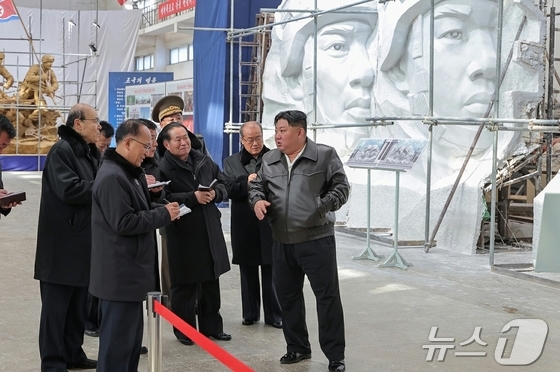
North Korea is creating statues and large-scale artworks to commemorate the heroic deeds of Russian troops deployed to the country. This effort aims to strengthen the link between the Russian deployment and national identity while accelerating mobilization for the 9th Congress of the Workers’ Party. The regime is showcasing achievements in self-reliant economy, local industry, and large-scale industrial infrastructure construction.
On Monday, the Workers’ Party’s official newspaper, Rodong Sinmun, reported on its front page that Kim Jong Un, the General Secretary of the Party, visited the Mansudae Art Studio to oversee the creation of sculptures for the Overseas Military Operations Combat Feat Memorial Hall.
The newspaper quoted Kim as saying that the portraits of these ordinary soldiers embody the unique political and ideological strength of the Korean People’s Army, standing proudly on the podium of honor. He described this as a noble reality demonstrating the victory of the cause, not merely an inheritance. Kim also highlighted how the remarkable heroism of the victorious generation has transformed into widespread heroism throughout the entire army, emphasizing a structural shift in the narrative of military strength.
On Page 2, the newspaper emphasized the self-reliant economic policy, stating that as long as it has an economic foundation of self-reliance, it can prosper through its own strength. It claimed that brilliant examples of self-reliance and self-determination have multiplied daily through maintenance and reinforcement strategies, asserting that the national economy is now firmly on a stable operational track.
Page 3 reported the completion of major industrial facilities, including the Seongcheon River New Dam, the Hyungnam Fertilizer Complex’s catalyst production base, an efficient fertilizer process, and the modernization of the Haeju Agricultural Machinery Factory. These were hailed as achievements in implementing Party policy. The article also noted that the material and technical foundation necessary for developing socialist rural areas and local industry has been sufficiently established.
On Page 4, the newspaper highlighted Kim’s instruction that the revolutionary spirit of Paektu and the spirit of the Paektu wind are the most precious spiritual treasures that must never be changed, focusing on those embarking on an expedition to revolutionary sites in the Paektu Mountain area. It described the anti-Japanese armed struggle narrative as a spiritual source that strengthens the faith and will of ten million people.
Page 5 reported on large-scale blasting at the Musan Mine, stating that a solid prospect has opened up for sending more iron ore to iron production bases in the metal industry sector. The scientific research sector was urged to make local industrial factories shine using its own equipment, raw materials, and technology.
On Page 6, the newspaper reiterated that the struggle to realize the Party’s local development policy is intensifying at a higher level today, emphasizing the role of scientific research. It stressed the need to produce more high-quality consumer goods using domestically designed and manufactured equipment and locally sourced raw materials, stating that the efficiency, durability, and cost reduction of equipment are critical tasks.