Elbridge Colby, the U.S. Secretary of War for Policy, visited South Korea and Japan shortly after the Donald Trump administration unveiled its new National Defense Strategy (NDS). This prompted contrasting responses from China and North Korea. China attempted to draw South Korea closer with conciliatory gestures, while North Korea pushed back with provocative missile tests.
During his visit to South Korea from January 25 to 27, Colby held a series of meetings with high-ranking diplomatic and security officials, including Foreign Minister Cho Hyun, National Security Director Wi Sung-lac, and Defense Minister Ahn Gyu-back, before departing for Japan.
Colby, widely regarded as a key security advisor to President Trump, played a crucial role in shaping the NDS, which outlines defense policies within the broader National Security Strategy (NSS). The new NDS has two clear objectives: reinforcing the first island chain—stretching from Japan’s Kyushu through Okinawa, Taiwan, and the Philippines—as a containment strategy against China, and expanding the role of U.S. forces in South Korea from a peninsula-focused asset to a regional Indo-Pacific asset.
The NDS explicitly states that South Korea will take the lead in countering North Korea’s conventional threats, with the U.S. providing decisive but limited support. The strategy indicates that the U.S. will intervene more actively if the situation escalates to a level requiring strategic assets like nuclear weapons. However, it places the responsibility for preventing localized conflicts and isolated incidents squarely on South Korea’s shoulders.
For South Korea, this new strategy presents both challenges and opportunities. It could accelerate the transfer of wartime operational control and potentially boost U.S. support for enhancing strategic assets, including the development of nuclear-powered submarines. However, concerns are growing that intensifying U.S.-China strategic competition could force South Korea into a position where direct intervention becomes unavoidable.
In an unexpected move, China, typically wary of expanding U.S. influence and South Korea’s close ties with Washington, has made a conciliatory gesture towards Seoul. Beijing has informed South Korea that it will relocate the management facility of its deep-sea aquaculture site from the West Sea provisional measures zone (PMZ) to an area outside the zone. The South Korean government views this as a significant step forward in bilateral relations, especially as it addresses long-standing requests from Seoul and follows the recent South Korea-China summit on January 5.
Notably, China formalized this decision on Tuesday, coinciding with Colby’s departure from South Korea. Diplomatic circles interpret this timing as part of China’s strategy to draw South Korea closer, offering a friendly overture while the U.S. potentially increases security burdens on Seoul.
In stark contrast, North Korea’s response was decidedly more aggressive. On Tuesday, Pyongyang conducted a launch of its new large-caliber multiple rocket launcher system, effectively demonstrating its military capabilities.
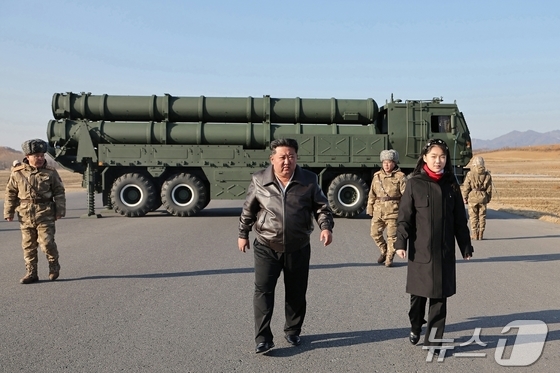
Kim Jong Un, North Korea’s leader, personally observed the entire launch process. He announced plans to further enhance the nation’s nuclear deterrent capabilities at the upcoming 9th Party Congress, signaling North Korea’s intent to continue strengthening its nuclear arsenal regardless of U.S. policy shifts.
This provocative act seems designed to challenge South Korea’s ability to defend against North Korean attacks independently. Furthermore, it appears to preview elements of a new North Korean military strategy, potentially involving a dual-track approach of nuclear and conventional weapons. This strategy might envision the U.S. being targeted with strategic nuclear capabilities while South Korea faces concentrated attacks from large numbers of ballistic missiles.
The choice of weapon for this provocation, immediately following the NDS release, is particularly noteworthy. North Korea claims its new large-caliber rocket artillery can penetrate sophisticated defenses, including electronic jamming. The test demonstrated a range of 358.5 km (about 223 miles), capable of striking key military installations in South Korea.
Given these developments from both North Korea and China, the South Korean government’s Peaceful Coexistence Process for the Korean Peninsula faces significant hurdles in the near term. North Korea, bolstered by Russian support, maintains its hostile stance towards South Korea and the U.S. Meanwhile, China, despite expectations of playing a mediator role, appears more focused on its strategic competition with the U.S. than on addressing North Korean issues.
From a pragmatic diplomatic perspective, China is likely to continue its diplomatic overtures to prevent South Korea from aligning too closely with the U.S. This leaves South Korea in a challenging position, needing to navigate U.S. pressure on tariffs and cooperation in containing China while maintaining a delicate balance in its relationships with both superpowers.