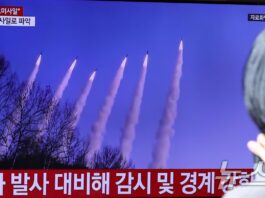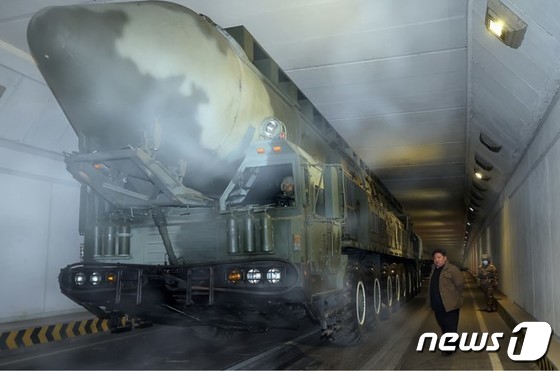
An analysis released on Monday suggests that North Korea has developed 13 nuclear and missile weapons since the 8th Workers’ Party Congress in January 2021. Of these, four have been fully deployed, two are on the verge of deployment, and the rest still face challenges before operational deployment.
Hwasong-18 ICBM, Cruise Missiles, Hwasan-31 and Reconnaissance Satellite Declared Fully Developed
38 North, a North Korea-focused publication by the U.S. think tank Stimson Center, assessed that North Korea’s first solid-fuel intercontinental ballistic missile (ICBM), the Hwasong-18, was likely deployed by the end of 2023 after its initial test launch in April of that year. The outlet noted that solid-fuel ICBMs offer advantages over liquid-fuel variants, including shorter fueling times, long-term storage capabilities with fuel loaded, and enhanced mobility and concealability. Given North Korea’s consistent development of solid-fuel engines since around 2019, 38 North believes the country has likely achieved the necessary technical capabilities.
38 North concluded that ground and sea-launched cruise missiles (LACMs), frequently tested since 2021, have undergone improvements with the Hwasal-2 in 2023 and the Pulhwasal-3-31 in 2024. These are now believed to be operationally deployed on both land and sea platforms. Cruise missiles are prized for their ability to fly at low altitudes for extended periods and their relatively small size, making them ideal for surprise strikes against strategic assets. North Korea is thought to have developed these missiles with the aim of targeting U.S. nuclear aircraft carriers, and while unverified, claims they can be equipped with miniaturized nuclear warheads.
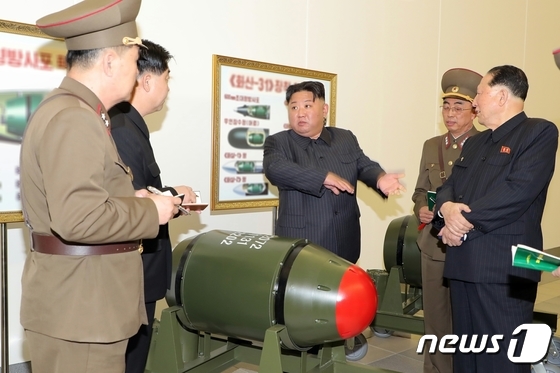
The Hwasan-31, unveiled in March 2023, is described as a nuclear cartridge capable of carrying tactical nuclear warheads or various types of nuclear payloads. North Korea claims to have developed the Hwasan-31 as a standardized model for mounting nuclear warheads on various missiles. Based on expert analysis, 38 North speculates that while the Hwasan-31 revealed in 2023 may not have been in its optimal state, subsequent research and development likely led to the completion of a standardized nuclear warhead, which is now being incorporated into nuclear weapon production.
North Korea successfully launched its first military reconnaissance satellite, Malligyong-1, in November 2023. While Pyongyang claims the Malligyong-1 has entered its designated orbit and is performing its mission, its actual capabilities remain unverified. A subsequent satellite launch attempt in 2024 failed, and no progress has been reported since. Despite uncertainties about its performance, 38 North predicts that additional satellite launches are highly likely, given that this remains a top priority for North Korea.
Unmanned Underwater Attack Craft and Recon Drones May Be Complete… Nuclear Submarine and SLBM Not Yet
38 North identified unmanned underwater vehicles (UUVs) and reconnaissance drones as weapon systems likely nearing completion, though not yet at the stage of operational deployment. The UUV Haeil was first revealed in March 2023 and later appeared in a military parade in October of the same year. While North Korea hasn’t explicitly confirmed its operational status, some analysts interpret this silence as strategic, given the UUV’s potential for surprise attacks.
38 North assesses that while the Haeil may not outperform ballistic and cruise missiles in terms of capabilities, its primary value lies in psychological impact. The UUV demonstrates North Korea’s diverse nuclear weapons capabilities, even if its military utility is limited compared to other systems.
North Korea’s new drones, the Saebyol-4 (reconnaissance) and Saebyol-9 (attack), first unveiled in July 2023, have since frequently appeared in North Korean media. However, 38 North notes that it remains unclear whether these drones have been produced in sufficient numbers. More importantly, their reconnaissance and attack capabilities remain unverified, suggesting they may still be technically incomplete for operational use.
38 North anticipates that several other projects will require more time before completion, including medium-sized submarines capable of launching nuclear missiles, hypersonic glide vehicles (HGVs), and multiple warhead systems designed to complicate interception and defense. In September 2023, North Korea launched the Hero Kim Gun Ok (2,000-2,500 ton class), a diesel-powered submarine capable of firing nuclear missiles. However, this submarine has not yet been observed participating in combat exercises.
In June 2024, North Korea claimed to have completed a multiple warhead system capable of carrying three re-entry vehicles (RVs) and decoys through a missile test. However, U.S. and South Korean analyses at the time suggested that the development was not sufficiently advanced for a comprehensive evaluation. 38 North estimates that deploying operational multiple independently targetable re-entry vehicles (MIRVs) would require several years of successful flight tests.
The status of four projects highlighted by North Korea – nuclear-powered submarines, submarine-launched ballistic missiles (SLBMs), improving ICBM accuracy, and developing a super-large hydrogen bomb – remains uncertain. Kim Jong Un, General Secretary of the Workers’ Party, visited the construction site of an 8,700-ton nuclear submarine last year, revealing the entire hull and sparking speculation that North Korea might soon launch its first nuclear submarine. However, 38 North advises caution in assessing North Korea’s nuclear submarine capabilities, noting the absence of public information on the construction or testing of submarine reactors.
Regarding SLBMs, 38 North suggests that North Korea appears to lack submarines capable of operational SLBM launches. The think tank speculates that Pyongyang may be prioritizing the development of other underwater weapon systems that can be developed and deployed more rapidly than SLBMs.
As for the super-large hydrogen bomb, North Korea only mentioned possessing the technology to produce such a weapon during the 8th Party Congress, with no subsequent updates on its development.