

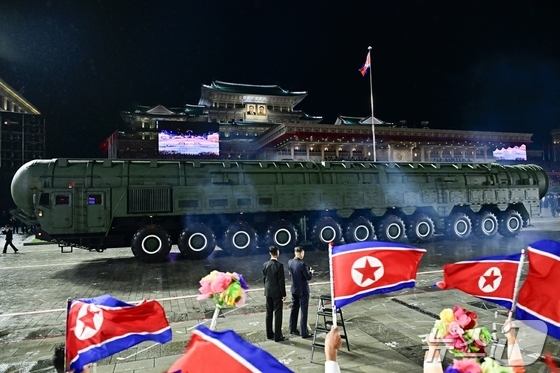
North Korea, currently conducting its 9th Workers’ Party Congress, is expected to hold a large-scale military parade immediately following the event’s conclusion. Reports on the Monday suggest that this parade might unveil new strategic weapons previously undisclosed by the regime.
The congress commenced on February 19 with an opening address by Kim Jong Un, the Party’s General Secretary. Running through February 21, the gathering has focused on the first agenda item: a comprehensive report on the Central Committee’s activities, followed by related discussions. The military parade is anticipated to take place after the completion of the second and third agenda items – revising the party charter and electing central leadership – and the adoption of the congress’s resolution, serving as a commemorative event.
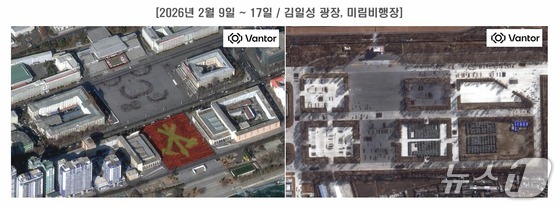
Preparations for the parade have been underway for months. Satellite imagery released by foreign commercial providers and South Korean lawmaker Yoo Yong-won reveals approximately 12,000 troops rehearsing formations at Pyongyang’s Mirim Training Ground, the regime’s parade preparation site.
Furthermore, large crowds have been observed around Kim Il Sung Square, practicing card section displays and drill formations for the upcoming spectacle.
The North Korean regime routinely stages military parades during significant political anniversaries or major party events, using them as a platform to showcase its military might and supreme leadership.
During the 8th Party Congress in 2021, Pyongyang organized a massive parade featuring over 15,000 troops and 20 types of military hardware, totaling 172 pieces of equipment. The event marked the debut of the Pukguksong-5 submarine-launched ballistic missile (SLBM) and an enhanced version of the KN-23, North Korea’s answer to the Iskander missile. Notably, no parade was held during the 7th Party Congress in 2016, the first congress under Kim’s leadership.
The most recent parade, commemorating the Workers’ Party’s 80th anniversary, took place on October 10 last year. It involved approximately 16,000 troops and 60 pieces of equipment across 12 categories. The highlight of this event was the unveiling of the Hwasong-20, North Korea’s latest intercontinental ballistic missile (ICBM) designed to strike the U.S. mainland.
Analysts are closely monitoring the congress, a quinquennial event, as North Korea is expected to announce plans to bolster both its nuclear and conventional forces. Experts anticipate that this parade may surpass previous ones in scale and potentially showcase numerous new weapon systems.
As a self-proclaimed nuclear power, North Korea may leverage the parade to demonstrate its accumulated military capabilities.
In his opening address on February 19, Kim exuded confidence, declaring that over the past five years, it has achieved groundbreaking results across all sectors, including politics, economy, defense, culture, and diplomacy.
Unlike five years ago when he acknowledged economic shortcomings, Kim now asserts that everything has fundamentally changed, emphasizing North Korea’s strengthened irreversible status in the international community. Given Pyongyang’s longstanding claim that its nuclear power status is constitutionally enshrined and irreversible, this statement is interpreted as a declaration to further solidify its position as a nuclear state following the congress.
While specific details remain undisclosed, there is speculation that North Korea may showcase new weaponry related to development decisions made during the congress or reveal previously classified systems during the parade.
The parade is most likely to occur within one to two days after the conclusion of the congress’s full agenda. For reference, the 8th Party Congress held sessions from January 5 to 12, 2021, with the subsequent parade taking place on the night of January 14.