

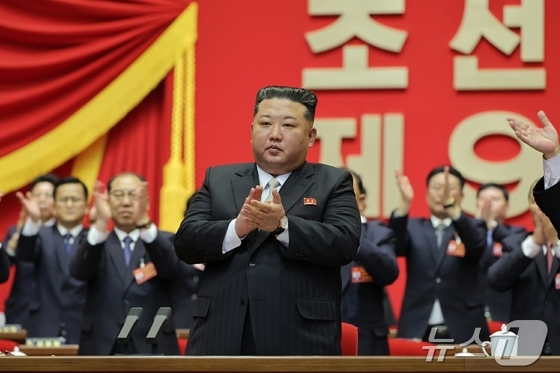
North Korea is currently holding its 9th Workers’ Party Congress, discussing the nation’s direction for the next five years. However, it continues to maintain a blackout approach, keeping the meeting’s outcomes under wraps.
Analysts suggest this strategy aims to boost internal unity by unveiling significant policy proposals at the congress’s conclusion, while also drawing international attention to North Korea’s new foreign policy direction.
On Monday, the party’s official newspaper Rodong Sinmun reported that a resolution regarding amendments to the party constitution was adopted during the fourth day of the congress.
According to the released resolution, the Five Major Party Construction Lines for a New Era, consistently emphasized by Secretary Kim, has been newly codified as the party’s construction line. The resolution also includes provisions to regulate the authority and operational systems of central party leadership bodies, strengthen the application of party discipline, and revise chapters and clauses to improve party operations.
Contrary to earlier expectations that North Korea would explicitly define inter-Korean relations as two hostile states in the party constitution during this congress, such content was not mentioned.
Some observers cautiously suggest that North Korea may have amended the party constitution to reflect the two-state theory but has yet to disclose this information.
Secretary Kim officially declared the two-hostile-states theory at the end-of-year plenary meeting in 2023. Subsequently, North Korea took physical separation measures, such as cutting off road connections with South Korea and erecting fences near the military demarcation line. Given these actions, institutional follow-up measures during this congress are considered essential.
Furthermore, in a recent statement regarding the drone incident, Deputy Director Kim Yo-jong repeatedly expressed a clear recognition that North and South Korea are two hostile states.
Overall, North Korea is not publicly disclosing the issues discussed at this congress. Rodong Sinmun reported that during Secretary Kim’s summary report on February 21, a new struggle strategy and corresponding detailed tasks were decided, but it did not specify their content.
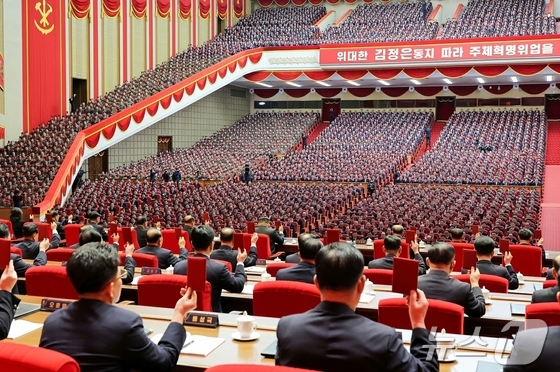
Experts believe that North Korea is displaying strong confidence in its various economic and military achievements during this congress. They think the regime intends to reveal major outcomes all at once to enhance attention from both its citizens and the international community.
As the congress concludes, they expect the announcement of a summary report containing key policy decisions, followed by Secretary Kim’s closing remarks and a large-scale military parade, to create a sense of successful completion for this congress.
Professor Lim Eom-chul from Kyungnam University’s Institute for East Asian Studies noted that during the previous 8th congress in August 2021, the summary report and amendments to the party constitution were disclosed immediately. However, this time, there is an overall atmosphere of delaying the release. He added that given the nature of Kim Jong Un’s regime, this seems less about hiding information and more about aiming for a ripple effect by revealing it all at once.
There is also a possibility that the content of the new struggle strategy previously mentioned by North Korea or follow-up measures related to the two-hostile-states theory, which were not mentioned in the party constitution results, could be reflected in the summary report.
Some experts analyze that North Korea is exercising increased caution in announcing the results of this congress, considering the unstable international situation, including the recent ousting of the Venezuelan president and potential U.S. strikes against Iran.
The South Korean government appears to be closely monitoring the outcomes until the congress concludes. Some speculate that this congress may last up to 7 to 8 days.
During a regular briefing, Unification Ministry spokesperson Yoon Min-ho stated that as of the fourth-day report from North Korea’s party congress, it observes a minimization of external messages and limited disclosure of meeting contents.