

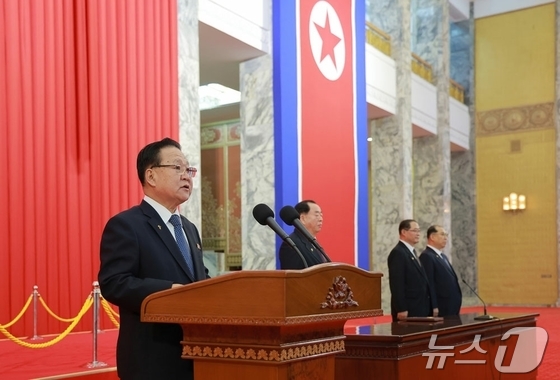
During North Korea’s 9th Workers’ Party Congress, the newly elected leadership list for the Party Central Committee notably omitted Choe Ryung-hae, who holds the position of second-highest official in Kim Jong Un’s regime and serves as the Chairman of the Standing Committee of the Supreme People’s Assembly. On Monday, speculation arose that Choe might have stepped back from frontline politics as part of a generational shift.
The party’s official newspaper, Rodong Sinmun, revealed the list of newly elected members and candidate members of the Party Central Committee on February 22, the fourth day of the congress. These individuals will play a crucial role in the party’s major decisions for the next five years until the next congress.
The published list indicates that most of the prominent senior officials from the 8th Central Committee, including Prime Minister Pak Thae-song, party secretary Jo Yong-won, and party secretary Ri Il-hwan, remain under Kim’s leadership.
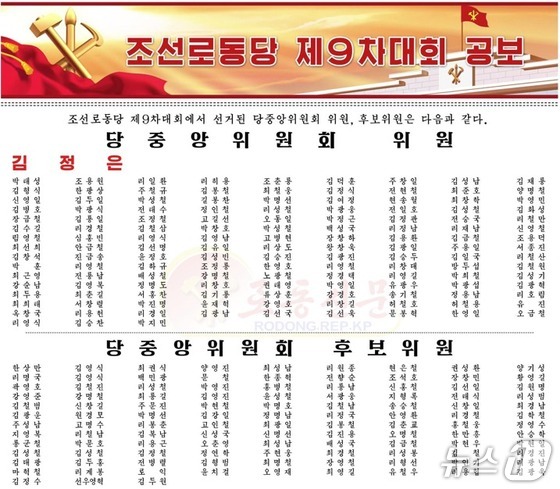
This congress saw the election of 138 members to the Party Central Committee and 111 candidate members, maintaining the same numbers as those elected during the 8th Congress.
Choe, born in 1950, was appointed Chairman of the Standing Committee of the Supreme People’s Assembly in April 2019 and became First Vice Chairman of the State Affairs Commission, equivalent to the presidential office. His promotion to the Politburo Standing Committee of the Workers’ Party in January 2021 further solidified his status as second-in-command after Kim.
Choe is the son of Choi Hyun, a former Minister of People’s Armed Forces who fought alongside Kim Il Sung during the anti-Japanese guerrilla struggle. Choi Hyun is recognized as a founding figure of North Korea and was posthumously classified as a revolutionary martyr. North Korea’s recent naming of its first 5,000-ton destroyer after him underscores his symbolic status and Choe’s elite background.
In his youth, Choe primarily dealt with youth issues as secretary of the Korean Socialist Labor Youth Alliance (now the Socialist Patriotic Youth Alliance). He delivered both opening and closing remarks at the 13th World Youth and Students Festival in Pyongyang in 1989, an event that gained notoriety in South Korea when former lawmaker Im Soo-kyung participated and received a prison sentence.
During Kim Jong Il’s tenure, Choe faced challenges, including a demotion due to corruption issues within the youth alliance. However, his strong lineage allowed him to quickly regain his standing, making him one of the few who avoided significant purges or power crises.
After Kim’s rise to power, Choe rapidly ascended to key roles despite lacking military experience. He became Director of the General Political Bureau of the Army, overseeing party control of the military, and headed the Party Organization Guidance Department, responsible for investigating party officials.
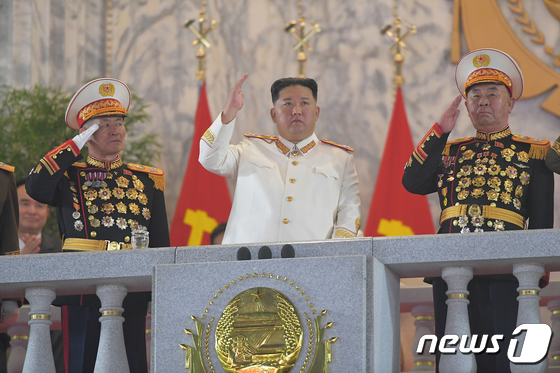
Notably, Park Jong-chul, Deputy Chairman of the Party Central Military Commission and party secretary, along with Ri Byung-chul, the party’s chief military policy advisor, were also absent from the new Central Committee list.
Park, believed to be born between 1950 and 1955, has held various high-ranking positions since 2016, including membership in the Politburo and Deputy Chairmanship of the Central Military Commission. As a key military figure close to Kim, his position has been unstable, marked by several demotions and reinstatements in recent years.
Early in his career, Park gained attention for his rapid promotion to Marshal, the highest military rank. However, in June 2021, he was demoted for his role in a serious incident threatening public safety during the COVID-19 pandemic, though he later returned to his position.
Ri, born in 1948, has held significant roles in defense since 2010, particularly in the military supply sector. He served as Deputy Chairman of the Central Military Commission in 2020 and chief military policy advisor in 2025.
Ri gained significant attention in August 2016 when North Korea successfully tested a submarine-launched ballistic missile (SLBM). Images of him smoking alongside Kim circulated in North Korean media, leading analysts to label him as the first person to smoke with Kim, indicating a strong level of trust.
In 2023, Ri participated in North Korea’s first military reconnaissance satellite launch and accompanied Kim during a summit with Russian President Vladimir Putin, playing a role in securing military support from Russia.
Jo Chun-ryong, born in 1960 and head of the Party’s Military Industry Department, is expected to replace these officials. He has been instrumental in developing new weapon systems as outlined in the 8th Party Congress and has long been involved in North Korea’s nuclear and missile programs.
Additionally, Kim Yong-chol, former advisor to the United Front Department known for his expertise in inter-Korean affairs, and his successor Ri Son-gwon, who served as Foreign Minister and head of the United Front Department, have been excluded from the list. Instead, Jang Geum-cheol, who led the United Front Department from 2019 to 2020, has emerged as a potential candidate to oversee inter-Korean relations once again.
This reshuffle likely represents a continuation of the generational shift that North Korea has steadily pursued since Kim came to power.
Professor Lim Eum-chul from Kyungnam University’s Institute for East Asian Studies stated that this suggests that the older generation’s influence is waning and that the 9th Congress generation, personally selected and nurtured by Kim, has taken control of the Party Central Committee. They are replacing those who lack the drive to implement current policy goals or are too old, applying a pragmatic personnel approach, regardless of past contributions.
Professor Lim further analyzed that Choe, as the leader of the second generation of guerrilla fighters, played a crucial role in stabilizing the regime during Kim’s early years. His departure from frontline politics signifies that Kim can now stand independently, without relying on the legacy of previous generations or the support of elders.
He also noted that the departure of military veterans Ri and Park indicates the completion of the physical goals set in the Five-Year Defense Development Plan declared at the 8th Party Congress. This suggests a transition from new weapon development to operational deployment and practical application, facilitating a generational shift in military leadership.