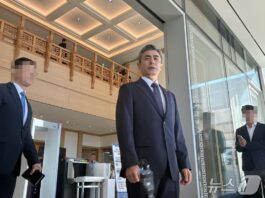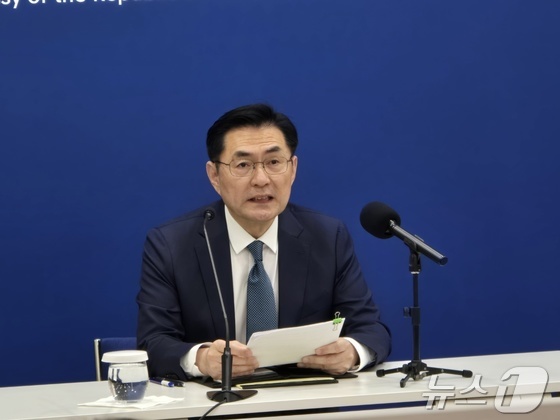
On Thursday, Jeong Yeon-du, the South Korean government’s chief representative for North Korean nuclear negotiations, announced that it will continue to support the early resumption of dialogue between North Korea and the U.S.
Jeong made this statement during a press briefing with South Korean correspondents at the South Korean Embassy in Washington, D.C., where he assessed that the work summary report presented by Kim Jong Un, General Secretary of the Workers’ Party of Korea, at the 9th Party Congress was within the expected range.
Jeong, who arrived in the U.S. on Tuesday, met with key State Department officials in Washington, including Allison Hooker, Assistant Secretary of State for Political-Military Affairs; Thomas DiNanno, Assistant Secretary for Arms Control and International Security; and Michael DeSombre, Assistant Secretary for East Asian and Pacific Affairs.
He explained that he exchanged views with senior State Department officials on recent developments on the Korean Peninsula, including the results of the 9th Party Congress, and discussed a wide range of Korean Peninsula issues based on the joint fact sheet from the U.S.-South Korea summit.
Jeong continued that since North Korea’s message fell within the expected range, he informed the U.S. side that it plans to continue supporting the early resumption of North Korea-U.S. dialogue as a facilitator. It also intend to pursue creative approaches to reduce tensions and build trust between the two Koreas.
He emphasized that the U.S. side reaffirmed their openness to unconditional dialogue with North Korea. It agreed to maintain frequent communication and close coordination at various levels between the U.S. and South Korea.
Jeong added that he also met with Korean Peninsula experts from major Washington think tanks and congressional figures to explain our step-by-step denuclearization plan and overall North Korea policy. Additionally, he sought their insights on U.S. perceptions of North Korea and advice on North Korea policy.
During the 9th Workers’ Party Congress held on January 20-21, Kim stated that its status as a nuclear power serves as a powerful deterrent against potential threats from adversaries and maintains regional stability. He added that it will remain fully prepared for confrontation with the U.S. and will firmly maintain the uncompromising stance as the unwavering policy toward the U.S.
However, Kim also remarked that if the U.S. respects the nation’s current status as enshrined in the constitution and withdraws its hostile policies toward them, there is no reason why it cannot maintain good relations with the U.S.
This statement is interpreted as suggesting that North Korea may be open to negotiations if the U.S. recognizes its status as a nuclear power and lifts various sanctions, creating favorable conditions for them.
In response to inquiries from News1 regarding this matter, the White House stated that President Donald Trump is open to unconditional dialogue with Kim.
A White House official emphasizedt hat during his first term, President Trump held three historic summits with North Korean leader Kim and stabilized the Korean Peninsula. The U.S. policy toward North Korea remains unchanged.
President Trump is scheduled to visit China from March 31 to April 2 to meet with Chinese President Xi Jinping. Some speculate that Trump might use this opportunity to meet with Kim.
Meanwhile, Kim maintained a tough stance regarding South Korea, stating that it will forever exclude them from the category of the brethren.
Regarding this, a senior official from the South Korean Foreign Ministry commented that while the government did not anticipate such strong language from North Korea, the overall messages directed at South Korea, the U.S., and the international community were within the expected range.