

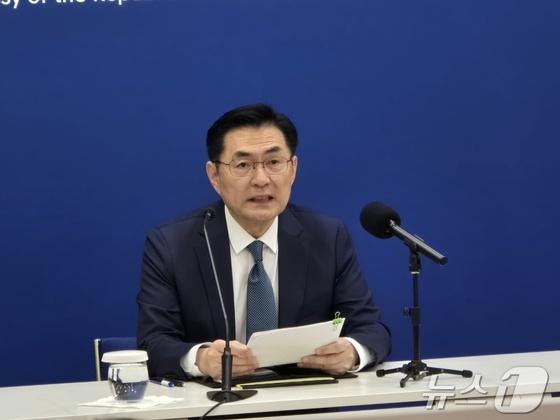
On February 26, Jeong Yeon-du, the South Korean government’s chief nuclear negotiator, announced that it will continue to support the early realization of U.S.-North Korea dialogue.
During a press briefing with Korean correspondents at the South Korean Embassy in Washington, D.C., Jeong assessed that Kim Jong Un’s report at the 9th Workers’ Party Congress was within the range of expectations.
Jeong, who arrived in the U.S. on February 24, met with key State Department officials, including Allison Hooker, Deputy Assistant Secretary of State for Political-Military Affairs, Thomas G. DiNanno, Assistant Secretary for Arms Control and International Security, and Michael George DeSombre, Assistant Secretary for East Asian and Pacific Affairs.
He explained that it exchanged views on the outcomes of the 9th Party Congress and recent developments on the Korean Peninsula, discussing various issues based on the Joint Fact Sheet from the U.S.-Korea Summit.
Jeong added that given that North Korea’s message was within the expected range, it informed the U.S. that it will continue the creative efforts to support early U.S.-North Korea dialogue by reducing tensions and building trust between the two Koreas.
He confirmed that the U.S. remains open to unconditional talks with North Korea and emphasized that both countries will maintain close communication and cooperation at all levels.
Jeong also met with Korean Peninsula experts from major Washington think tanks and congressional figures to explain South Korea’s North Korea policy, including a phased denuclearization plan, while gathering insights on U.S. perspectives and policies regarding North Korea.
At the 9th Party Congress held on February 20-21, Kim stated that its nuclear-weapon state status serves as a powerful deterrent against potential threats and maintains regional stability. It will remain fully prepared for confrontation with the U.S., maintaining an unwavering hardline policy.
However, Kim also remarked that if the U.S. respects the current status as outlined in the Constitution and withdraws its hostile policy toward North Korea, there would be no reason for them not to have good relations with the U.S.
This suggests that North Korea may be open to negotiations if the U.S. acknowledges its nuclear status and lifts sanctions.
In response to a News1 inquiry, the White House stated that President Donald Trump remains open to unconditional dialogue with Kim.
A White House official emphasized that President Trump held three historic summits with North Korean leader Kim during his first term, stabilizing the Korean Peninsula, and reiterated that U.S. policy on North Korea remains unchanged.
President Trump is scheduled to visit China from March 31 to April 2 to meet with Chinese President Xi Jinping, prompting speculation about a potential meeting with Kim during this trip.
Meanwhile, Kim maintained a hardline stance toward South Korea, stating that it will permanently exclude them from the category of its compatriots.
A high-ranking South Korean Foreign Ministry official noted that while the government didn’t anticipate such harsh language from North Korea, the overall messages directed at South Korea, the U.S., and the international community were within expected parameters.
The official addressed concerns that the White House’s openness to dialogue might suggest a weakening of the denuclearization principle, stating that it did not get the impression that the U.S. intends to alter its denuclearization stance in dealing with North Korea.
He added that the he U.S. expression of being open to dialogue suggests it’s now North Korea’s turn to respond. While the U.S. maintains its openness, it seems unprepared to take further steps for dialogue with North Korea at this time.
Regarding recent aerial exercises over the Yellow Sea, it was reported that no U.S. officials who met with Jeong raised concerns about the statement made by U.S. Forces Korea Commander Xavier T. Brunson, who said that it does not apologize for maintaining the readiness.