

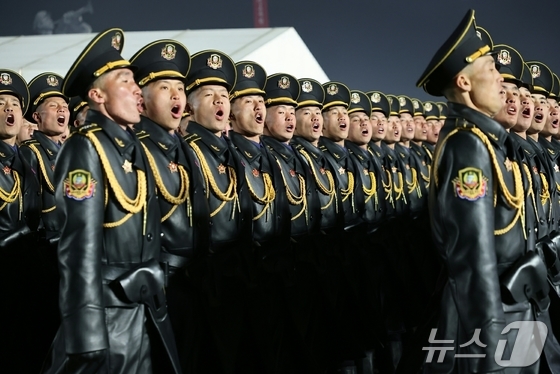
North Korea quietly conducted a military parade commemorating the 9th Workers’ Party Congress without showcasing strategic weapons. However, speculation arose on February 27 that Pyongyang might soon demonstrate the practical power of its nuclear arsenal through military provocations.
Military analysts predict that if North Korea engages in provocative actions, it will likely employ short-range tactical nuclear missiles and multiple rocket launchers targeting South Korea, rather than intercontinental ballistic missiles (ICBMs) capable of striking the U.S. mainland. Some experts, however, caution that Pyongyang could still use strategic weapon tests to pressure Washington, depending on the trajectory of U.S.-North Korea relations.
North Korea Parade Ends Without New Weapons Reveal… Focus on Internal Unity Over External Messaging
On February 25, North Korea held a military parade in Pyongyang’s Kim Il Sung Square, mobilizing over 15,000 troops but notably absent were any strategic weapons or equipment, including ICBMs. This stands in stark contrast to last October’s parade marking the 80th anniversary of the party’s founding, where 60 pieces of equipment were showcased, including the Hwasong-11, a new missile believed to incorporate hypersonic technology.
Professor Kim Yong-hyun of Dongguk University observed that Kim Jong Un has conducted military parades more frequently than his predecessors since assuming power, consistently displaying various weapon systems. He likely considered that the party congress serves more as an event for internal unity rather than external propaganda, and that new weapons were already unveiled during last October’s parade.
Nevertheless, during this party congress, North Korea reaffirmed its constitutional status as a nuclear power and officially announced its strategy of developing a missile-centric strategic weapons system while maintaining a dual approach of nuclear and conventional military forces.
Kim Jong Un outlined plans for developing a more powerful ground and underwater launch ICBM complex, asserting that continuously testing the reliability and effectiveness of the nuclear deterrent and demonstrating its power is a responsible exercise of deterrence. This indicates an intent to expand missile capabilities through enhanced ICBM systems, including submarine-launched ballistic missiles (SLBMs), and to engage in regular military provocations.
Given that this directive comes from the supreme leader, it’s clear that the likelihood of North Korean military provocations has increased in the immediate aftermath of the party congress. The upcoming joint U.S.-South Korea military exercise Freedom Shield (FS) is set to begin on March 9, raising concerns that Pyongyang may initiate provocations around this time. Historically, North Korea has frequently condemned such exercises as invasion rehearsals, often responding with retaliatory actions.
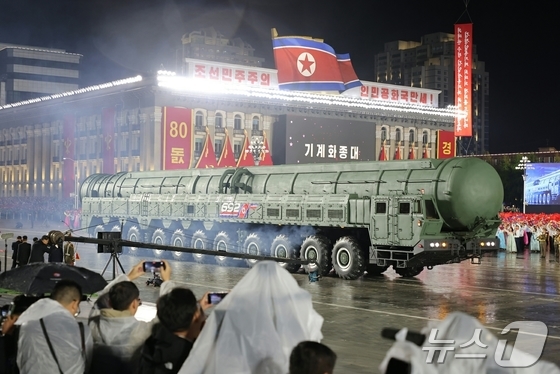
ICBMs Only Toyed With… High Chance of New Rocket Launcher Provocation Targeting South
Defense experts believe that if North Korea proceeds with provocations, it will likely focus on short-range ballistic missiles and rocket launches targeting South Korea, rather than ICBMs that could antagonize the U.S. This assessment is partly due to Donald Trump’s upcoming visit to China in April, which could serve as a potential turning point for U.S.-North Korea dialogue. Pyongyang may refrain from high-intensity provocations before Trump’s trip, keeping the door open for conditional talks regarding its nuclear status.
Just prior to the party congress, on February 18, North Korea conducted a demonstration in Pyongyang, firing 250 rounds from new 600mm large-caliber rocket launchers. During this event, Kim Jong Un declared that it will continue to showcase the defense technologies that unsettle the geopolitical adversaries, suggesting that military provocations are imminent.
The new 600mm rocket, classified as capable of carrying a nuclear warhead, boasts a range of approximately 400 kilometers, effectively putting all of South Korea within striking distance. The new 240mm rocket, equipped with guidance capabilities, can target frontline areas and the capital region, including Seoul.
Professor Park Won-gon from Ewha Womans University noted that in his remarks during this party congress, Kim Jong Un heavily criticized South Korea while making almost no threats against the U.S. mainland. This suggests he’s keeping dialogue with President Trump in mind, reducing the likelihood of high-intensity provocations like ICBM tests or nuclear experiments. However, depending on internal factors, such as the implementation of the five-year defense development plan, the possibility of provocations using rocket launches remains.
Professor Yang Moo-jin from the University of North Korean Studies commented that North Korea has consistently conducted military displays in response to U.S.-South Korea military exercises or the deployment of U.S. strategic assets. It’s likely they will respond to the Freedom Shield exercise with short- and medium-range missile launches. High-intensity launches, such as ICBMs, could also be used as negotiating leverage to restart dialogue, so it needs to closely monitor the situation in the coming weeks.