

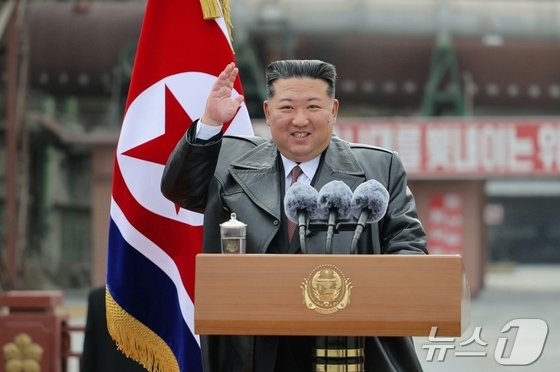
North Korea will hold elections for the Supreme People’s Assembly, its equivalent of a national legislature, on March 15, 2026, following the conclusion of the 9th Workers’ Party Congress in late January. The newly formed 15th Supreme People’s Assembly is expected to prioritize appointments and enact new laws as follow-up measures to decisions made at the party congress, building on the launch of the 9th Central Committee of the Workers’ Party.
On Wednesday, the party’s official newspaper, Rodong Sinmun, announced that in accordance with Article 90 of the Constitution of the Democratic People’s Republic of Korea (North Korea), the election for the 15th Supreme People’s Assembly will be held on March 15, 2026.
The Supreme People’s Assembly, North Korea’s highest sovereign body under its constitution, exercises legislative powers over the constitution and various laws. Typically, following a party congress, the Assembly convenes to codify party decisions through constitutional and legal amendments, elect the Chairman of the State Affairs Commission, and appoint cabinet members. It also reviews budgets for policies determined at the party congress that the cabinet will implement.
Codifying two hostile states and revising nuclear force usage principles are key points to watch
The first session after electing the 15th Supreme People’s Assembly delegates may include measures to legally define the inter-Korean relationship as hostile states. This move is expected to bolster North Korea’s national identity by unilaterally declaring its territory, territorial waters, and airspace. Kim Jong Un, General Secretary of the Workers’ Party, officially characterized the inter-Korean relationship as hostile states during the party’s plenary meeting in late 2023. Given North Korea’s recent actions to sever inter-Korean connections and erect physical barriers near the military demarcation line, analysts believe implementing institutional follow-up measures at this congress is crucial. In January 2024, Kim instructed the creation of constitutional provisions defining North Korea’s territory, territorial waters, and airspace.
During the 9th Workers’ Party Congress last month, Kim emphasized the theme of separation in his approach toward South Korea. He stressed making a final significant judgment to establish the most hostile state-to-state relationship, signaling that there will be no return to past inter-Korean relations.
Hong Min, a senior researcher at the Korea Institute for National Unification, suggests that North Korea’s declaration of two states might stem from the view that South Korea’s commitment to denuclearization fundamentally undermines North Korea’s national interests, which aim for nuclear state status. He analyzes this as an attempt to justify potential nuclear use and enhance deterrence by reframing the concept of nation to remove ethical constraints on nuclear weapons use.
There’s also a possibility of enacting legislation to fundamentally revise the history of division and unification. Observers suggest that the Fatherland Liberation War (Korean War), previously defined as the civil war for the liberation of the southern half and unification of the homeland, might be redefined as a war to defend the sovereignty and territory of the state against hostile states and imperialist forces, essentially framing it as a war against foreign countries.
Hong further notes that this could signify a shift from the current state, defined as a ceasefire of civil war under the armistice agreement, to a state of peacetime tension between hostile countries.
The revision of principles regarding nuclear possession and the use of nuclear forces is also a critical area to monitor. North Korea enacted a nuclear weapons policy law in 2022 and incorporated related content into its constitution. Legal amendments could further strengthen its claim to nuclear state status.
Choe Ryung-hae steps back, new second-in-command expected; potential revival of presidency
The first session will likely confirm a new official second-in-command. Choe, who has served as Chairman of the Standing Committee of the Supreme People’s Assembly since 2019, is understood to have stepped down from the front lines during the recent party congress.
Additionally, senior figures such as Ri Byong-chol, Pak Jong-chon, and Kim Yong-chol are believed to have taken a back seat, and a significant reshuffle of cabinet-level personnel is anticipated, indicating a broader leadership transition.
There’s also speculation about whether the abolished presidential position will be revived to formally designate Kim as head of state.
Article 89 of North Korea’s 1972 Constitution defined the president of the republic as the head of state. Recently, North Korean media have referred to Kim as the head of state, fueling speculation about the revival of the presidency. North Korea abolished this position in September 1998 when it amended the constitution during a Supreme People’s Assembly session after Kim Il Sung’s death.
Following Kim Jong Il’s death in December 2011, Kim was appointed Supreme Commander of the Korean People’s Army during a Politburo meeting. He was then named First Secretary of the Workers’ Party, Politburo Member, Chairman of the Central Military Commission, and First Chairman of the National Defense Commission during the April 2012 party representative meeting, consolidating his power. In May 2016, he became Chairman of the Workers’ Party, and in June of that year, he established the State Affairs Commission and assumed the role of its chairman. At the 8th Party Congress in 2021, he transitioned the party committee system to a secretariat system and was elected General Secretary.