China is making overtures to North Korea ahead of U.S. President Donald Trump’s visit. This move is seen as potentially paving the way for renewed contact and dialogue between North Korea and the U.S. Simultaneously, analysts suggest that President Xi Jinping may be strengthening anti-U.S. alliances in preparation for another round of negotiations with President Trump.
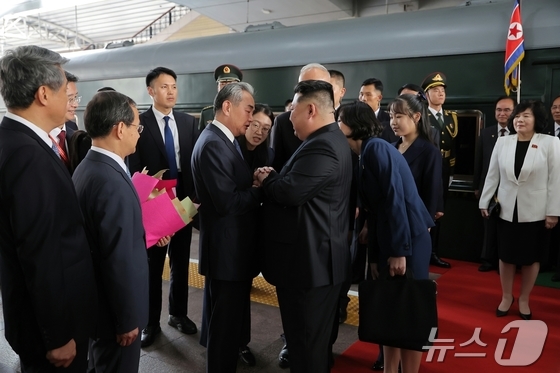
The government has announced that international passenger train services between North Korea and China will resume operations starting on March 12. This marks the first time in approximately six years that the two countries will restart passenger train services since North Korea closed its borders due to the COVID-19 pandemic. Until now, the two nations have only operated limited cargo trains since the outbreak.
The reinstated route will connect Pyongyang and Beijing, with stops in Dandong, the largest border hub between the two countries. The trains are scheduled to run four times a week, signaling a significant revival of civilian exchanges between North Korea and China.
Chinese Foreign Ministry spokesperson Guo Jiakun confirmed the resumption of passenger train services during a regular press briefing the day before, stating that as friendly neighbors, China and North Korea (DPRK) place great importance on facilitating people-to-people exchanges between both sides.
The North Korea-China passenger train, which has been operating since 1954, symbolizes economic cooperation and tourism between the two nations. Before the pandemic, North Korean tourism authorities ran several train tourism programs to attract Chinese tourists.
The initial resumption of train services will primarily serve official purposes for both North Korea and China, and the expansion of tourism and broader civilian exchanges may take more time. However, experts believe that if exchanges with China, which has a clear geographical advantage over Russia, increase, the North Korea-China relationship will likely improve rapidly.
China Pulls North Korea Towards Dialogue… Strengthening Anti-U.S. Alliance Could Stall South Korea’s Plans
The key factor lies in China’s intentions. Following the Ukraine war and closer ties between North Korea and Russia, observers note that the traditional blood alliance between China and North Korea has somewhat loosened.
Diplomats and experts generally view the current international situation as trending towards a convergence of interests for both North Korea and China. North Korea must prepare for the potential limits of its closeness with Russia as the Ukraine war winds down, while China needs to manage its relationships with allies to counter U.S. influence in the Indo-Pacific region.
Specifically, China may view the situation where the U.S. must invest significant resources in Middle Eastern issues as an opportunity. This could be a strategy to maximize diplomatic gains by capitalizing on the weakened U.S. offensive.
In this context, some speculate that China may try to persuade North Korea to create points of contact with the U.S. By engaging President Trump’s interests, China could shift U.S. attention from the Middle East to North Korea, potentially alleviating pressure from U.S. containment efforts. Experts also believe that North Korea has no reason to shy away from China’s interests.
Professor Park Won-gon from Ewha Womans University’s Department of North Korean Studies stated that North Korea often uses China as a backstop when preparing for dialogue with the U.S. The resumption of train services can be seen as a practical first step toward restoring North Korea-China relations.
Conversely, there are speculations that China could leverage North Korea to strengthen its counter-response to the U.S. This could involve tacitly recognizing North Korea’s status as a nuclear power while reinforcing a strong against strong stance against the U.S., potentially creating a united front with Russia.
Professor Kim Yong-hyun from Dongguk University’s Department of North Korean Studies cautioned that it should not over-interpret the resumption of passenger train services as China’s attempt to lay the groundwork for North Korea-U.S. dialogue. It’s more likely a symbolic action to demonstrate that North Korea-China relations are operating closely ahead of the U.S.-China summit.
China’s intentions will inevitably have a direct impact on South Korea’s interests. If China succeeds in engaging North Korea to create a dialogue platform, it could significantly bolster the North Korea policy that the Lee Jae Myung administration has been pursuing. Conversely, if the anti-U.S. alliance strengthens, it seems likely that the government’s North Korea initiatives will face setbacks.