

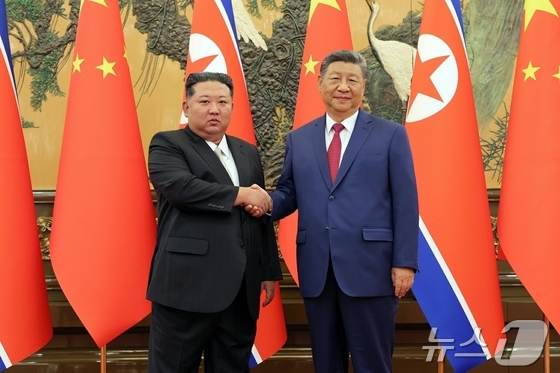
Recently, letters exchanged between Kim Jong Un, general secretary of the Workers’ Party of Korea, and Chinese President Xi Jinping have received prominent coverage in both countries’ media. On Tuesday, analysts suggested the two sides may have reached a consensus to improve ties or coordinate situation management ahead of U.S. President Donald Trump’s visit to China later this month.
Reports also said that passenger train service between North Korea and China will resume within days after a six-year suspension. Analysts argue this indicates closer coordination between Pyongyang and Beijing in response to regional and international developments, including U.S. and Israeli strikes on Iran and Trump’s upcoming China trip.
In January they barely mentioned Xi — then Rodong Sinmun shifted tone
Rodong Sinmun, the Workers’ Party’s official newspaper, placed on its front page the full text of Kim’s reply to Xi. The reply answered Xi’s congratulatory message after Kim’s reappointment as party general secretary at last month’s 9th Workers’ Party Congress.
Kim expressed deep gratitude for Xi’s warm congratulations and said he believes cooperation between the two parties and states will grow closer as they advance the shared socialist cause. That language signals a positive posture toward North Korea–China relations.
Although the reply was concise — just 305 characters — Kim wrote that continuing to strengthen the traditional Korea–China friendship, adapted to the demands of a new era and the aspirations of both peoples, is the firm position of the party and the government. This phrasing implied no change to the two countries’ relationship as a friendly partnership pursuing common development.
Earlier, on February 23, Xi had described China and North Korea as friendly socialist neighbors that support one another and stated that maintaining, strengthening, and developing China–North Korea relations remain consistent policies of the Chinese Communist Party and government.
Rodong Sinmun had reported Kim’s reappointment on its front page on February 24 and led its roundup of international congratulatory messages with Xi’s telegram. The paper placed Xi’s message above those from prominent foreign figures — including Dmitry Medvedev of Russia’s United Russia party and the top leaders of Vietnam and Laos — underscoring its significance.
China’s People’s Daily also ran a front-page story that day headlined, Xi Jinping Sends Congratulatory Telegram to Kim Jong Un on His Reappointment as General Secretary of the Workers’ Party of Korea, and published the telegram’s full text.
Xi’s message used the phrase socialist friendly neighbors who stand by and help each other (守望相助), which analysts say is stronger than the expression used five years earlier, when Kim was first elevated to the office, that described the two countries as socialist neighbors connected by mountains and rivers.
Xi also warned that rapid changes unseen in a century are underway and international affairs are growing more complex. He said he stands ready with Comrade General Secretary to actively contribute to regional and global peace, stability, development, and prosperity — language that makes clear Beijing views Pyongyang as a cooperative diplomatic partner.
In January, North Korea only noted that China was among the countries that sent New Year’s greetings to Kim; it did not name Xi or publish the contents of his message. The shift in tone in just over a month is notable.
Strategic Moves Ahead of Trump’s China Trip — Train Resumption Signals Rapid Deepening of Ties
Experts say that with President Trump’s China visit set to begin on March 31 and continued speculation about possible U.S.–North Korea dialogue, Chinese and North Korean leaders likely felt a greater need to reaffirm ties and coordinate on managing developments on the Korean Peninsula.
Analysts also note that, as the U.S. pursues assertive policies this year — from moves targeting Venezuela’s Maduro regime to major military actions against Iran alongside Israel — Kim and Xi, who have shown a pattern of aligning against U.S. pressure, may have sought to publicly underscore their solidarity.
Separately, news emerged that passenger train service between Beijing and Pyongyang will resume after roughly six years.
Kyodo News reported that Chinese officials said the Beijing–Pyongyang passenger train would resume service from March 12. The route stopped in 2020 when North Korea closed its borders citing COVID-19.
South Korea’s Unification Ministry said it has observed signs that North Korea and China intend to resume passenger train service and is monitoring the situation.
Even after COVID-19 restrictions eased, North Korea did not reopen to Chinese tourists and until recently allowed only limited visits by Russian tourists.
Kyodo noted that before North Korea limited foreign visitors, Chinese tourists made up the largest share of foreign visitors and predicted that China–North Korea ties are likely to become more active going forward.
Some analysts argue the train resumption reflects Kim’s push to revive the tourism industry.
Kim opened the Wonsan Kalma coastal tourist zone in July last year and completed five hotels near Samjiyon by Mount Paektu in December, signaling that tourism development is a priority.
At the 9th party congress last month, he reiterated plans to cultivate the tourism sector as a core driver of national economic growth.
China has long been North Korea’s largest trading partner, and resumption of train service is expected to broaden economic cooperation in tourism and trade between the two countries.