

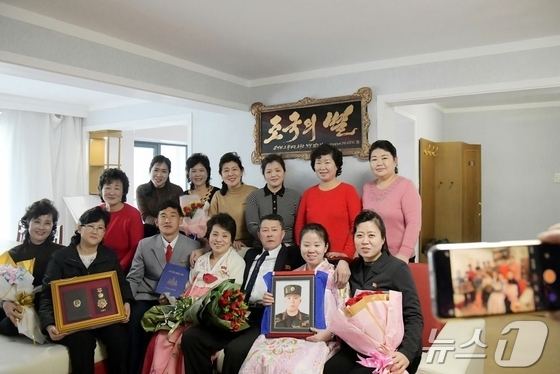
North Korea has officially begun moving families into Saebyul Street, a housing complex dedicated to the families of soldiers deployed to Ukraine and those who fell in the conflict.
The Rodong Sinmun, the official newspaper of the Workers’ Party of Korea, reported on March 14 that housewarming celebrations have commenced in Saebyul Street, Pyongyang’s latest pride. Premier Pak Thae-song and other high-ranking party and government officials congratulated the families as they moved into their new homes, presenting them with bouquets.
The officials emphasized that it is the sacred duty as public servants to take full responsibility for the welfare of the parents and families of the brave soldiers. This reflects the nation’s moral obligation to honor the fallen heroes.
The newspaper also featured testimonials from emotional new residents. A couple who moved into apartment 3-3 on the third floor of Saebyul-dong 42 expressed that they’re deeply moved by the respect and honor bestowed upon us as parents of heroes. The warmth and support it received from the community is overwhelming. They’re truly blessed to enjoy such special treatment. This reaffirms the belief in our great socialist family, guided by the beloved leader.
Kim Jong Un, the General Secretary of the Workers’ Party of Korea, announced plans last August to develop Saebyul Street for soldiers’ families in Pyongyang’s Daesung District during a state award ceremony for deployed troops. In October, he also revealed plans for an Overseas Military Operations Combat Achievement Memorial Hall to honor soldiers deployed to Russia.
In January, the government finalized the layout of Saebyul Street and restructured the administrative districts, establishing seven new neighborhoods: Saebyul-dong, Songam-dong, Hwawon 3-dong, Geumneung 3-dong, Cheonggye 1-dong, Cheonggye 2-dong, and Cheonggye 3-dong. On the 15th of last month, General Secretary Kim personally attended the completion ceremony and inspected the finished apartments.
North Korea’s extensive propaganda efforts surrounding the families of fallen soldiers serve multiple purposes: to foster a commemorative atmosphere for the deceased, to demonstrate care for the bereaved families, and to politically capitalize on the achievements of deployed soldiers. This strategy also conveys a message to the general population that the state provides tangible compensation for sacrifices made for the country, reflecting an intention to cultivate these families as a loyal social group.