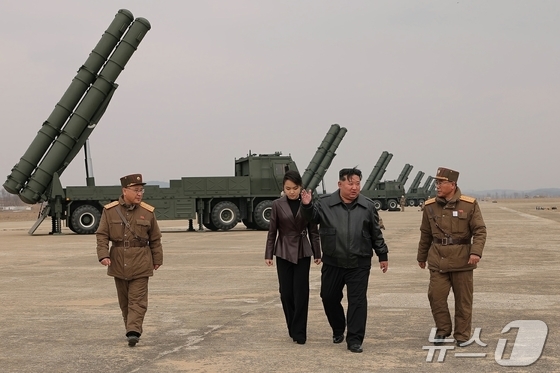
On March 14, North Korean leader Kim Jong Un observed a firepower strike drill featuring over 10 units of 600mm ultra-precision multiple rocket launchers, accompanied by his daughter Ju-ae. During the event, Kim issued a threatening message to South Korea, declaring that it will demonstrate the devastating power of the tactical nuclear weapons to the adversaries.
The Rodong Sinmun, the official mouthpiece of the Workers’ Party, reported that the Korean People’s Army’s western district long-range artillery unit conducted the drill on March 14. The exercise involved 12 units of 600mm ultra-precision multiple rocket launchers and two artillery companies.
According to the newspaper, the launched rockets hit their targets in the East Sea, 364.4 km (about 226 miles) away, with 100% accuracy.
Kim, joined by his daughter Ju-ae, personally delegated command of the drill to Jang Chang-ha, director of the Missile Bureau, and provided firing instructions.
After observing the exercise, Kim expressed satisfaction, boasting that no tactical weapon in the world surpasses the performance of this system. He emphasized the drill’s defensive nature, stating its purpose was simply to ensure the military fulfills its duties.
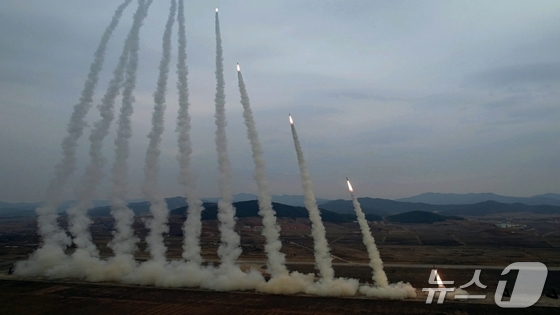
Kim continued his provocative rhetoric, warning that this drill will instill fear in hostile forces within a 420 km (about 261 miles) range and provide a clear understanding of the tactical nuclear weapons’ destructive power.
The North Korean leader further cautioned that if these defensive measures fail to prevent foreign military provocations or invasions, they will immediately transform into massive destructive attack tools. Should this weapon be employed, enemy military infrastructure within strike range will not survive.
Kim added that this drill is a routine exercise to assess the defense posture and war deterrence capabilities. Such drills will continue regularly in the future.
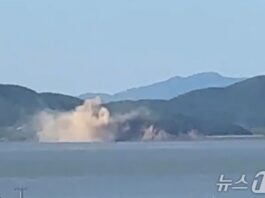
Earlier, South Korea’s Joint Chiefs of Staff reported detecting over 10 ballistic missiles launched from North Korea’s Sunan area into the East Sea around 1:20 p.m. (South Korean time) the previous day. The estimated flight distance was approximately 350 km (about 217 miles).
This marks North Korea’s first ballistic missile launch since January 27, when they fired short-range ballistic missiles (SRBMs) into the East Sea, making it the third launch this year.
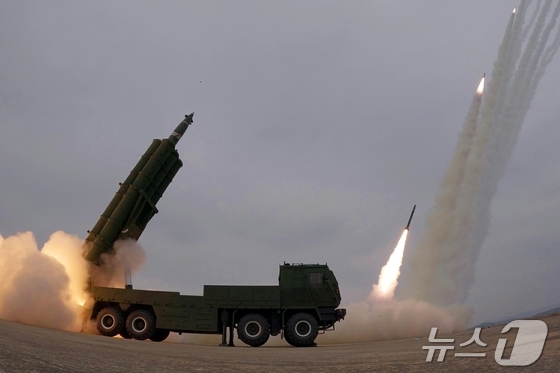
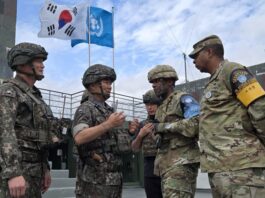
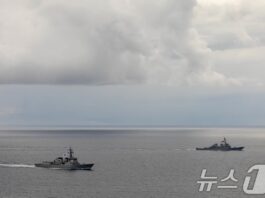
The unusual firing of multiple missiles simultaneously is widely interpreted as a response to the ongoing U.S.-South Korea joint exercise Freedom Shield (FS), which began on March 9.
Despite the U.S. and South Korea reducing the duration of outdoor maneuver training (FTX) to less than half of last year’s exercise, North Korea continues to denounce it as a hostile drill.
Hong Min, a senior researcher at the Korea Institute for National Unification, noted that Kim has been refining the operational concept of the 600mm super-large rocket launcher since 2023. Hong explained that previously limited to simple deterrence, it now encompasses preemptive and retaliatory strike capabilities against U.S. and South Korean air power in the event of conflict.
Kim’s explicit mention of enemies within a 420 km (about 261 miles) range is seen as a direct threat to key U.S. military bases in Pyeongtaek, Osan, and Gunsan, as well as South Korean air facilities.
Some analysts point out that this show of force occurred shortly after reports of President Donald Trump expressing interest in dialogue with North Korea.
On March 13, South Korean Prime Minister Kim Min-seok held a 20-minute conversation with President Trump at the White House. According to Prime Minister Kim, Trump stated he maintains a good relationship with Kim and inquired whether the North Korean leader desired dialogue with the U.S. or himself.
However, some experts believe North Korea’s missile tests are part of a pre-planned military schedule, suggesting that Trump’s reported interest in dialogue may not have prompted an immediate response.
Researcher Hong concluded that this launch is likely a routine show of force in response to the U.S.-South Korea joint exercise, rather than an immediate reaction to President Trump’s remarks. It serves to demonstrate deterrence to the U.S. and reinforce North Korea’s status as a nuclear power, pressuring Washington to adopt a more proactive stance towards dialogue.