

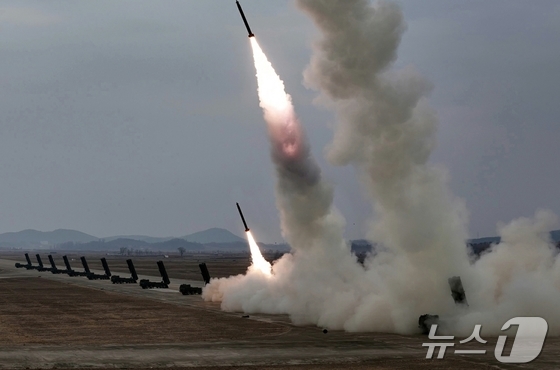
North Korean leader Kim Jong Un observed a precision strike training exercise involving 600mm multiple rocket launchers, issuing a threat that it would cause anxiety to enemies within a 420-kilometer (about 261 miles) range. By specifically mentioning South Korea’s capital region and key U.S. military bases, analysts interpret this as North Korea’s signal of enhanced precision strike capabilities aimed at South Korea and the U.S.
North Korea’s state-run newspaper, Rodong Sinmun, reported on March 15 that Kim, accompanied by his daughter Ju-ae, had observed the 600mm precision multiple rocket launcher firepower strike training the previous day.
During the exercise, Kim stated that while the weapon system is primarily for defense, these deterrent measures would immediately serve as a means of massive destructive attack if they fail to prevent foreign military provocations or invasions against national sovereignty.
He emphasized that although the primary purpose is deterrence, these weapons could be used offensively if deterrence fails.
Kim declared that this weapon system would instill fear in hostile forces—specifically, enemies within a 420-kilometer (about 261 miles) range—and demonstrate the destructive power of tactical nuclear weapons.
His explicit mention of the 420 km (about 261 miles) range is seen as a clear indication that the weapon system targets South Korea. This range encompasses not only the Seoul metropolitan area but also includes U.S. military bases in Pyeongtaek, Osan, and Gunsan.
The unusual simultaneous launch of over ten missiles is viewed as a demonstration of North Korea’s ability to overwhelm U.S.-South Korea missile defense systems, showcasing what they term saturation attack capability.
Over 10 Missiles Fired Simultaneously in Rare Move… Seen as Show of Ability to Overwhelm ROK–U.S. Air Defenses
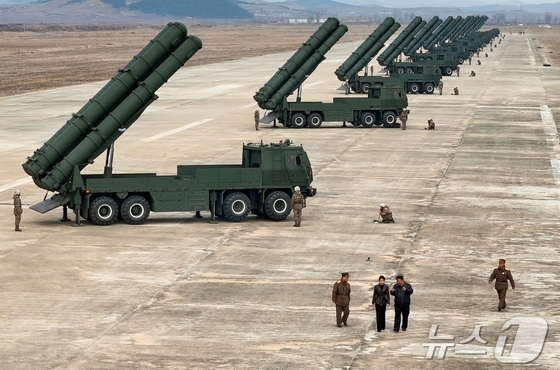
This exercise took place amid the ongoing U.S.-South Korea joint military drill Freedom Shield (FS), which began on March 9. Analysts believe North Korea conducted this demonstration to express displeasure with U.S.-South Korea military cooperation while flexing its enhanced military capabilities.
The simultaneous launch of multiple missiles is particularly noteworthy, interpreted as a demonstration of North Korea’s ability to potentially overwhelm U.S. and South Korean missile defense systems such as Terminal High Altitude Area Defense (THAAD) and PAC-3.
Kim also warned that peace must be actively maintained, not merely wished for, indicating that such training exercises would continue regularly.
Experts predict that North Korea will increasingly pursue overt nuclear and missile development targeting South Korea and the U.S. while maintaining a public stance of defense and war deterrence.
Yang Moo-jin, a professor at the University of North Korean Studies, noted that by defining the primary mission of tactical nuclear weapons as deterrence and the secondary mission as offensive capability, North Korea is asserting its right to launch preemptive strikes if it perceives a threat.
Showing Discomfort with Seoul’s Mediator Role in Prospective U.S.–North Korea Summit?
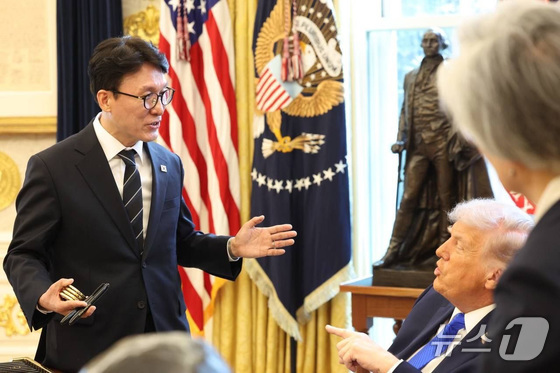
Some analysts speculate that Kim’s message may reflect discomfort following reports of discussions between former U.S. President Donald Trump and South Korean Prime Minister Kim Min-seok regarding U.S.-North Korea dialogue.
On March 13, Prime Minister Kim revealed that he spoke with Trump for about 20 minutes at the White House about North Korea. He noted that Trump expressed interest in whether Kim Jong Un wants to engage in dialogue with the U.S. or him personally, showing continued interest in a potential U.S.-North Korea summit.
Prime Minister Kim stated that he briefed Trump on North Korea’s current situation, their potential willingness for talks, and suggestions for improving relations. He added that Trump responded positively and directed an aide to take action.
However, given North Korea’s consistent designation of South Korea as an enemy state and refusal to engage in dialogue, Pyongyang may view the South Korean government’s mediation efforts in U.S.-North Korea talks with discomfort or suspicion.
During the 9th Congress of the Workers’ Party last month, Kim had left the door open for dialogue with the U.S., stating that if the U.S. retracts its hostile policy toward North Korea, there is no reason for them not to get along. However, he completely rejected any possibility of improving relations with South Korea, labeling it a thorough enemy and eternal adversary.
Professor Lim Eum-chul from Kyungnam University’s Institute for Far Eastern Studies suggested that Chairman Kim may feel insulted by the South Korean Prime Minister’s attempt to speculate on his strategic approach to U.S.-North Korea relations. He advised that future mediation efforts should ideally be conducted through informal channels.