

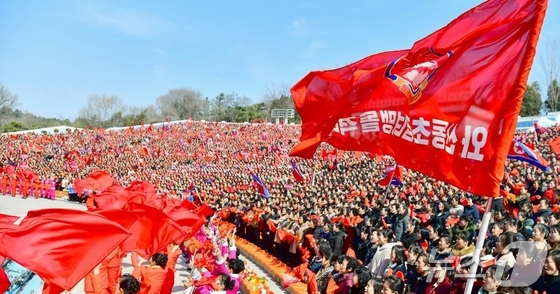
Since the 9th Congress of the Workers’ Party, North Korea has prominently showcased its people’s spirit and achievements. The regime has strategically arranged messages across various sectors, emphasizing international friendships, capital development, talent cultivation, production incentives, cultural propaganda, and class education.
On March 22, the Workers’ Party’s official newspaper, Rodong Sinmun, featured a front-page message from Kim Jong Un, General Secretary of the Workers’ Party. The message was addressed to Thongloun Sisoulith, President of Laos and General Secretary of the Lao People’s Revolutionary Party, commemorating the 71st anniversary of their party’s founding.
In his message, Kim hailed the establishment of the Lao People’s Revolutionary Party as a historic event of great significance in shaping the Laotian people’s destiny. He expressed confidence in the continued growth of the friendly cooperative relationship between the two parties and nations.
The second page was dedicated to a comprehensive narrative summarizing the five-year housing construction project for 50,000 households in Pyongyang. The newspaper highlighted Kim’s statement that Pyongyang must be the world’s most beautiful and greatest city, framing the period from the completion of Songhwa Street to the fourth phase of the Hwasong District and the completion of Saebyol Street as a golden era of capital development.
The third page emphasized the crucial role of talent in implementing the decisions from the 9th Congress. It argued that the strategic placement and active engagement of skilled individuals is fundamental to the collective advancement of all sectors and units.
The article also featured Kim’s directive that in every sector and unit, it must prioritize talent, enhance the role of scientific and technological experts, and approach all work with scientific planning and execution.
The fourth page focused on boosting coal production. It reported on the competitive production situations in the Chonsong Youth Coal Mine and other mines in the Sunchon and Pukchang districts, asserting that workers and the labor class in the coal industry are demonstrating high morale and accelerating production.
The fifth page identified the literary and artistic sector as a key propaganda tool supporting the spirit of the 9th Congress. It quoted Kim’s statement that the literary and artistic sector must create thought-provoking masterpieces that resonate with the people, keeping pace with the revolution’s rapid advancement and the dynamic reality. The article also highlighted works created by the Central Committee of the Korean Writers’ Union, including Our Respected Kim Jong Un Comrade, the poem Joy of February, and The Glorious Flower Basket, among others.
The sixth page featured articles on class education through memoirs and testimonies from the victorious generation. By showcasing the story of Kim Yong-hyun, a war veteran highlighted during a visit to the Museum of the Victory of the Fatherland Liberation War, the newspaper reinforced Kim’s assertion that it must firmly uphold revolutionary principles and class positions under any circumstances and fight relentlessly against the class enemies.