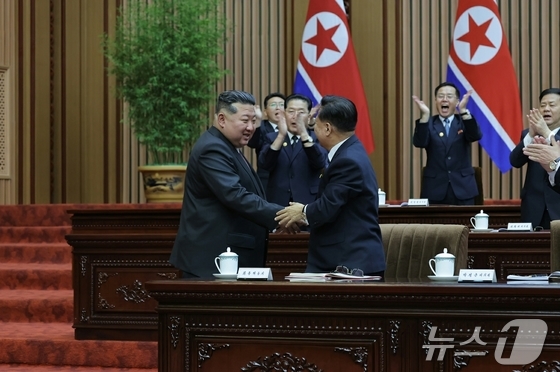
North Korea’s leader Kim Jong Un delivered a hardline message during his speech at the Supreme People’s Assembly, threatening South Korea with merciless consequences while adopting a noticeably different tone towards the U.S. He continues to maintain a stance of total rejection toward South Korea, perpetuating a diplomatic approach that has remained unchanged since the previous administration.
According to the party’s official newspaper, Rodong Sinmun, Kim stated in his speech on the previous day, during the first session of the 15th Supreme People’s Assembly, that it is up to their adversaries to choose between confrontation or peaceful coexistence. He asserted that North Korea is prepared to respond to either choice.
While Kim reaffirmed an anti-American stance by criticizing U.S. imperialism and aggression, he refrained from directly targeting President Donald Trump or explicitly rejecting dialogue with the U.S.
In contrast, his message toward South Korea was far more direct and hostile. Kim declared that he will recognize South Korea as the most hostile nation and will deal with it by thoroughly rejecting and ignoring it with the clearest words and actions. He added that any actions by South Korea that touch its republic will face merciless consequences without the slightest hesitation. This rhetoric reinforces North Korea’s animosity and unwillingness to view South Korea as a dialogue partner.
Despite Overtures, Inter-Korean Divide Hardens… Is the U.S. Opting for Strategic Management?
Kim’s speech is particularly significant as it coincided with expectations that North Korea would incorporate its two-state policy into its constitution during the Supreme People’s Assembly. Although North Korea has not publicly confirmed these constitutional changes, analysts believe that related measures were likely implemented based on Kim’s speech.
The Lee Jae Myung administration has consistently pursued a policy of engagement with North Korea since taking office in June last year. However, North Korea’s approach toward the South remains unaltered. If the two-state policy was indeed reflected in the constitution during this meeting, North Korea is expected to continue its hostile actions to emphasize and reinforce this stance internally for some time.
Interestingly, while maintaining a fundamentally hostile stance toward the U.S., Kim appeared to moderate his expressions, suggesting a form of management. He criticized the U.S. for committing state terrorism and acts of aggression around the world and accused the U.S. and its allies of constantly bringing nuclear strategic assets near the nation, shaking the foundation of regional security. However, he stopped short of explicitly rejecting dialogue, indicating that he may not want to completely close the door on future U.S.-North Korea negotiations.
Kim also emphasized the legitimacy of North Korea’s status as a nuclear power and the necessity of enhancing its nuclear capabilities. He clearly stated that North Korea is no longer interested in past negotiation frameworks that exchanged denuclearization for economic compensation. This aligns with his previous statement at the 9th Party Congress in February, where he indicated that if the U.S. respects North Korea’s current status as a nuclear power and withdraws its hostile policy, there would be no reason for North Korea not to maintain good relations with the U.S.
Hong Min, a senior researcher at the Korea Institute for National Unification, highlighted the importance of Kim’s remarks about strengthening North Korea’s position as a nuclear power. Hong noted that Kim claimed to have achieved enormous results that cannot be compared with any guarantees or economic support.
Hong added that Kim’s message indicates a desire to distance North Korea from agreements involving compensation for denuclearization or economic support. While Kim does not completely reject the possibility of dialogue with the U.S., he is drawing a clear line against negotiations that would require giving up nuclear weapons in exchange for benefits.
North Korea Prioritizes its Own Path, Maintaining a Hardline Approach Regardless of Changes in the South Korean Government.
Since the inauguration of the Lee administration, Kim has consistently maintained a hostile message toward South Korea, not even setting conditions for dialogue. This stance was evident in his speeches at the Supreme People’s Assembly last September and at the 9th Party Congress in February this year.
Curiously, North Korea continues to issue similarly hostile rhetoric toward South Korea, despite the Yoon administration’s proposals for engagement. This mirrors the level of criticism directed at the previous administration, indicating that North Korea is focused solely on its own agenda, disregarding any messages from South Korea.
Experts predict that North Korea will maintain this stance until it achieves the final version of its two-state policy, which was initiated during the Yoon Suk Yeol administration in December 2023. They also anticipate that North Korea will prioritize strengthening diplomatic ties with Russia and China, having received substantial economic and military support, over improving relations with the U.S. and South Korea. However, analysts suggest that the differing tones in messages directed at the U.S. and South Korea may reflect expectations for greater opportunities in dealing with the U.S.
A source familiar with North Korea’s stance remarked that rather than adjusting messages based on their opponents, North Korea is handling the U.S. and South Korea on different trajectories aligned with their external strategy. The source added that the inter-Korean relationship is moving toward a posture of hostile distancing, while the North Korea-U.S. relationship is entering a phase of strategic management amid distrust.
Hong predicted that with South Korea, North Korea is more likely to maintain a state of non-aggression rather than engaging in dialogue or reconciliation.