

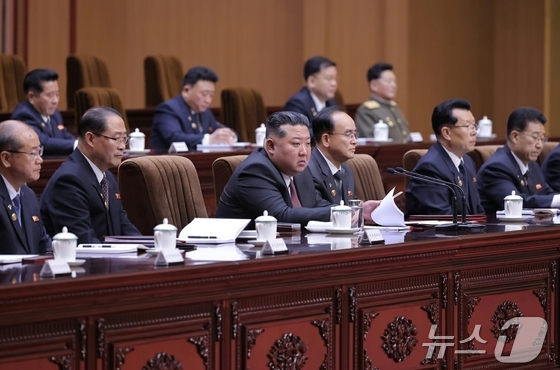
North Korea has completed the selection of leadership for the party, government, and military to lead Kim Jong Un’s (Kim) 3rd term through the 9th Congress of the Workers’ Party (February 19-25) and the 1st Session of the 15th Supreme People’s Assembly (March 22-23). Kim was re-elected as General Secretary of the Workers’ Party and Chairman of the State Affairs Commission, Pak Thae-song was retained as Premier, and Jo Yong-won, former Organization Secretary of the Workers’ Party, was newly elected as Chairman of the Supreme People’s Assembly Presidium and Chairman of the Standing Committee of the Supreme People’s Assembly.
These three individuals, along with the newly appointed Kim Jae-ryong as Organization Secretary and Ri Il-hwan as Propaganda Secretary, form the Politburo Standing Committee. The Politburo Standing Committee is the highest decision-making body of the Workers’ Party, responsible for discussing and deciding on major issues that are urgently raised politically, economically, and militarily.
Jo, Chairman of the Supreme People’s Assembly Presidium, was also appointed as First Vice Chairman of the State Affairs Commission. Although he stepped down from his role as the party’s Organization Secretary, he is expected to continue playing a crucial role in both party and state institutions. Born in 1957 (estimated), he graduated from Kim Il Sung University’s Physics Department and worked as a professor at his alma mater before joining the Organization and Guidance Department, a core party department, in the 1990s, where he has been active for over 30 years. He emerged as a close aide to Kim Jong Un after the latter was designated as successor, and has been assisting him from the closest proximity. His personality can be glimpsed through the testimony of a South Korean official who met him during the inter-Korean summit in September 2018.
It was when the two Korean leaders went to Mount Paektu after the summit. Jo’s gaze never left Kim, not only when the two leaders were moving together but also when he was taking commemorative photos with other South Korean officials. Even while doing other tasks, he was always ready to rush to Kim’s side at the slightest gesture. The impression was that of a quiet and modest but simultaneously sharp-edged official.
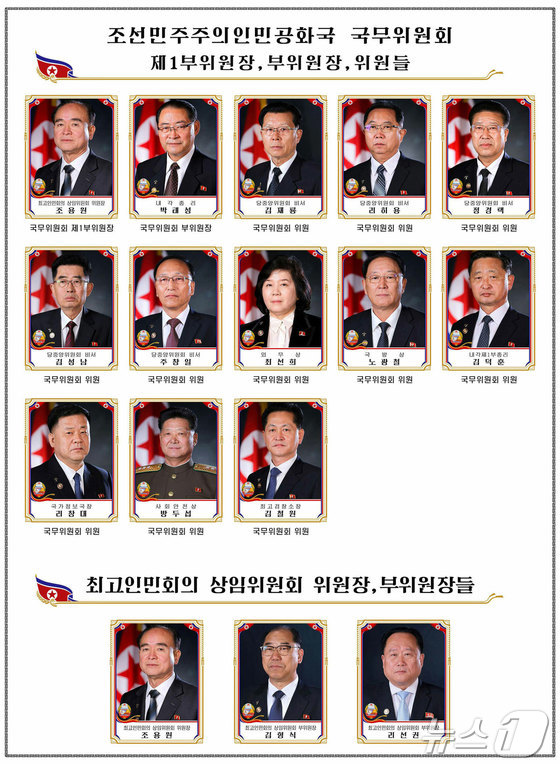
Regarding the State Affairs Commission, Park Jung-chun, Kim Yong-chol, Ri Son-gwon, O Su-yong, and Kim Yo-jong were removed, while Kim Jae-ryong (Party Organization Secretary), Ri Hi-yong (Cadre Secretary), Jung Kyong-tack (Military Political Secretary), Ju Chang-il (Working Organizations Secretary), Kim Tok Hun (First Vice Premier), and Kim Chol-won (Chief Prosecutor) were newly elected.
Jo will oversee the general affairs of the State Affairs Commission. The economic sector will be managed by Premier Pak and First Vice Premier Kim Tok-hun. Organization and discipline will be handled by Cadre Secretary Ri Hi-yong, Working Organizations Secretary Ju Chang-il, and Chief Prosecutor Kim Chol-won. The foreign affairs sector will be led by Kim Song-nam, the party’s International Secretary, and Foreign Minister Choe Son-hui. The military sector will be managed by Jung, the party’s Military Political Secretary, and Minister of National Defense No Kwang-chol.
Jung, appointed as the Workers’ Party’s Military Political Secretary to politically guide and control the People’s Army, is the son of Jung Jun-taek, a former Deputy Premier of the Cabinet who served as North Korea’s first Deputy Prime Minister and Chairman of the State Planning Commission. He was suddenly appointed as Minister of State Security at the 7th Congress of the Workers’ Party in 2016, and after serving as Director of the General Political Bureau of the Korean People’s Army, he entered the party’s Secretariat. He is a third-generation military figure from the Air Force, following in the footsteps of Jo Myong-rok, former Director of the General Political Bureau, and Ri Pyong-chol (former Air Force Commander and Munitions Secretary).
It is somewhat surprising that Kim Yo-jong, who was promoted to Director of the General Affairs Department, was excluded from the State Affairs Commission. This is because even after her promotion, she issued a statement targeting the Republic of Korea (ROK)-U.S. joint exercise on March 10 in her capacity as a State Affairs Commissioner in charge of foreign affairs. It appears to be an intention to focus on her party duties. As a result, there is now no official in the State Affairs Commission who was previously involved in South Korea-related work.
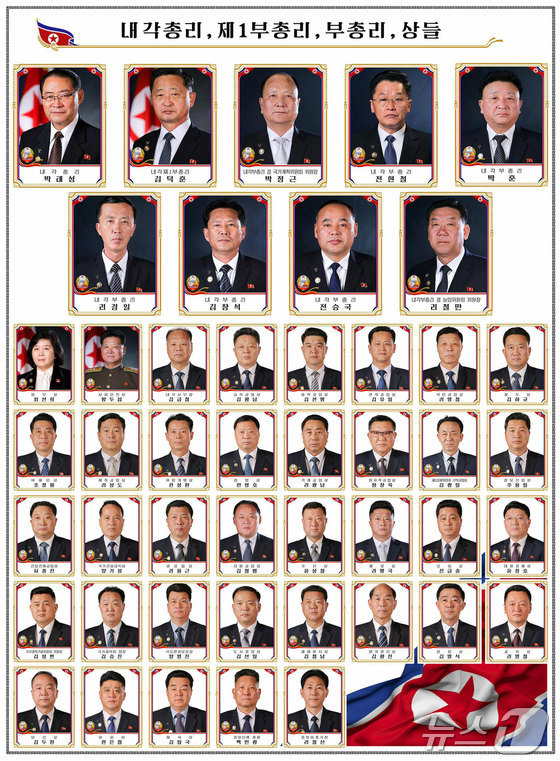
In the Cabinet, the position of First Vice Premier was newly created, further strengthening the trend towards a cabinet-responsible system. Premier Pak, from the Organization and Guidance Department, will oversee all cabinet affairs, while the newly appointed First Vice Premier Kim Tok-hun, with a background in economic administration, is expected to mainly handle practical economic matters. In the Cabinet, individuals in their 60s are positioned at the Premier and Vice Premier levels, while most of the ministerial positions are filled by fourth-generation, up-and-coming economic officials in their 40s and 50s.
First Vice Premier Kim Tok-hun, who became Premier at the relatively young age of 59 in August 2020 and oversaw the economy, was expected by many to be dismissed due to recent criticisms. However, his appointment as a member of the Politburo shows that he still enjoys trust. Born in 1961, he was already appointed as the manager of the Daean Heavy Machine Complex, North Korea’s largest machinery production factory, at the age of 40, and was considered a frontrunner among managers in their 40s at the time. It is said that he earned the nickname theorist for his fondness for reading socialist economic theory books since his university days. After serving as the chairman of the Jagang Province People’s Committee, he was appointed as Vice Premier in 2014, becoming a high-ranking economic official. He seems to continue to be employed in high positions in the party’s economic departments and the cabinet because he is evaluated as an official with both theoretical knowledge and field experience.
Through this personnel reshuffle in the party, government, and military, it is assessed that General Secretary Kim’s personal ruling system has become more firmly established.
First, the last of the second-generation revolutionaries in their 70s who assisted Kim during the early days of his regime in 2012, such as Ri Pyong-chol, Park Jung-chun, and Choe Ryung-hae, have retired. In their place, third-generation officials in their 60s who have worked closely with Kim during his first and second terms have risen to the highest positions in the party, government, and military. In essence, the generation that grew up during the Chollima Movement of the 1950s and 60s has given way to the generation that developed through the Three-Revolution Team Movement of the 1970s and 80s.
Ri Il-hwan, the Propaganda Secretary who has newly entered the Politburo Standing Committee, is a prime example. Born in 1960, he is the grandson of an anti-Japanese partisan and a graduate of the Mangyongdae Revolutionary School. He began his rapid ascent after being appointed as the First Secretary of the Youth League in 1998, alternating between the Party’s Working Organizations Department and the Propaganda and Agitation Department before being appointed as the head of the Working Organizations Department after the establishment of Kim’s regime. Both his grandmother and father are buried in the Patriotic Martyrs’ Cemetery, North Korea’s national cemetery.
Secondly, the advancement of officials from the Party’s Organization and Guidance Department, who have closely assisted General Secretary Kim, is notable. Jo (First Vice Chairman of the State Affairs Commission), Park (Premier), Kim Jae-ryong (Organization Secretary), Ri Hi-yong (Cadre Secretary), and Kim Hyong-sik (Vice Chairman of the Standing Committee of the Supreme People’s Assembly) are all from the Organization and Guidance Department.
However, the Organization and Guidance Department appears to have been restructured with a reduced role compared to the past. It now focuses on its basic tasks of party life, personnel management, and inspections, while administrative discipline tasks have been transferred to the Discipline Investigation Department and the Party Central Inspection Committee. The party’s guidance of the military has been moved to the Military Political Guidance Department, and the ad hoc central promotion committee tasks for local development have been transferred to the newly established Party Construction Department.
Thirdly, the party’s control over the military has been strengthened, and a rapid generational change in the military has taken place. Officials who became generals after the establishment of Kim’s regime have been appointed to leadership positions in the Ministry of National Defense, the General Political Bureau, the General Staff Department, and various corps.
Notably, among the five members of the 9th Politburo Standing Committee, there is not a single military official. In the past, one or two military personnel were usually selected as members of the Politburo Standing Committee, but this time military figures were excluded, and instead, the secretary in charge of propaganda and agitation took that position.
In particular, the appointment of Jung Kyong-tack, a former Director of the General Political Bureau, as the Party Central Committee Secretary and head of the Military Political Guidance Department, as well as Vice Chairman of the Party Central Military Commission, in place of Park Jung-chun, a former Chief of the General Staff, symbolically shows that political and ideological control by the party is being prioritized over expertise in military command and operations.
Additionally, the ranks of the generals holding key military positions have generally been lowered. Major General Kim Sung-gi (2-star), who was appointed as the Director of the General Political Bureau of the Korean People’s Army, is a fourth-generation military official promoted to general by General Secretary Kim in 2018. He has risen to a core position in the People’s Army in just 8 years. Considering that past Directors of the General Political Bureau held the rank of Marshal or General, this represents an extremely radical generational change. Except for Chief of the General Staff Ri Yong-gil (Marshal) and Minister of National Defense No Kwang-chol (General), major positions in the General Staff Department and the Ministry of National Defense are now held by Lieutenant Generals and Major Generals.
Furthermore, a gradual generational change has been implemented among frontline corps commanders, with those in their 40s, who can be considered the fourth generation, emerging as the main force. All corps commanders, including the recently appointed Ju Sung-nam (2nd Corps Commander), Jung Myong-nam (4th Corps Commander), Ri Jung-guk (5th Corps Commander), Hong Chol-ung (7th Corps Commander), and Ji Young-bok (9th Corps Commander), are individuals who were personally promoted by Chairman Kim in the late 2010s.
For example, An Young-hwan, the 1st Corps Commander, received his stars in April 2019. Unlike in the past, the rank of corps commanders has been lowered from Colonel General (3-star) to Lieutenant General (2-star), and the commander of the 91st Corps, responsible for defending the capital Pyongyang, has been lowered by two ranks from Lieutenant General to Colonel. Notably, among the military personnel promoted after the establishment of Kim’s regime, many are said to be fellow students who attended Kim Il Sung Military University with General Secretary Kim during his regular and research courses from 2002. The June 2023 issue of the North Korean literary magazine Chosun Literature even featured a story about Kim strengthening camaraderie with his university classmates by pounding rice cakes with a mallet in December 2003.
In essence, officials from the Organization and Guidance Department are thriving in the party, professional economic officials with extensive field experience are excelling in the cabinet, and graduates of Kim Il Sung Military University are doing well in the military.
Meanwhile, although the position of First Secretary of the Party Central Committee, which acts as a proxy for the General Secretary, was newly created at the 8th Party Congress in 2021, a First Secretary was not elected at the 9th Party Congress. Some experts believe that the First Secretary position was created with Kim’s daughter, Kim Ju-ae, in mind as a potential successor, but currently, it is presumed that Kim Yo-jong, Director of the General Affairs Department, is effectively performing the role of First Secretary. Re-elected as an alternate member of the Politburo after five years, she appears to be expanding the role of the General Affairs Department and is also partially involved in the work of the Organization and Guidance Department and the Secretariat.
Notably, Kim Ju-ae, who had attracted attention, did not appear at the 9th Party Congress and only attended the commemorative military parade after the congress ended. This indicates that she has not yet been officially designated as the successor.