

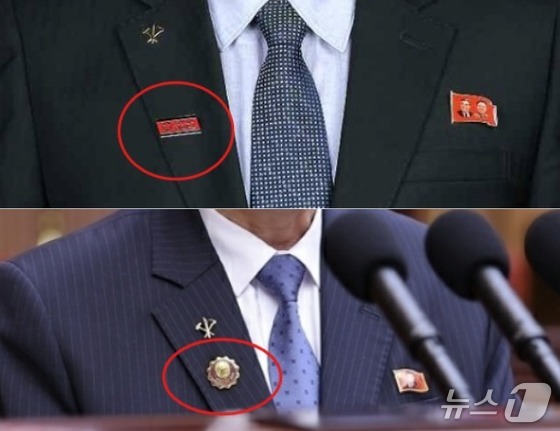
A new badge featuring the national emblem has been spotted at North Korea’s 15th Supreme People’s Assembly. Analysts suggest that this development, centered on the national representation granted to Supreme Leader Kim Jong Un, signals a symbolic shift as of Thursday.
North Korean state media, including the Rodong Sinmun newspaper and Korean Central Television, revealed that participants at the first session of the 15th Supreme People’s Assembly, held over two days from March 22-23, wore the new national emblem badge on their right chest. In contrast, delegates from the previous 14th Assembly had worn national flag badges during their legislative activities.
Changes were also evident in the overall stage production. Screens for congratulatory performances prominently displayed the national emblem, showcasing state symbols throughout the event.
Experts believe these changes align with trends observed since the 2019 constitutional amendments. At that time, North Korea revised its constitution to explicitly grant national representation to Kim and has since been working on reorganizing elements that symbolize the state.
The 2019 constitution explicitly stated that the Chairman of the State Affairs Commission of the Democratic People’s Republic of Korea is the supreme leader representing the state and elevated Kim’s status as the highest position of the state.
Evidence suggests that the national emblem is increasingly being integrated into state symbols, including the license plates and vehicles assigned to Kim.
Kim In-tae, a senior researcher at the National Security Strategy Institute, interprets this as a process of establishing a national image suited to the Kim era. He analyzes that this goes beyond mere symbolic changes, reconstructing the regime’s image to highlight Kim as the very embodiment of the state and its absolute authority.
Recently, the Workers’ Party emblem (hammer, brush, and sickle) gained prominence during the party congress. Instead of portraits of the leader, the party flag and emblem were placed in the background of the podium, emphasizing the political message of the Workers’ Party’s status and authority in the Kim era.