North Korea has reportedly constructed buildings resembling a typical nursery at a key missile base near Pyongyang, potentially to disguise military facilities.
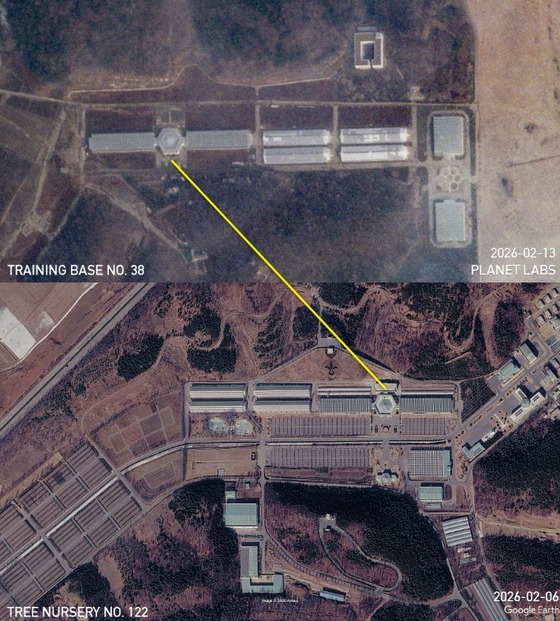
On Tuesday, NK News, a U.S.-based media outlet focusing on North Korean affairs, revealed through satellite imagery analysis that newly constructed hexagonal structures, greenhouses, and outdoor planting facilities at the Korean People’s Army Training Base No. 38, east of Pyongyang, bear striking similarities to the design of the 122nd Korean People’s Army nursery in Hwangju County, southwest of the capital.
The site is situated between two expansive mansion complexes owned by Kim Jong Un, with one believed to be called the Azalea Guesthouse.
NK News suggests this architectural mimicry could be a calculated strategy to mislead potential adversaries.
Training Base No. 38 has been under development since early 2023 as a launch site for intercontinental ballistic missiles (ICBMs) and short-range missiles. The same grassy area used for a missile launch in April 2024 recently served as a sniper rifle training ground for Kim, his daughter Ju-ae, and other officials.
The report also highlights that the 122nd Korean People’s Army nursery in Hwangju County exhibits military characteristics, including artillery positions on five surrounding hills and a launch pad to the north. These military installations predated the farm’s construction and continue to undergo maintenance.
NK News posits that the replication of design features at both Training Base No. 38 and the 122nd farm suggests North Korea may be attempting to conceal military activities under the guise of legitimate environmental facilities.
This tactic aligns with North Korea’s history of disguising military installations as civilian structures, such as labeling weapons factories as tractor factories or camouflaging a newly built missile base as a golf course.
The analysis concludes that establishing tree farms at military bases could effectively obscure the purpose of intermittent military movements, while acknowledging that some areas of the 122nd nursery likely serve genuine horticultural functions.