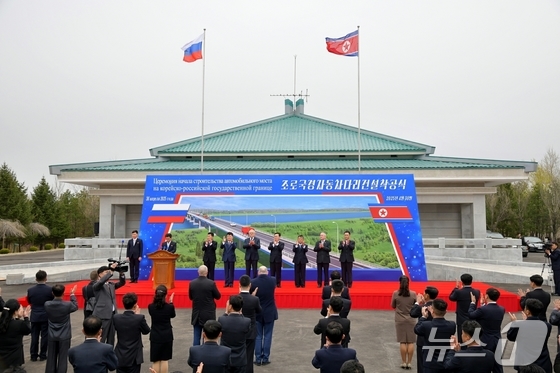
The Russia-North Korea Border Vehicle Bridge, connecting Rason in North Korea with Khasan in Russia across the Tumen River, is set to open this summer.
On April 5, the Russian Embassy in North Korea reported via Telegram that during the First International Transport and Logistics Forum held in St. Petersburg from April 1-3, they met with North Korea’s Minister of Land and Maritime Transport to discuss the construction of a road bridge spanning the Tumen River.
The embassy also cited the Russian Ministry of Transport, stating that construction continues on the Khasan checkpoint, which will have the capacity to process 300 vehicles and over 2,000 individuals daily.
Rail transport between North Korea and Russia is also experiencing growth. Passenger traffic in the first two months of this year quadrupled compared to the previous year. The development of tourist routes, including rail services linking Vladivostok and Rason, is in progress. Last year, four trains operated, carrying 286 tourists, with plans to expand to six trains this year.
Earlier, Kim Jong Un, General Secretary of the Workers’ Party of Korea, and Russian President Vladimir Putin agreed during their June 2024 summit to construct a new bridge for vehicles across the Tumen River, which currently only has a railway bridge.
North Korea and Russia began construction of the vehicle bridge over the Tumen River in late April last year, with a total investment of 115 million USD. The bridge’s total length, including access roads, is 4.7 kilometers (about 2.9 miles), with the main structure measuring 7 meters (about 23 feet) wide and 1 kilometer (about 0.62 miles) long. Russia is responsible for constructing 424 meters (about 1,391 feet), while North Korea is handling 581 meters (about 1,906 feet).
During this meeting, the two countries also announced the signing of an Agreement on Mutual Recognition of Seafarer Diplomas, which standardizes training requirements for marine vessel crews.
Since July of last year, Russia’s Nordwind Airlines has been operating monthly direct flights between Moscow and Pyongyang. Discussions are ongoing regarding the training and retraining of North Korean civil aviation personnel at Russian educational institutions.