

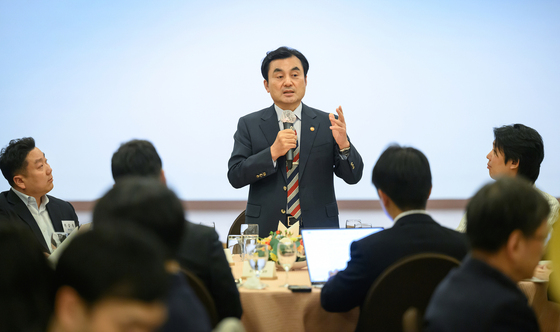
South Korea’s Defense Minister Ahn Kyu-back unveiled plans to dramatically reduce frontline guard personnel by leveraging artificial intelligence (AI) technology. This initiative aims to address the inevitable decline in military manpower due to the country’s shrinking population.
At a press briefing held on Tuesday at the Defense Convention Center in Seoul’s Yongsan district, Minister Ahn revealed that it currently has about 22,000 guard troops stationed at the frontline General Outposts (GOP). Its plan is to cut this number down to around 6,000 using an AI-driven surveillance system.
He further elaborated that the remaining 16,000 troops will be positioned in the Forward Edge of Battle Area (FEBA), behind the GOP, ready for immediate deployment if a situation arises.
This announcement signals a major shift from the current linear defense strategy, where guards are positioned along the fence line, to a regional defense concept. The plan appears to involve reorganizing troops withdrawn from the GOP into specific units, allowing each FEBA to oversee multiple GOP sectors.
However, this strategy has raised concerns about vulnerability to North Korean surprise attacks. These worries are particularly acute given Pyongyang’s recent focus on military enhancement and observed drills simulating breakthrough attacks in frontline areas.
Last month, on March 19, North Korean leader Kim Jong Un inspected joint exercises involving special forces and tank units at the 60th Training Base of the People’s Army’s Capital Defense Corps in Pyongyang.
North Korea’s state-run Rodong Sinmun reported that the drills aimed to perfect coordination and combat techniques for tactical units striking, raiding, and occupying enemy anti-tank defense lines, while expanding offensive capabilities through tank and infantry assaults. Military analysts interpret this as preparation for a potential large-scale invasion attempt to breach the border and capture key South Korean frontline positions.
While the Yoon Suk Yeol administration initially proposed the GOP troop reduction and AI replacement strategy, the Lee Jae Myung government has been working to flesh out the details. This marks the first time a Defense Minister has publicly disclosed specific troop reduction figures.
Minister Ahn also mentioned ongoing discussions about outsourcing rear base security to civilian contractors and transferring coastal patrol duties to the Coast Guard. He emphasized that these changes will allow the military to focus more on core combat missions.
Addressing military service reforms, Ahn reaffirmed plans for a ‘selective enlistment system’ based on conscription, which would allow volunteers to serve as non-commissioned officers.
He clarified that the selective enlistment system doesn’t mean people can choose whether to serve. Everyone still goes to the military. An outlined plans to maintain about 50,000 technically skilled non-commissioned officers (NCOs) to operate advanced weapon systems, with a structure designed to help them transition into related civilian careers after their service.
Minister Ahn announced that comprehensive military restructuring plans, covering forces, units, and personnel, are underway and slated for presidential approval by year-end. The overall goal is to maintain a total force of 500,000, comprising a 350,000-strong standing army and 150,000 outsourced personnel for rear area security.