

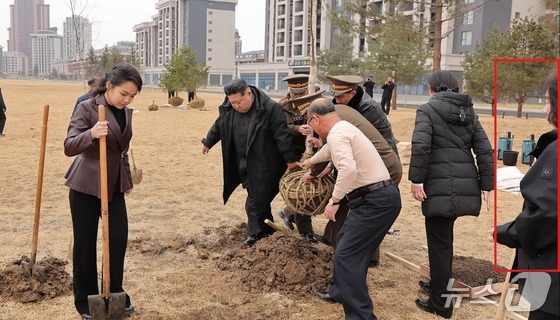
As North Korea commemorates the Day of Tree Planting, the regime heavily emphasizes messages of patriotism and people-centric ideology. However, the event was overshadowed by the spotting of high-ranking officials wearing luxury foreign brands. This serves as a symbolic reminder that even under international sanctions, the elite continue to indulge in Western luxury goods.
The April 2026 issue of North Korea’s monthly propaganda magazine, Joson, showcases Kim Jong Un participating in a tree-planting event with officials at Saebyol Street Park in Pyongyang on March 14. The photographs depict key military and party figures assisting in planting trees.
Among the attendees, a black padded jacket worn by an individual believed to be Foreign Minister Choe Son-hui drew particular attention. The garment is identifiable as a product from the Canadian luxury brand Moose Knuckles, known for its high-end outerwear with price tags in the hundreds of thousands of KRW (thousands of USD). This incident further exemplifies the foreign luxury consumption habits of North Korea’s elite.
Officially, North Korea consistently emphasizes self-reliance and the use of domestically produced goods. State-run media outlets like Rodong Sinmun frequently tout achievements in domestic production and improvements in citizens’ living standards as major successes. However, the attire and consumption patterns of the supreme leadership and key elites consistently contradict this narrative.
Kim himself has been spotted multiple times wearing luxury Swiss timepieces (presumed to be IWC or Patek Philippe) and expensive outerwear. Kim Yo-jong, a deputy director of the Workers’ Party, has been repeatedly photographed carrying Dior handbags and wearing designer coats. Ri Sol-ju, the leader’s wife, has faced ongoing scrutiny for her luxury accessories and handbags.
The latest example involving Choe further confirms that high-end foreign goods consumption among North Korea’s power elite is not an isolated incident but a recurring structural phenomenon. Notably, despite long-standing international sanctions against North Korea, the influx and consumption of foreign luxury brands among certain privileged groups continue unabated.
This incident also highlights the disconnect between the message North Korean media aims to convey through the tree-planting event and the reality on display. The regime’s publications emphasize the event as a symbolic act of patriotism and inheritance of revolutionary traditions, attempting to elevate it beyond mere environmental stewardship.
Joson reported that Kim urged citizens to emulate the noble spirit of fallen heroes and carry on the tradition of victory, attributing patriotic significance to each tree planted. He also emphasized patriotism as the driving force behind creation and transformation, underscoring the nation’s commitment to development.
Ultimately, while the event itself carries a strong political message aimed at mobilizing the populace and fostering patriotism, the conspicuous consumption patterns revealed among the elite create a stark contrast with the regime’s narrative of frugality and people-centeredness.