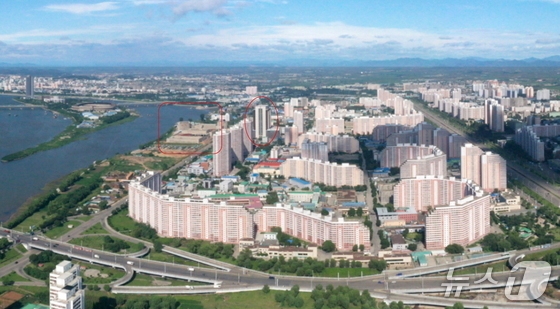
Three years ago, in 2023, the Ryugyong Golden Commercial Center building was completed and opened for business on Rakrang Street (formerly Tongil Street) in East Pyongyang. Commercial center is a term used in China to refer to commercial districts with concentrated large-scale marts or shopping malls. North Korea defines it as a comprehensive service base that includes commerce, food service, hotels, and office areas.
The first appearance of a large-scale mart (supermarket) named commercial center in Pyongyang was the Kwangbok District Commercial Center, which opened in 2012 after remodeling the Kwangbok Department Store. The Kwangbok District Commercial Center is a comprehensive shopping center that sells a variety of items including clothing, electronics, groceries, miscellaneous goods, and household items. It also operates amenities such as a children’s playground, beauty salon, café, and buffet restaurant.
Immediately after the opening of the Kwangbok District Commercial Center, North Korea began construction of the Tongil Street Commercial Service Network across the Taedong River. After a full decade, they completed the Ryugyong Golden Commercial Center. This complex shopping mall is about seven times larger than the Kwangbok District Commercial Center. It was developed with over 20 floors above and below ground, featuring not only commercial facilities but also hotels, offices, and wedding halls, serving multiple functions.
A noteworthy point is that this complex shopping mall is located right behind the Tongil Street Market. In South Korean terms, it’s like having an E-mart or Lotte Mart right in front of a traditional market. Naturally, this would impact the sales of the Tongil Street Market, which had dominated the commercial area of Rakrang District (administratively equivalent to a district in South Korea).
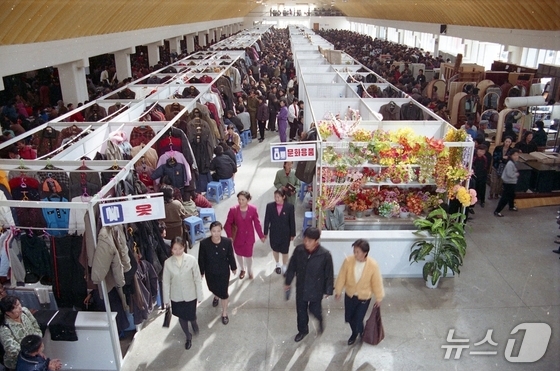
The Tongil Street Market, which opened in 2003, was North Korea’s first official comprehensive market (officially called regional market in North Korea). After North Korea’s declaration of two hostile states in late 2023, its name was changed to Rakrang Market and recently to Kumgang Market.
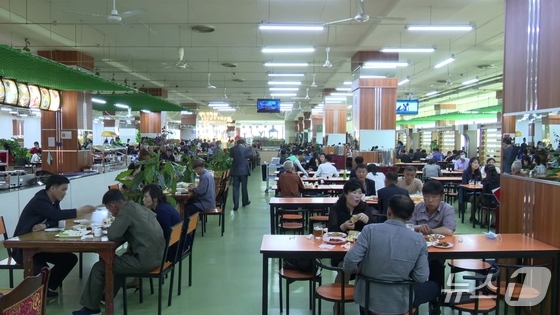
As farmers’ markets, which operated every ten days, grew explosively during the worst economic crisis of the 1990s, North Korea criticized that as the state became unable to properly supply food in recent years, many people abandoned their existing jobs and turned to business to fill their own pockets, but attempts to control the markets were unsuccessful. Subsequently, North Korea officially recognized (legalized) the rapidly proliferating farmers’ markets (jangmadang) as comprehensive markets, shifting policy from control to utilization.
In Explanation of Our Party’s Economic Ideology in the Military-First Era, authored by Professor Seo Jae-young of Kim Il Sung University and others, published in 2005, comprehensive markets are defined as a form of socialist commerce.
The proper operation of regional markets is of great significance in stabilizing and improving people’s lives at present. Regional markets are a form of commerce in socialist society, reflecting the transitional characteristics of socialist society. Officials should correctly recognize that, under current circumstances, regional markets are an important supplementary space necessary for economic management and people’s lives, and ensure that they are well managed and operated. Markets should be established in one or several convenient locations for people to use, considering the population and regional characteristics of cities, counties, and districts.
North Korea officially established about two comprehensive markets in each city district and rural county, using the Tongil Street Market, invested in by government authorities, as a model. It is estimated that about 440 comprehensive markets have been established nationwide. The Tongil Street Market, equipped with about 2,200 stalls, was particularly bustling in its early days, with daily visitors reaching 100,000 to 150,000.
As comprehensive markets spread, some evaluated that North Korea’s marketization was evolving beyond the official recognition of comprehensive markets to a stage where real estate, labor, and capital were being traded.
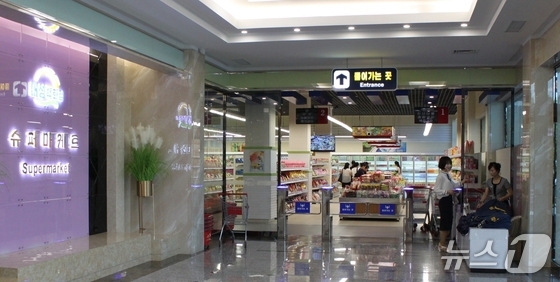
However, North Korea’s comprehensive markets faced a crisis when borders were closed due to the COVID-19 pandemic, halting imports of foreign products and restricting market opening hours. The Tongil Street Market, for instance, opened every other day for only 2-3 hours. Naturally, the income of importers and market merchants plummeted, and traders (money holders) began to leave the markets.
Starting with the 8th Congress of the Workers’ Party of Korea in 2021, North Korea began to fully engage in the restoration of state-owned commercial networks nationwide. North Korea emphasized the activation of commodity distribution through state-owned commercial networks as a measure to restore the state commercial system and socialist commerce. They also openly advocated the need to expand state financial revenue by recovering the state-led distribution system.
First, they shifted from the past planned economy method where authorities unilaterally distributed and rationed consumer goods, to a method that prioritizes ‘ensuring convenience in daily life’ by accepting global trends. They also changed the operation method of state-owned commercial networks to a structure where goods are self-procured through direct transactions with production companies and sold autonomously at agreed prices close to market prices rather than state-set prices. This policy shift transformed state-owned commercial networks from simply supplying goods to residents to entities that generate profits, competing with comprehensive markets and increasing fiscal revenue.
This policy change began to yield results in Pyongyang first. Based on the operational experience of the Kwangbok District Commercial Center, which opened in 2012 with Chinese capital, new commercial facilities different from the past began to emerge one by one.
In 2014, the Hwanggeumbeol Store, the first convenience store-style shop in Pyongyang, opened its doors. Ryang Seung-jin, the manager of the state-owned Hwanggeumbeol Store, opened three chain store-style convenience stores after receiving entrepreneurship education provided by Choson Exchange, a non-governmental organization in Singapore, and later expanded to about 20 stores. The Hwanggeumbeol Store is operated by Hwanggeumbeol Trading Company, a socialist enterprise.
In the Mirae Scientists Street completed in 2015, large-scale marts such as the Changkwang Store and Mirae Store were established. In the Ryomyong Street completed in 2017, a ‘comprehensive commercial district’ was created with various convenience facilities including stores and pharmacies. In the recently completed high-rise apartment complex in the Hwasong district, it is said that 1-3 convenience stores have been installed for each complex.
Additionally, direct sales outlets operated by institutions or enterprises in each district have moved beyond selling only specific product groups to selling a variety of goods including household items, food, and clothing. While not yet reaching the level of large supermarkets or department stores in South Korea, they have begun to operate at the level of corporate supermarkets (SSMs).
Secondly, commercial networks are diversifying to target various consumer groups. The Daesong Department Store, which reopened in 2019 after renovation, is a prime example. The Daesong Department Store, which previously mainly catered to foreigners, now has a supermarket on the first floor targeting general residents, while the second floor and above focus on electronic products, high-end clothing, and imported goods, catering to Pyongyang’s upper class.
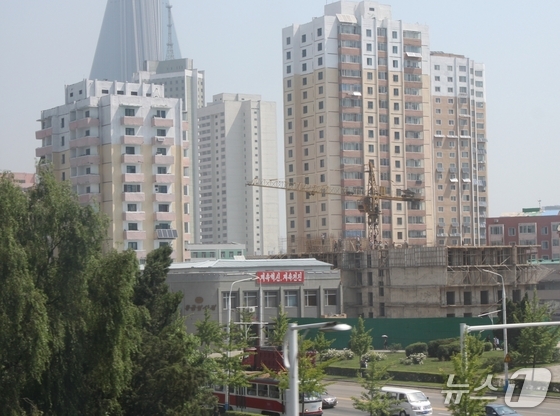
The newly established Ryugyong Golden Commercial Center on Rakrang Street in 2023 and the Rakrang Street Patriotic Kumgang Hall also have supermarkets on the first floor and luxury goods sections from the second floor up. The Rakrang Patriotic Kumgang Hall is a large complex shopping mall characterized by the sale of similar products centered on Western brands like IKEA and Starbucks. The first floor has a supermarket and soft drink shop, the second floor is for furniture, the third floor for household goods and a buffet, the fourth floor for home appliances and dried goods, the fifth floor for restaurants and teahouses, the sixth floor for a convenience store and children’s playground, the seventh floor for a comprehensive sports facility, and the eighth floor for a swimming pool. These types of commercial facilities seem to be targeting Pyongyang’s upper-class consumers who used to visit large shopping centers in front of Dandong Station in China to purchase luxury goods.
Recently, North Korea has begun full-scale construction of the Pyongyang Kumgang Hotel and Pyongyang Kumgang Commercial District along the Taedong River in front of the Ryugyong Golden Commercial Center. It appears that the East Pyongyang District Commercial Street project, which had only held a groundbreaking ceremony in 2014 before being suspended, has been resumed under a new name.
A large commercial complex is also being developed in the Hwasong district of Pyongyang. The Cabinet’s Ministry of External Economic Relations established the Central Material Exchange Company as a joint venture between China and North Korea last year, and is developing a comprehensive commercial complex of about 68,000 square meters (about 731,945 square feet). This commercial complex aims to be a large-scale wholesale and distribution hub handling various goods imported from China and other countries, including construction materials, home appliances, and furniture, with completion targeted for this year.
Thirdly, e-commerce (online shopping), which has emerged as a new commercial platform, is rapidly taking root, especially among the younger generation. This is not just a change in distribution networks but a measure to build a new commercial distribution system led by the authorities. It reflects a natural change in the modernization and digitalization of state-owned commercial networks, accepting global trends.
North Korea’s e-commerce began in earnest with the launch of an electronic store called Okryu in 2015, and since then, various online stores such as Manmulsan, Eunpasan, Apnal, and Bomhyanggi have appeared, with over 20 electronic stores currently operating. These electronic stores function as integrated platforms that handle thousands of items centered on daily consumer goods such as food, medicine, cosmetics, and household items, as well as food and train tickets, providing delivery and payment services all in one. Manmulsan, a representative electronic store, had 400 companies registered and distributed over 450 types and 60,000 products as of 2019.
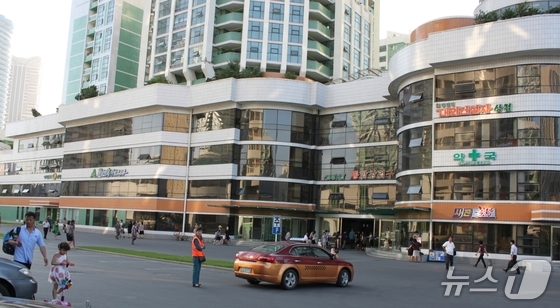
The modernization of existing department stores in Pyongyang, the new large-scale complex shopping centers on major streets, and the spread of e-commerce accepting the changes of the times will inevitably lead to the contraction and reduction of comprehensive markets, even without increased control by North Korean authorities. The crisis facing Pyongyang’s comprehensive markets is similar to the situation in South Korea, where the decline of traditional markets that began with the emergence of large-scale marts in the 1990s has been further intensified by the development of e-commerce. Consumers in Pyongyang are also shifting from outdated regional markets to department stores, large marts, convenience stores, or online shopping.
North Korea has recently been focusing on expanding Pyongyang’s success cases to other regions. Large stores or ‘comprehensive service centers’ are being built one after another in local areas. The Sinuiju Future Store, which opened as a two-story building in Sinuiju City in June 2023, marks the starting point, and comprehensive stores are being established within comprehensive service centers in newly constructed county-level housing complexes.
Comprehensive service centers are one of the three essential targets (city/county hospitals, comprehensive service centers, grain management offices) included in the 20×10 Local Development Policy that has been pursued since 2004. Last year, comprehensive service centers were completed in three areas: Kangdong County in Pyongyang City, Jongpyong County in South Hamgyong Province, and Kaepung District in Kaesong City. Comprehensive service centers are complex facilities that integrate movie theaters, libraries, sports facilities, stores, beauty salons, bathhouses, and restaurants in one space. The stores sell food, clothing, household goods, and electronic products including mobile phones.
In particular, North Korea is strictly regulating the flow of goods produced by local industrial factories built under the 20×10 Local Development Policy into regional markets. Since 2023, the sale of food in markets has been prohibited, making it possible to purchase rice, beans, corn, and other grains officially only at grain sales offices. The trading of imported goods in regional markets has also become subject to crackdowns, allowing them to be bought and sold only in state-owned stores such as department stores and comprehensive stores. On one hand, they are controlling regional markets through restrictions on operating hours, age limits for salespeople, and bans on selling unregistered products, while on the other hand, they are building modernized state-owned stores that can replace regional markets.
The Ryugyong Golden Commercial Center, built right next to the Tongil Street Market, symbolically shows the crisis of comprehensive markets that have been the mainstay of North Korean residents’ lives for the past 30 years. Unlike Pyongyang, the restoration of state-owned commercial networks in local areas is still in its initial stages. For a while, transformed state-owned commercial networks and comprehensive markets will have to coexist.
However, when the 20×10 Local Development Policy, which aims to improve people’s material living standards by building local industrial factories, hospitals, and comprehensive service centers in 20 counties every year for 10 years, comes to an end, local regional markets may also be reduced in status to the level of past farmers’ markets rather than comprehensive markets. Moreover, rapidly expanding e-commerce will significantly encroach upon the domain of comprehensive markets. Of course, this outlook assumes that the delivery system essential for e-commerce is established nationwide, and that comprehensive service centers are built as planned in local areas, ensuring stable supply of goods. For the success of the 20×10 Local Development Policy, there are numerous challenges that North Korean authorities need to address, including funding, electricity, and materials.