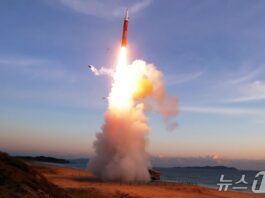
The Japanese government announced on Wednesday that it had lodged a strong protest with North Korea, stating that the country’s consecutive ballistic missile launches were absolutely unacceptable.
Chief Cabinet Secretary Hirokazu Matsuno, a government spokesperson, made the remarks during a briefing that afternoon, noting that North Korea had launched ballistic missiles in the afternoon following a launch earlier that morning.
According to the South Korean Joint Chiefs of Staff, North Korea fired several short-range ballistic missiles (SRBMs) toward the East Sea from the Wonsan area in Gangwon Province at around 8:50 a.m. that day, and then fired another SRBM toward the East Sea at around 2:20 p.m. South Korean military authorities analyzed that the missile fired by North Korea in the morning had a flight range of approximately 240 km (about 149 miles), while the one fired in the afternoon had a range of over 700 km (about 435 miles).
Japan’s Ministry of Defense also stated that the missile fired by North Korea in the afternoon reached a maximum altitude of approximately 60 km (about 37 miles) and traveled a distance of over 700 km (about 435 miles), adding that it is presumed to have landed in waters outside Japan’s Exclusive Economic Zone (EEZ). The ministry noted that the missile may have flown on an erratic trajectory.
Regarding this, Minister Matsuno stated that as of now, it has received no reports of damage to aircraft or vessels navigating near the missile’s impact point, but criticized the launch, saying that North Korea’s repeated ballistic missile launches threaten the peace and security of Japan, the region, and the international community.
He explained that such ballistic missile launches violate the United Nations (UN) Security Council resolutions and are a serious issue directly linked to public safety, adding that he had lodged a protest with North Korea through the Japanese Embassy in Beijing and strongly condemned the action.
Minister Matsuno stated that it plans to make every effort to gather and analyze additional information, as well as maintain vigilance and surveillance, while closely coordinating with the U.S., South Korea, and others.
Prime Minister Sanae Takaichi also announced that, after receiving a report on North Korea’s missile launch that afternoon, she issued three directives: to gather intelligence, promptly provide information to the public, verify the safety of aircraft and vessels, and maintain readiness for any contingencies.
North Korea had also launched a projectile eastward from the Pyongyang area the previous day. However, the projectile reportedly showed signs of malfunction immediately after launch and disappeared.