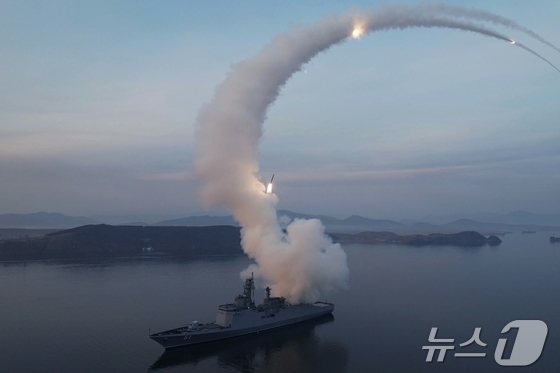
Shortly after President Lee Jae Myung expressed regret over the North Korean drone incursion, Pyongyang launched three ballistic missile provocations. Analysts believe the short-range ballistic missiles (SRBMs) fired by North Korea were specifically aimed at South Korea.
The Blue House is on high alert as North Korea resorts to military provocations before any expectations for improved inter-Korean relations could take hold.
On Thursday, the Blue House reported that the National Security Office convened an Emergency Security Situation Review Meeting the previous day with relevant agencies, including the Ministry of National Defense and the Joint Chiefs of Staff, to assess the security implications of North Korea’s missile launches.
The Joint Chiefs of Staff reported that North Korea fired several SRBMs into the East Sea from the Wonsan area around 8:50 a.m. on Wednesday. An additional missile was launched at 2:20 p.m. the same day. On Tuesday, North Korea also attempted to launch an unidentified projectile, marking three separate military displays over two days.
These military provocations from North Korea came after President Lee officially expressed regret over the drone incident on Monday, signaling Pyongyang’s intent to maintain a hostile stance.
Some observers noted a glimmer of hope for inter-Korean relations after Kim Yo-jong, Deputy Director of the North Korean Workers’ Party, issued a statement shortly following President Lee’s expression of regret.
In her statement, Kim characterized President Lee’s regret as very fortunate and a wise decision, quoting Kim Jong Un and describing it as the attitude of a frank and bold person.
Despite her seemingly positive remarks, Kim made it clear that North Korea intends to block attempts at contact with South Korea while emphasizing the need for measures to prevent future incidents. However, some within the South Korean government speculated that progress in inter-Korean dialogue might still be possible.
Nevertheless, analysts interpret North Korea’s missile provocations as a clear message that Pyongyang has no intention of engaging with Seoul.
The Blue House is particularly focused on North Korea’s choice to launch SRBMs rather than intercontinental ballistic missiles (ICBMs). They view this use of shorter-range missiles as a direct message aimed at South Korea, rather than the United States.
A senior Blue House official stated that while ICBMs target the U.S. mainland and major military bases, short-range missiles Target South Korea or Japan. This carries significant implications for South Korea and is something it must be cautious about.
President Lee’s expression of regret was intended to restore trust and ease military tensions between the two Koreas, but it has become clear that North Korea still does not view South Korea as a dialogue partner.
Jang Geum-cheol, North Korea’s First Vice Minister of Foreign Affairs and Director of the 10th Bureau, criticized South Korea’s response to Kim’s statement, saying that if the South interprets its swift reaction as an unusual friendly response or rapid mutual confirmation of intentions between leaders, it will be recorded as foolish wishful thinking that surprises the world.
The Blue House maintains its position that immediate progress in inter-Korean relations is unlikely, while also expressing a commitment to continue pursuing peace policies on the Korean Peninsula. However, they believe that the current focus should be on managing the situation.
A Blue House official stated that for now, it has no choice but to concentrate on managing the situation, adding that it will continue to promote policies for peace and coexistence on the Korean Peninsula.