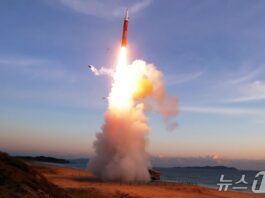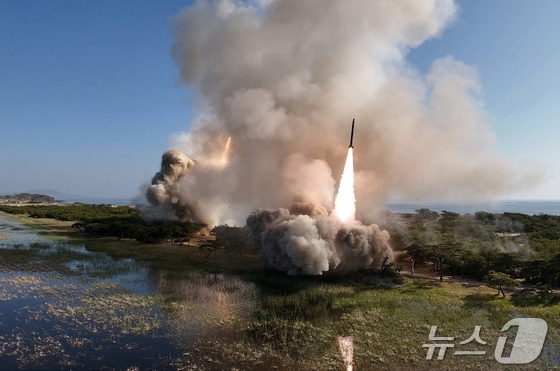
On Wednesday, North Korea conducted two separate launches of short-range ballistic missiles (SRBMs). This followed an attempted launch of an unidentified projectile on Tuesday, marking three military demonstrations over two consecutive days. Analysts suggest these actions underscore North Korea’s message of disengagement with South Korea.
The Joint Chiefs of Staff (JCS) reported that North Korea fired one SRBM from the Wonsan area into the East Sea at approximately 2:20 p.m. (South Korean time). The missile is believed to have traveled over 700 km (about 435 miles).
Earlier that day, around 8:50 a.m. (South Korean time), North Korea launched several SRBMs from the same area into the East Sea. These missiles flew about 240 km (about 149 miles) before impact. Due to their low-altitude trajectory and flight distance under 300 km, experts speculate they could be close-range ballistic missiles (CRBMs), which are notoriously difficult to intercept.
U.S. and South Korean intelligence agencies are currently analyzing the technical specifications of the ballistic missiles launched by North Korea. The unidentified projectile fired the previous day reportedly malfunctioned shortly after launch and was lost.
Military experts interpret North Korea’s back-to-back provocations as a clear signal rejecting any potential easing of tensions with what Pyongyang refers to as two hostile nations. This comes despite South Korean President Lee Jae Myung’s recent expression of regret over a civilian drone incursion into North Korean airspace, which Kim Jong Un had described as a bold and candid gesture.
However, North Korea swiftly countered any notion of reconciliation. Deputy Foreign Minister Choe Son-hui issued a statement reaffirming South Korea’s status as North Korea’s most hostile adversary, asserting that this fundamental stance would not change based on mere words or actions from Seoul. The two high-intensity military demonstrations in a single day appear designed to emphatically reject any conciliatory overtures. This marks the first instance of North Korea launching ballistic missiles twice in one day since President Lee took office.
In response to these provocations, South Korea’s National Security Office convened an emergency meeting with the Ministry of National Defense and the JCS. Officials emphasized that these actions violate the United Nations (UN) Security Council sanctions against North Korea and directed the military to maintain heightened readiness.
Some defense analysts speculate that North Korea may have been testing its recently unveiled high-output solid-fuel engine or attempting to launch intercontinental ballistic missiles (ICBMs) and long-range artillery systems targeted at South Korea.
Excluding the failed launch on Tuesday, this marks the first confirmed ballistic missile launch into the East Sea by North Korea in nearly three weeks. The previous incident occurred on March 14, when the JCS reported that North Korea fired over ten ballistic missiles from the Pyongyang Sunan area, traveling approximately 350 km (about 218 miles).
Including the unidentified projectile on Tuesday, North Korea has now conducted four ballistic missile provocations this year. Previous launches occurred on January 4, coinciding with President Lee’s visit to China for a summit, and on January 27, following U.S. Deputy Assistant Secretary of Defense Elbridge Colby’s visit to the region to discuss the new National Defense Strategy (NDS).
A JCS spokesperson stated that South Korean and U.S. intelligence agencies are closely monitoring launch activities and sharing critical information with Japan. It remains vigilant, maintaining a robust combined defense posture against North Korea’s various provocations.