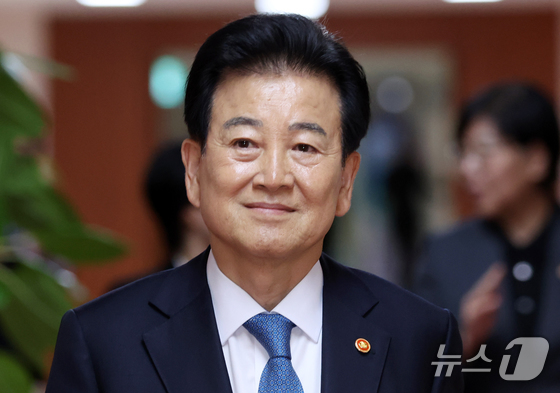
After South Korea’s Unification Minister Chung Dong-young identified Kusong City as the location of North Korea’s third uranium enrichment facility, controversy erupted when the U.S. protested, claiming a leak of confidential information and partially suspending intelligence sharing with South Korea. In response, President Lee Jae Myung intervened, stating that the claim of a confidential information leak was incorrect, as he sought to defuse the situation.
This move appears to dismiss the opposition’s concerns about a crisis in U.S.-South Korea relations and calls for Chung’s dismissal, while also clarifying to the U.S. that the Minister’s comments were not problematic.
On Monday evening, President Lee posted on X (formerly Twitter), asserting that the existence of nuclear facilities in Kusong was already widely known globally through various academic papers and media reports before Minister Chung’s remarks. He emphasized that any claims and actions presuming that Minister Chung leaked confidential information provided by the U.S. are erroneous.
He added that he needs to investigate why such absurd situations are occurring.
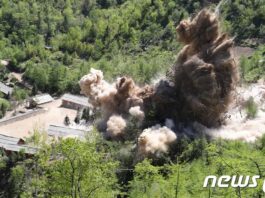
Previously, on March 6, Minister Chung mentioned Kusong City as a location of North Korea’s uranium enrichment facilities, in addition to the sites in Yongbyon and Gangseon, which had already been officially confirmed by the government and the International Atomic Energy Agency (IAEA).
The U.S. expressed dissatisfaction with Minister Chung’s comments, interpreting them as a disclosure of shared confidential information, and reportedly began suspending some intelligence sharing with South Korea about a week prior.
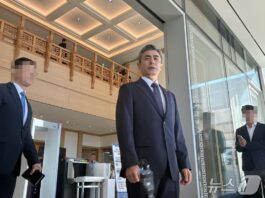
Addressing the controversy, Minister Chung met with reporters on Monday at the Government Seoul Building, stating that Kusong has been mentioned several times in past reports from U.S. think tanks and domestic media, so he regrets that this is being framed as an information leak.
He also remarked that he mentioned Kusong during the confirmation hearing on July 14 of last year, and there was no response then. He finds it suspicious that this issue has suddenly resurfaced nine months later.
President Lee’s subsequent message appears to support Minister Chung’s rebuttal and aims to stabilize the situation.
Currently, the specifics regarding the scale and nature of the restricted intelligence on North Korea that the U.S. has limited remain unclear. However, discussions have arisen about the possibility that the U.S. has restricted information related to North Korean technology gathered through satellite surveillance.
During a regular briefing on Tuesday, the Ministry of National Defense explained that the intelligence authorities of South Korea and the U.S. are closely communicating, including information on North Korea’s missile launch trends, and a tight information-sharing system remains in place. The Ministry also emphasized that the information sharing between the two countries is complementary rather than unilateral.
Professor Cho Sung-ryeol from Kyungnam University highlighted that North Korea-related intelligence is not something South Korea receives unilaterally from the U.S.; both sides exchange information. He noted that the military also gathers intelligence on North Korea using Paektu and Geumgang reconnaissance aircraft, and we provide the U.S. with signals intelligence (SIGINT) and human intelligence (HUMINT).
Some speculate that the South Korean government may take reciprocal action against the U.S. In response to the U.S.’s preemptive intelligence restrictions, South Korea might choose not to share some of the North Korea-related intelligence it has provided to the U.S. thus far.
However, if the U.S. has not restricted critical intelligence related to North Korea’s missile launch trends, analysts suggest that it would be more rational for both sides to communicate and resolve misunderstandings surrounding this issue.
Most importantly, President Lee’s clear message indicating that there is no problem with Minister Chung’s comments suggests that there may have already been some behind-the-scenes communication or negotiations between the U.S. and South Korea.
In the past, the two countries have occasionally limited information sharing when disagreements or conflicts over North Korea policy arose.
Minister Chung also mentioned that the U.S.’s restriction on information sharing has occurred intermittently in the past, expressing hope that the issue can be resolved through smooth communication between the U.S. and South Korea.