

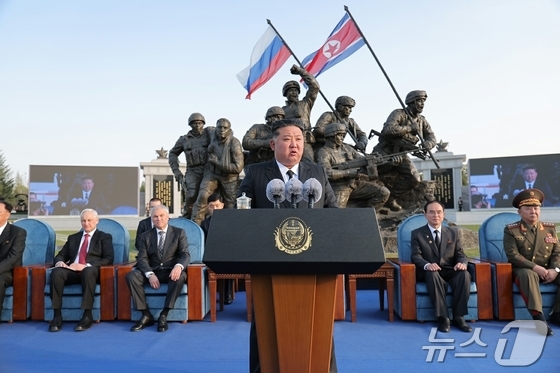
Recent analyses indicate that North Korea is intensifying efforts to reshape its constitutional framework and legal systems to present itself as a normal country. This strategy goes beyond mere image improvement; experts believe it aims to secure regime survival while stabilizing its economy, diplomacy, and internal governance, as noted on Thursday.
The recently disclosed revised constitution reveals that North Korea has significantly altered its constitutional structure compared to previous versions. The country has reorganized chapters and articles related to state institutions and power structures to more closely align with the order found in other nations’ constitutions.
North Korea has officially changed the name of its constitution from Socialist Constitution to Constitution of the Democratic People’s Republic of Korea. This revision minimizes ideological elements, introducing a previously unspecified territorial clause, now reflected in Article 2. The original Article 2, which defined North Korea’s identity as a socialist state, has been removed.
For the first time, the constitution places the Chairman of the State Affairs Commission ahead of the Supreme People’s Assembly in the order of state institutions, further centralizing governance.
The constitution’s preamble, which previously lauded the achievements of past leaders, has seen the removal of many references to socialism. Ideologically charged phrases like imperialist aggressors, liberated from exploitation and oppression, and destructive activities of internal and external hostile forces have also been eliminated.
Normalization in Both Foreign and Domestic Policy… Unhesitatingly Adopting Western Institutions, Such as the Establishment of a Police Force
These changes reflect a trend that has been building since North Korea altered its diplomatic approach following the breakdown of denuclearization talks in 2019. Although these negotiations failed to yield results, Kim Jong Un’s direct engagement in comprehensive diplomacy with the U.S. and South Korea likely provided him with both the necessity and confidence to pursue a new path.
Since the 8th Congress of the Workers’ Party in 2021 and the declaration of two Koreas in December 2023, North Korea has been pursuing a diplomatic strategy to establish a new multipolar system. This approach breaks from the conventional notion that confrontation with the U.S. is inevitable, instead seeking to ally with other nations to dismantle the U.S.-led unipolar system.
To achieve this, North Korea is closely aligning itself with Russia while still relying on China’s support to expand friendly relations with socialist and communist countries. Analysts interpret that North Korea is transforming its national system to present a normal country image to nations that harbor doubts about it.
Kim announced in March during the Supreme People’s Assembly that he plans to introduce a new police system. Until now, the military-derived Social Safety organization has performed police duties, but Kim’s vision includes creating a police organization capable of cooperation with other countries.
At that time, Kim stated that establishing a police system is an essential requirement for national governance, and suggested that the term police itself is not inherently negative. His remarks seem aimed at convincing officials and the populace, indicating that the measures for North Korea’s normalization have not yet been fully embraced within North Korean society.
However, the new constitution removes unrealistic socialist welfare provisions like free medical care, a tax-free nation, and a country without unemployment. This suggests that North Korea will intensify its efforts to eliminate internal discrepancies in perceptions as part of its normalization process.
North Korea’s confirmed participation in the Asian Football Confederation (AFC) tournament in South Korea and its active promotion of large urban development projects through modernization initiatives in Pyongyang and other regions are interpreted as extensions of its normalization efforts. Furthermore, the development of large-scale tourist sites like the Wonsan Galma Coastal Tourist Zone and the Samjiyon Tourist Zone can also be seen in this context.
What does North Korea’s pursuit of normalization entail? It may be a long-term strategy aimed at gaining recognition for its nuclear capabilities.
However, experts argue that the concept of normalization that North Korea seeks differs fundamentally from Western-style democratic nations. North Korea engages in non-compromising diplomacy to achieve its primary goal of nuclear possession.
The recent geopolitical climate in the Middle East and the situation in Iran may have intensified internal perceptions in North Korea that a weakened nuclear deterrent could threaten the regime’s very existence. Consequently, some analysts speculate that North Korea’s normalization efforts are part of a long-term strategy to gain international acknowledgment of its status as a nuclear power.
In this context, assessments suggest that North Korea’s normalization cannot be interpreted as a relaxation of its tightly controlled system or a depoliticization of its power institutions. Even if laws and systems are refined for normalization, they are likely to serve merely as a more sophisticated structure reinforcing the Workers’ Party’s governance.
Professor Jeong Ryeong-hyun from Kyungnam University’s Institute of Far Eastern Studies recently pointed out in his report, Considerations on the Establishment of a Police System in North Korea, that it is premature to conclude that the establishment of such a system will lead directly to institutional normalization. He emphasized that even if state operations are based on laws, it does not necessarily reflect a separation of powers or political neutrality in the sense of liberal democracy.