

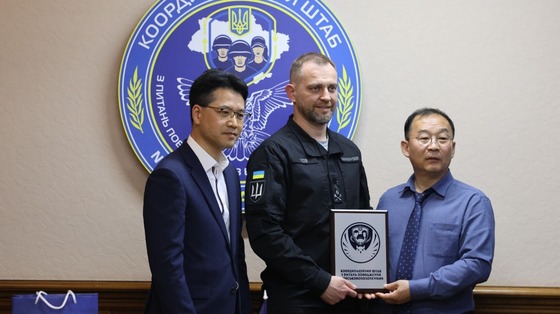
The Ukrainian Ministry of Defense’s Prisoner of War (POW) Treatment Coordination Office has informed South Korean civilian North Korean human rights activists that it will not forcibly repatriate North Korean soldiers captured in Ukraine. However, Ukrainian officials also indicated that a swift transfer to South Korea is not feasible, suggesting that the fate of these North Korean POWs may remain unresolved for an extended period.
Jang Se-yul, Secretary-General of the Emergency Committee for the Free Repatriation of North Korean Soldiers and representative of the Korean Unification Coalition, along with other activists, held talks with the POW office in Kyiv, Ukraine, on May 7. They disclosed the details of this meeting on Monday.
During the discussions, POW officials explained that the process for the free repatriation and international protection of North Korean soldiers requires systematic registration, legal review, and cooperation between international organizations. They assured that forced repatriation would not occur but also stated that expediting all procedures for an immediate transfer to South Korea is not practically viable. While this stance may not be optimistic regarding the soldiers’ return to South Korea, the Ukrainian commitment to avoid forced repatriation is seen as a positive development.
The committee reported that the meeting was arranged at their request, facilitated by Ukrainian human rights organizations. Jang emphasized during the talks that North Korean soldiers could face severe consequences, including punishment and human rights violations, if returned to North Korea.
The Ukrainian delegation included four representatives from the POW office, led by Chief Officer Dmitry Usov, along with a public affairs officer and officials from the Civil Society Cooperation Department. The South Korean contingent comprised Jang, Lee Byung-rim (head of the North Korean Political Prisoners’ Dissolution Movement Headquarters), Yang Si-yeon (Secretary-General of the Korean Unification Coalition), Woo Young-bok (team leader of the Political Prisoners’ Dissolution Movement Headquarters), and Professor Kang Dong-wan from Dong-A University.
POW officials reported that the North Korean soldiers initially attempted suicide by biting their wrist veins and engaged in self-harm and other extreme actions after capture. However, they are now receiving protection and are in stable condition.
The POW office also stated that they are in ongoing consultations with the South Korean government and have implemented international protection measures in collaboration with the International Committee of the Red Cross (ICRC).
On May 9, the POW office took the unusual step of publicly acknowledging the meeting by sharing a photograph with six South Korean civilian activists on social media.
Analysts suggest that this unprecedented disclosure of a meeting with civilian activists, despite previous silence on interactions with the South Korean government, aims to highlight Ukraine’s multifaceted approach to addressing the North Korean POW issue with South Korea.
The two North Korean soldiers were deployed in October 2024 and captured during the Battle of Kursk in January 2025.
In March of the following year, one prisoner expressed a desire to defect to South Korea. After careful consideration, the second soldier also declared his intention to defect in October, confirming that both wish to relocate to South Korea.