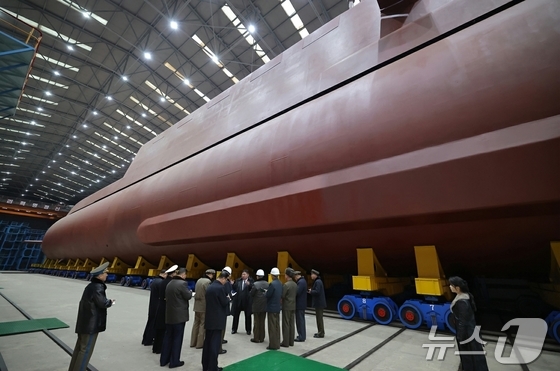
On Thursday, reports surfaced indicating that Russia may be aiding North Korea’s nuclear force enhancement by providing submarine propulsion systems and uranium enrichment technology. U.S.-based North Korea watchdog 38 North highlighted that Pyongyang’s new nuclear-powered submarine under construction is comparable in size to Russia’s Akula-class submarines, which displace over 8,000 tons. The report stated that the possibility of technology and component transfers from Russia cannot be ruled out.
The International Atomic Energy Agency (IAEA) recently voiced concerns about the rapid expansion of North Korea’s nuclear program, pointing to potential new uranium enrichment facilities at the Yongbyon nuclear complex. 38 North estimates that North Korea currently possesses over 50 nuclear warheads and assesses that military cooperation between Pyongyang and Moscow is now extending into the nuclear-powered submarine domain.
The outlet drew particular attention to the December 2024 sinking of the Russian military logistics vessel Ursus Mayor near Spanish waters. The ship, operated by a company affiliated with the Russian Ministry of Defense, sank while en route from St. Petersburg to Vladivostok.
38 North speculated that the Ursus Mayor may have been transporting reactors or related components for North Korea’s nuclear submarines. The presence of the Russian warship Ivan Gren and the intelligence-gathering vessel Yantar at the accident site further suggests the ship was carrying sensitive military cargo.
The report emphasized the similarity in size between North Korea’s new submarine and Russian Akula-class submarines. It suggested that decommissioned Akula-class submarines may have served as donors for propulsion systems,” noting the potential transfer of certain technologies, including reactor and cooling systems. However, the report added that the transfer of complete reactors has not been confirmed.
38 North predicted that if North Korea’s nuclear submarine development accelerates, the country’s demand for highly enriched uranium (HEU) will inevitably spike. Consequently, activities at the Yongbyon nuclear facility may become closely tied to the Navy’s efforts to secure reactor fuel.
The analysis also pointed to expanding research and resource cooperation between North Korea and Russia. North Korean geologists have reportedly received training in uranium exploration and mining at Russian institutions, while Russian universities are serving as educational hubs for North Korean personnel in fields such as energy, chemistry, and mechanical engineering.
Earlier, CNN had also raised the possibility that Western military forces intervened in the Ursus Mayor sinking to prevent the transfer of nuclear technology to North Korea.
38 North concluded that Russia is leveraging North Korea’s nuclear and military modernization to expand its strategic influence in the Asia-Pacific region. The report also projected that ongoing military cooperation between North Korea and Russia will likely pose significant obstacles to future negotiations regarding North Korea’s nuclear program.