

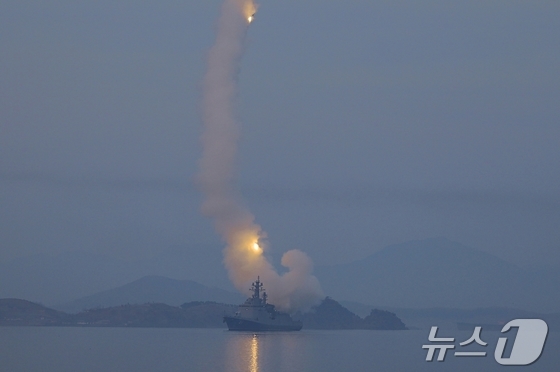
China refrained from making any new comments regarding North Korea’s launch of several close-range ballistic missiles (CRBM) into the West Sea on Tuesday afternoon, stating that it has no new comment.
During a regular press briefing that day, Chinese Foreign Ministry spokesperson Mao Ning responded to related questions by noting that they’re aware that the parties involved have differing views on the definition of the launch, and firmly stated that it has no new comment.
Earlier, the Joint Chiefs of Staff (JCS) reported that at around 1:00 p.m., they’ve detected the launch of various projectiles, including close-range ballistic missiles, from the Jeongju area in North Pyongan Province into the West Sea. The military has heightened monitoring and vigilance in preparation for additional launches, and South Korea, the U.S., and Japan are closely sharing relevant information to maintain readiness. The missiles launched by North Korea are estimated to have flown approximately 50 miles.
There are also speculations that the close-range ballistic missiles launched that day could be a new type of CRBM under development by North Korea. North Korea’s new CRBM has a range of less than about 186 miles and has the advantage of flying at a lower altitude compared to the existing North Korean Iskander (KN-23), making it more challenging for U.S. and South Korean surveillance to detect.
Previously, North Korea had disclosed that it tested the performance of new warheads on April 4, including cluster munitions that disperse smaller bombs from a single warhead and aerial mines designed to disrupt enemy transportation networks, by launching five CRBM Hwasong-11 missiles into the East Sea. When launched from the border area, these missiles could potentially reach targets throughout the Seoul metropolitan area and the U.S. military base at Camp Humphreys in Pyeongtaek, Gyeonggi Province.
This marks the eighth time North Korea has launched ballistic missiles this year. Since firing several short-range ballistic missiles (SRBM) into the East Sea on January 4, North Korea has continued its provocations at intervals ranging from as short as one day to as long as one or two months. The most recent provocation occurred on April 19 when several SRBMs were launched into the East Sea from the Sinpo area in South Hamgyong Province. This year, North Korea has conducted a total of 10 provocative actions, including two strategic cruise missile launches in March from the waters off Choe Hyon-ho.