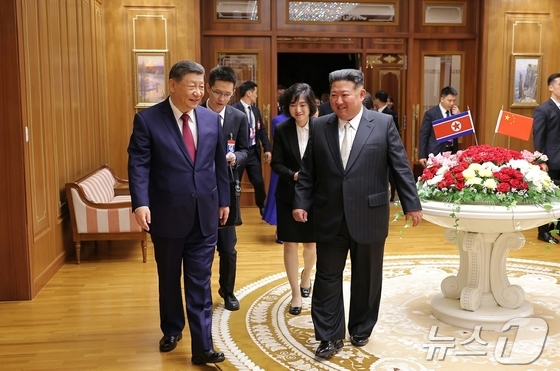
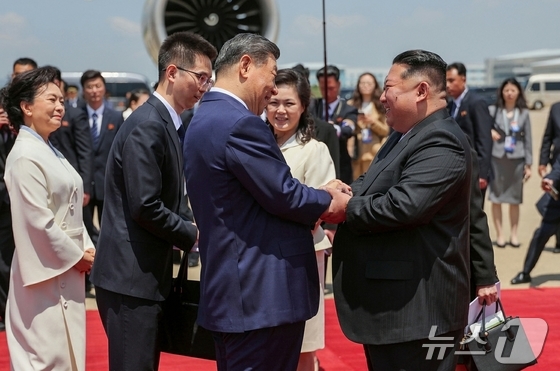
Following Chinese President Xi Jinping’s visit to North Korea, which successfully restored North Korea-China relations, observers on Wednesday suggest that North Korea will reaffirm its hardline stance towards the U.S. and South Korea through the Workers’ Party plenary meeting scheduled for later this month. After strengthening strategic cooperation with Russia and now China, analysts believe that Kim Jong Un, General Secretary of the Workers’ Party, may present a more aggressive foreign policy direction for the latter half of the year.
During their two-day summit on June 8-9, General Secretary Kim and President Xi defined the North Korea-China relationship as an unalterable, special, genuine, and solid strategic relationship, and confirmed their willingness to expand cooperation in all areas including politics, economy, culture, and military. North Korea and China also hinted at conducting aggressive cooperative diplomacy by agreeing to strengthen coordination on issues of peace, stability, and development in the region and the world.
This summit was markedly different from President Xi’s visit to North Korea seven years ago in June 2019. While the previous meeting focused on denuclearization of the Korean Peninsula and managing dialogue with the U.S., this time the Korean Peninsula issue itself disappeared from the agenda, with the strengthening of North Korea-China relations through strategic cooperation taking center stage.
Notably, this summit publicly mentioned strengthening military exchanges and cooperation while completely omitting North Korea’s denuclearization issue, leading some to assess that China has acknowledged North Korea’s position as a nuclear state. Experts interpret this as China losing interest in mediating the North Korean nuclear issue and instead shifting its diplomatic stance towards managing North Korea as a strategic partner to counter the U.S. This forms the backdrop for predictions of accelerated closeness between the two countries in the future.
Following Russia, China Also Appears to Accept North Korea as a Nuclear-Armed State, Marking a Diplomatic Gain for Pyongyang
From North Korea’s perspective, the creation of such an atmosphere is likely to be self-evaluated as a diplomatic achievement. Since enacting the Nuclear Forces Policy Law in 2022 and priding itself as a nuclear state, North Korea may conclude that its nuclear possession has become a fait accompli, having secured implicit support from China following Russia.
Hong Min, a senior researcher at the Korea Institute for National Unification, assessed that President Xi’s promise of firm support for North Korea’s socialist cause without mentioning denuclearization means accepting North Korea as it is. He added that North Korea could interpret this as tacit approval of its nuclear state status and an achievement in elevating its strategic position.
In fact, North Korea seemed to focus on establishing its relationship with China as a state-to-state relationship, moving beyond the traditional party-to-party (Communist Party and Workers’ Party) relationship during this summit.
In his meeting with President Xi, General Secretary Kim stated that developing North Korea-China relations would be the country’s most important primary strategic task, and that he would do his utmost to make North Korea-China relations a model for state relations.
General Secretary Kim’s mention of the word state and the agreement to expand mutual cooperation and exchanges in all areas can be seen as expressing the will to transform the unbalanced relationship formed in the process of establishing party-to-party relations into a relationship where transactions are possible and mutual benefits can be pursued.
Party Plenum Reaffirms Hard-Line Stance Toward the U.S. and South Korea, with Tougher Rhetoric Possible
This atmosphere is expected to be reflected in the Workers’ Party plenary meeting scheduled for later this month. North Korea has typically used the June plenary meeting to summarize the first half of the year’s activities and adjust the direction of state operations for the latter half.
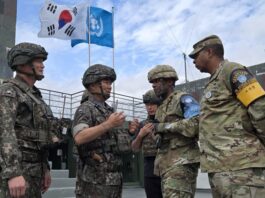
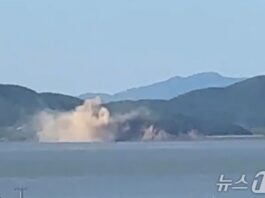
At this meeting, North Korea is expected to continue its policy of maintaining a hardline stance towards the U.S. and South Korea while flaunting its confidence as a nuclear state. In February, at the 9th Party Congress, General Secretary Kim denounced South Korea as an eternal enemy, stating that it would be permanently excluded from the category of same people and treated as a thoroughly hostile country.
Regarding the U.S., General Secretary Kim stated that the inherent hostile view and the gangster-like nature of the U.S. towards them, which is ingrained with authoritarianism, has not changed at all, and declared that North Korea would continue to prepare for confrontation with the U.S. and firmly maintain an unwavering hardline stance as the foundation of its policy towards the U.S.
Given this expression of policy at the Party Congress and the strong support now received from China, the prevailing view is that it is unlikely for North Korea to withdraw its aggressive foreign policy stance in the near future.
Diplomatic circles suggest that at this plenary meeting, North Korea may present more aggressive foreign policy messages, based on its confidence in securing simultaneous support from China and Russia.