President Lee Jae-myung continued a series of bilateral and multilateral diplomatic engagements with leaders of major economies on June 17 (local time) as he wrapped up his participation in the Group of Seven summit and concluded his European tour.
One of the notable developments from the summit was Lee’s brief exchange with U.S. President Donald Trump, during which Lee called for a more active U.S. role in resolving issues related to North Korea and Trump responded that he would make efforts to do so. Attention remains focused on whether the two leaders will hold a formal summit meeting.
Lee attended the second expanded-session meeting of the G7 summit in Evian, France, on Tuesday. After holding separate bilateral meetings the previous day with German Chancellor Friedrich Merz and Canadian Prime Minister Mark Carney, Lee was also reported to be coordinating additional meetings or informal discussions with other G7 leaders.
As the leader of an invited non-member country, Lee faced practical limits in proactively requesting bilateral summits. Nevertheless, he actively sought opportunities to engage with participating leaders.
During his meeting with Merz, the two leaders discussed ways to strengthen cooperation between South Korea and Germany. In talks with Carney, whose government is preparing to select a contractor for a submarine project reportedly valued at about $43 billion, Lee emphasized the potential for broader bilateral cooperation and suggested further discussions on specific areas of partnership.
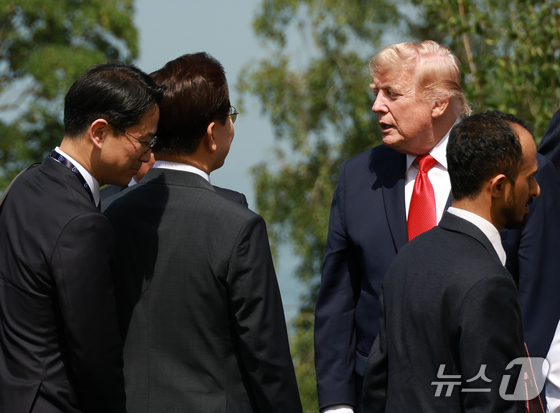
Particular attention was drawn to Lee’s brief encounter with Trump during the G7 family photo session, marking their first face-to-face exchange in roughly seven months.
According to the presidential office, Trump asked Lee about recent developments in inter-Korean relations. Lee responded by urging Trump to take a leading role in achieving a peaceful resolution of North Korea-related issues, comparing it to Trump’s efforts to end the conflict in the Middle East. Trump replied that he would work toward resolving issues involving North Korea.
While prospects for a formal South Korea-U.S. summit remained uncertain, observers noted that such a meeting could still take place depending on Trump’s schedule and willingness to meet with leaders of invited countries.
Some analysts have also suggested that any formal talks could include discussions of security-related cost-sharing, including potential contributions tied to post-conflict maritime security efforts following the reopening of the Strait of Hormuz after the U.S.-Iran ceasefire agreement.
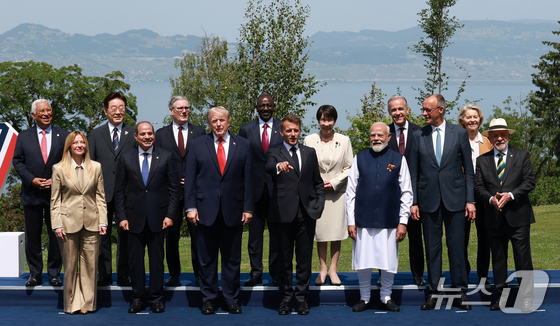
Lee concluded his eight-day, 10-day European trip following the G7 expanded-session meeting.
During the tour, he held a summit with Belgian Prime Minister Bart De Wever, where the two sides signed four memorandums of understanding. In talks with the European Union, Lee also secured what officials described as meaningful progress in limiting reductions to tariff-rate quotas affecting South Korean steel exports.
The joint South Korea-EU statement, which reaffirmed that North Korea’s status as a nuclear weapons state would not be recognized and condemned military cooperation between North Korea and Russia, prompted criticism from Pyongyang. However, Lee reiterated his commitment to peace and coexistence on the Korean Peninsula during meetings including an audience with Pope Leo XIV. He also formally invited the pope to visit South Korea next year in connection with World Youth Day events.
During his state visit to Italy, Lee and Italian leaders agreed to elevate bilateral ties to a “special strategic partnership” and adopted a South Korea-Italy Strategic Action Plan for 2026-2030. The two countries also signed four memorandums of understanding covering advanced technology cooperation and joint development initiatives in Africa.
National Security Adviser Wi Sung-lac said the trip provided an opportunity not only to address current challenges but also to explore future avenues of cooperation.
“This European tour was a meaningful journey that addressed current issues while seeking directions for future cooperation,” Wi said. “It was also part of South Korea’s effort to work with the international community in pursuing solutions based on shared values of peace, prosperity, solidarity and cooperation amid changes in the global order.”