“Who discusses the nuclear issue without even knowing whether there are nuclear weapons or not?”
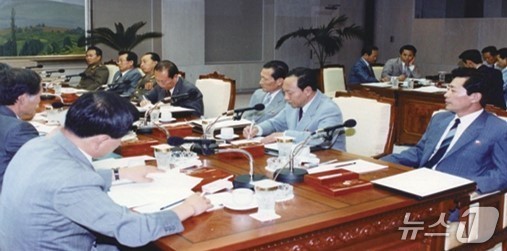
On the morning of March 10, 1992, at Tongilgak on the North Korean side of Panmunjom, tensions erupted during the sixth round of working-level talks on establishing and operating the South-North Joint Nuclear Control Commission. Lim Dong-won, then South Korea’s vice minister of national unification and chief delegate, slammed his hand on the table. Almost instantly, a loud bang came from across the table as North Korean chief delegate Choe U-jin, a Foreign Ministry ambassador-at-large, struck his own desk.
Choe U-jin: “Hey! What are you doing, banging the table?”
Lim Dong-won: “Someone discussing the nuclear issue without even knowing whether there are nuclear weapons or not…”
Choe U-jin: “Hey! Why are you banging the table?”
Lim Dong-won: “Why are you shouting?”
Choe U-jin: “Why are you banging the table?”
The confrontation quickly spread to the other delegates. Gong Ro-myung, then head of the Institute of Foreign Affairs and National Security and later foreign minister, clashed with Kim Yong-chol, deputy director of North Korea’s Ministry of the People’s Armed Forces.
Gong Ro-myung: “Then why are you lying?”
Kim Yong-chol: “What lie are you talking about?”
Gong Ro-myung: “Just listen for a moment.”
Kim Yong-chol: “What do you know?”
The unfiltered transcript was never made public at the time. Following the heated exchange, North Korea issued a statement under Choe’s name accusing South Korea of delaying resolution of the nuclear issue. A newspaper report published two days later was the only public record of the incident.
The 3,836 pages of inter-Korean nuclear negotiation transcripts released Monday by South Korea’s Ministry of Unification capture the atmosphere inside 32 rounds of nuclear negotiations held between December 1991 and January 1993. Historians and former officials have described them as the most contentious negotiations ever held between the two Koreas, and the records have now been released for the first time.
‘I know more than you do’ — Clash over Yongbyon nuclear facility
The dispute centered on North Korea’s Yongbyon nuclear complex. During the sixth round of talks, North Korea repeated its proposal to establish the Joint Nuclear Control Commission first without setting deadlines for inspections. After Choe repeatedly described Yongbyon as little more than “one small reactor,” Lim sharply challenged him.
“It’s extremely frustrating trying to talk to people who don’t even know what nuclear facilities they have at Yongbyon or why they’re at the center of this issue.
“We know exactly what’s there, as if looking at the palm of our hand, through scientific equipment. We have the most advanced technology as well as years of accumulated intelligence. That’s why it’s a problem when your representatives come here without knowing.”
The North Korean delegation reacted immediately. Rather than directly disputing Lim’s factual claims, Choe argued that questioning his knowledge was an insult to his authority as the North’s fully authorized representative.
Choe U-jin: “Then should I step down as chief delegate?”
Lim Dong-won: “I’m asking whether you actually know.”
Choe U-jin: “Say it clearly.”
Lim Dong-won: “Whether you know, or whether you know and are deliberately saying otherwise.”
Choe U-jin: “Now you’re questioning my qualifications.”
Lim Dong-won: “A person who doesn’t even know whether there are nuclear facilities at Yongbyon!”
Choe U-jin: “I know more than you do. More than you!”
Gong Ro-myung: “Then why did you say there weren’t any? Why deny it?”
Kim Yong-chol: “What lie are you talking about?”
Gong Ro-myung: “What do you know?”
Apology offered, but confrontation continued
After tempers cooled somewhat, Kim Yong-chol formally raised the issue.
He said Lim had referred to Choe as “someone who doesn’t even know about Yongbyon,” using an insulting term. “That kind of language has never appeared in the history of our dialogue,” Kim said. “The recording should be replayed, and it should be entered into the official record.”
Lim immediately responded.
“I honestly don’t remember whether I used that word while speaking in anger. If I did, I apologize.”
At the same time, Lim noted that harsh language had surfaced during previous inter-Korean talks as well.
“In past negotiations there were expressions such as ‘nonsense’ and other inappropriate remarks,” he said. “Those were never appropriate expressions either.”
The exchanges offer a rare glimpse into the intensity of negotiations in which both Koreas defended their national interests and political pride during direct talks over the nuclear issue.