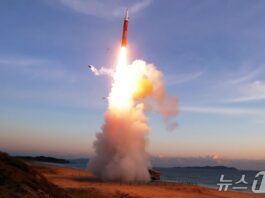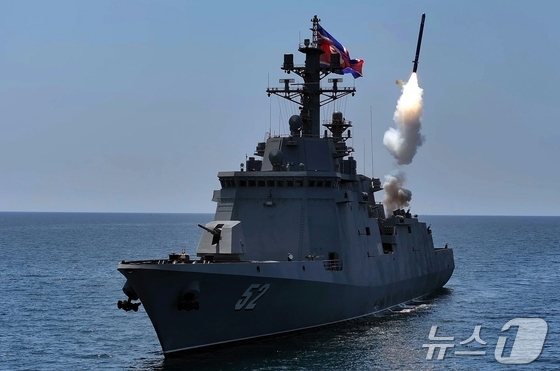
North Korea has conducted performance evaluation tests on the armament system of its new 5,000-ton multipurpose destroyer, the Kang Kon, and plans to commission it into naval service within two months. This follows the commissioning of the first ship of the Choe Hyon-class, the Choe Hyon-ho, signaling a significant advancement in North Korea’s naval nuclear armament program and overall military capabilities expansion.
However, military analysts caution that the acquisition of just two destroyers does not necessarily translate to substantial blue-water operational capabilities or effective maritime nuclear deterrence. Despite the rapid construction of these large surface vessels, significant challenges remain in developing essential support infrastructure such as fleet bases, maintenance systems, crew training programs, and command and control networks.
Accelerated Testing Process for New Destroyer
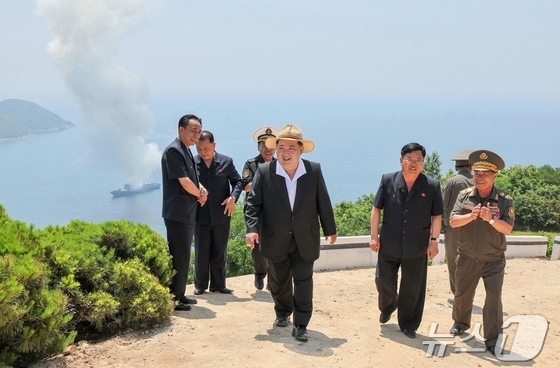
According to North Korea’s state-run Rodong Sinmun newspaper, Kim Jong Un, General Secretary of the Workers’ Party, observed the Kang Kon’s armament system performance evaluation on July 3. He directed that the destroyer be fully commissioned into the navy within the next two months.
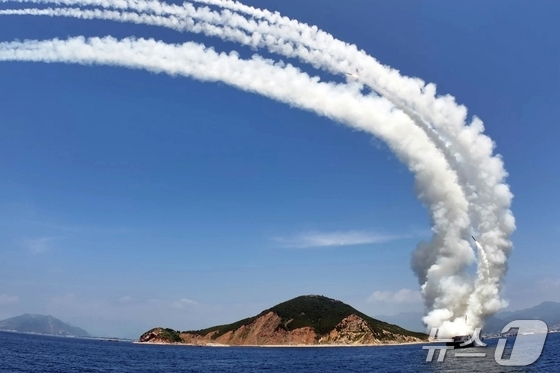
The tests validated an array of systems, including strategic cruise missiles, anti-ship, anti-submarine, and anti-aircraft weapon systems, as well as electronic warfare capabilities. North Korean media released images showing the vessel’s stern-mounted vertical launch system (VLS) firing what appear to be strategic cruise missiles in rapid succession. The photos also captured the operation of surface-to-air missiles, the 127mm main gun, and close-in weapon systems (CIWS).
Notably, the Kang Kon’s testing and evaluation procedures were significantly streamlined compared to its predecessor.
Hong Min, a senior researcher at the Korea Institute for National Unification, explained the difference: The Choe Hyon-ho underwent months of separate tests for individual weapons systems, sensor and command integration, and national strategic weapons command system verification. In contrast, the Kang Kon conducted target detection, information processing, integrated firepower system checks, and live-fire tests in a single, comprehensive evaluation.
This efficiency indicates that North Korea is applying lessons learned from the Choe Hyon-ho’s development to standardize and accelerate the testing and deployment process for its new destroyer class.
Another key difference in the Kang Kon’s development was the focus on hull and maneuvering stability verification following a capsizing incident during its launch in May last year. This more cautious approach contrasts with the Choe Hyon-ho, which showcased its weapons systems immediately after launch before conducting integrated systems and navigation tests.
Expanding Maritime Nuclear Capabilities
Shin Jong-woo, Secretary-General of the Korea Defense and Security Forum (KODEF), assessed the situation: North Korea is rapidly expanding its naval nuclear capabilities in both the East and West Seas through the accelerated commissioning of the Kang Kon. Following cruise missile launch tests from the Choe Hyon-class destroyer, they’ve now demonstrated the use of multiple close-in defense weapons, signaling a comprehensive approach to naval warfare.
The Kang Kon’s armament configuration is particularly noteworthy. Imagery suggests a dense arrangement of automated weapons systems along the vessel’s sides, including 30mm multi-barrel close-in defense guns and 14.5mm machine guns.
This weapons layout is interpreted as an effort to enhance the ship’s short- and medium-range defense capabilities, addressing potential vulnerabilities. Unlike older vessels where crew members were exposed during close-range engagements, these modern ships incorporate remote control and automation systems to minimize personnel risk.
Strategic Implications and Challenges
During the recent tests, Kim outlined a phased approach for developing and deploying various maritime and underwater combat systems across designated military operational areas.
Researcher Hong elaborated on North Korea’s concept of military operational areas: This term encompasses regions where South Korean, U.S., and Japanese military assets and bases are deployed, as well as North Korea’s corresponding naval operational zones. It suggests a tiered strategy: short-term focus on waters near the Korean Peninsula, mid-term expansion to areas around Japan and within range of U.S. bases there, and long-term projection into the Western Pacific.
However, experts believe North Korea faces a significant time gap between this ambitious vision and actual operational capabilities.
Operating large destroyers effectively requires extensive supporting infrastructure, including dedicated port facilities, maintenance and supply chains, crew training programs, inter-vessel command and control systems, and logistical and air support for extended deployments. North Korea’s repeated emphasis on fleet base construction and shipyard capacity expansion indicates awareness of these infrastructure shortfalls.
Kim has again stressed the importance of developing fleet bases and enhancing shipyard capabilities, viewing these as crucial to naval command, culture, and combat effectiveness. This echoes his May 23 remarks at the Choe Hyon-ho’s commissioning ceremony, where he called for large, multi-functional naval bases.
These factors lead analysts to characterize North Korea’s naval nuclear armament program as still grappling with the limitations of destroyers without bases.
The Kang Kon is expected to undergo further testing, including integration with strategic cruise missiles and the national strategic weapons command system, as well as anti-submarine and electronic warfare trials. Experts anticipate a possible commissioning around September 9, coinciding with North Korea’s 78th founding anniversary.
There’s speculation that North Korea might launch a third ship of the class around October 10, the Workers’ Party founding day, creating a narrative of rapidly expanding naval power.
In conclusion, the successive commissioning of the Choe Hyon-ho and Kang Kon marks a significant shift in North Korean naval strategy, transitioning from an aging coastal defense fleet to a force built around large, strategic weapon-equipped surface combatants. However, the realization of North Korea’s claimed naval nuclear deterrent hinges not just on ship construction, but on the development of critical support infrastructure, including fleet bases, maintenance facilities, and advanced command and control networks.