

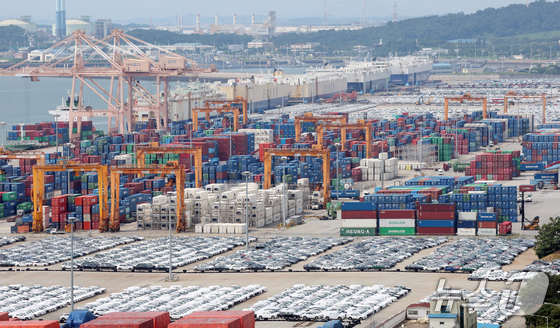
A recent analysis shows that tariffs imposed by the U.S. government on Korean exports have skyrocketed nearly 47-fold compared to the figures before the beginning of Donald Trump’s administration, marking the fastest growth rate among major countries. In the second quarter, the total tariff amount reached 3.3 billion USD, placing South Korea sixth in the world in terms of tariffs paid.
The Korea Chamber of Commerce and Industry released these findings on September 21, based on an analysis of U.S. International Trade Commission (ITC) tariff statistics for the top 10 countries exporting to the U.S. in Q2.
ITC data reveals that South Korea paid 3.3 billion USD in tariffs on its exports to the U.S. in Q2. This amount is lower than China’s 25.93 billion USD, Mexico’s 5.52 billion USD, Japan’s 4.78 billion USD, Germany’s 3.57 billion USD, and Vietnam’s 3.34 billion USD.
Compared to Q4 of last year, before the commencement of Trump’s second term, the increase in tariffs on South Korea reached 3.23 billion USD, ranking fourth after China’s 14.18 billion USD, Mexico’s 5.21 billion USD, and Japan’s 4.2 billion USD.
In terms of growth rate, South Korea experienced a staggering 4,614% increase (47.1 times), the highest among the ten countries. Canada followed with a 1,850% increase (19.5 times), Mexico with a 1,681% increase (17.8 times), Japan with a 724% increase (8.2 times), Germany with a 526% increase (6.3 times), and Taiwan with a 377% increase (4.8 times).
Until Q1, the Korea-U.S. Free Trade Agreement (FTA) had kept tariffs minimal. However, Q2 saw the introduction of a 10% universal tariff, along with specific tariffs on automobiles, parts, steel, and aluminum, leading to a significant spike.
In contrast, although China experienced the largest absolute increase in tariffs, it had already been subject to high tariffs on electric vehicles, batteries, semiconductors, and solar cells during the Joe Biden administration, resulting in the lowest growth rate among the ten countries.
Breaking down South Korea’s Q2 tariff bill by product, automobiles and auto parts accounted for 1.9 billion USD, comprising 57.5% of the total. This surge was largely due to the 25% tariff imposed on fully assembled vehicles in April and on auto parts in May.
Machinery and electrical/electronic items face both direct tariffs and additional tariffs on their steel and aluminum components. Steel and aluminum products were hit with a 25% tariff in March, which increased to 50% in June.
It is worth noting that this analysis is based on figures up to Q2, and tariff rankings may shift following negotiations in Q3.
The Chamber also calculated the average effective tariff rate by dividing the tariff amounts by the export values for Q2.
The results show that South Korea’s exports were valued at 32.86 billion USD, with 3.3 billion USD in tariffs, yielding an effective tariff rate of 10.0%. This rate ranks third among the top 10 U.S. export partners, behind China’s 39.5% and Japan’s 12.5%. Given that South Korea’s Q2 export value ranks eighth globally, this suggests a disproportionately high tariff burden relative to its export scale.
Taiwan, which primarily exports semiconductors, and Ireland, which mainly exports pharmaceuticals, currently face lower effective tariff rates as their specific tariff rates have yet to be determined. Meanwhile, products from Mexico and Canada under the U.S.-Mexico-Canada Agreement (USMCA) enjoy tariff exemptions, resulting in lower effective rates.
Experts predict that the tariff burden on South Korean exporters will continue to increase. A report by Goldman Sachs from August estimated that as of June, U.S. importers bore 64% of the tariffs, consumers 22%, and exporters 14%. However, projections for October and beyond suggest that consumers will shoulder 67%, exporters 25%, and importers only 8%. This shift indicates that while importers initially bear the brunt, exporters will assume an increasing share of the burden over time.
The Chamber stressed the urgent need for policies and legislative support to alleviate the strain on South Korean exporters. Kang Seok-gu, head of the research division, stated that as their companies navigate this challenging period of adapting to the new trade landscape, it must prioritize measures that ease their burdens rather than implement policies that add pressure and undermine their competitiveness.