Recent analysis suggests that South Korea’s long-sought approval from the United States to build nuclear-powered submarines is revealing strategic differences between the two countries. South Korea sees these submarines as essential to strengthening deterrence against North Korea, while the United States appears to view them as part of its broader strategy to counter China in the Indo-Pacific.
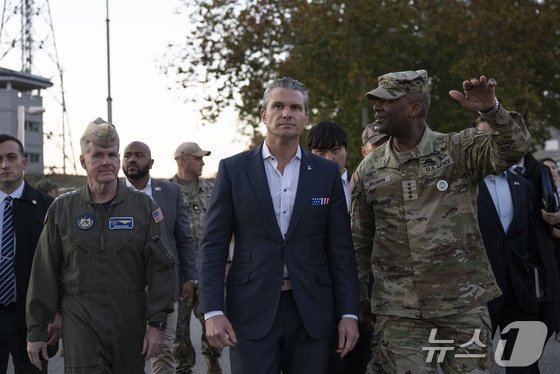
On Monday, Gen. Xavier T. Brunson, commander of United Nations Command, ROK-U.S. Combined Forces Command, and United States Forces Korea, referenced what he called triangular cooperation among South Korea, Japan, and the Philippines during a written interview about eastward-oriented maps. He described the three countries as an interconnected network, presenting the Korean Peninsula as a strategic hub linked not only to North Korea but also to the wider South Pacific, including China and Russia.
The joint fact sheet on tariffs and security released by South Korea and the United States on Friday further reflects Washington’s strategic direction.
While the fact sheet does not explicitly mention China, it includes references to maintaining peace and stability in the Taiwan Strait, opposing unilateral changes to the status quo, protecting freedom of navigation, and addressing regional threats to allies. These elements signal U.S. intentions to expand the alliance beyond the Korean Peninsula to the broader Indo-Pacific region.
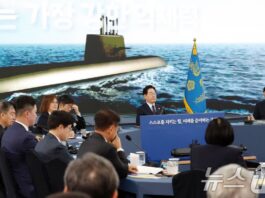
Within this context, South Korea’s nuclear submarine program stands out as a symbolic development. The fact sheet confirms U.S. approval of South Korea’s plan to construct nuclear-powered submarines and pledges cooperation on core technologies, marking a major milestone for Seoul after years of failed attempts under previous administrations.
However, the U.S. perspective differs from South Korea’s. During a Friday press briefing, Chief of Naval Operations Adm. Daryl Caudle suggested that it is natural to expect South Korea’s nuclear-powered submarines to play a role in deterring China. He also said that U.S. Forces Korea or South Korean forces would likely have a role in a Taiwan contingency.
Gen. Brunson presented a map highlighting not only Pyongyang but also Beijing, Taipei, and Manila, emphasizing regional allied forces as the most substantial deterrent. While saying that the allies are not creating a new alliance or targeting specific countries, his comments suggest a clear view of allied forces, including U.S. Forces Korea, as a forward base for deterring China.
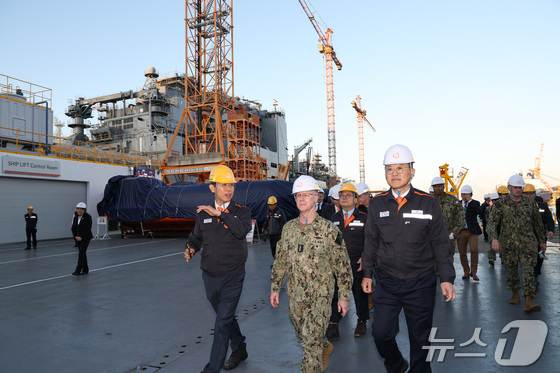
The South Korean government has attempted to distance itself from references to China in discussions about SSNs and Taiwan. Then-National Security Advisor Cho Tae Yong stated during a May 14 briefing that there had been no discussion of roles in a Taiwan Strait contingency. He emphasized that the primary purpose of the SSNs is to deter North Korea.
Experts assess that the key issue will be how long South Korea can maintain its emphasis on the SSNs-for-North-Korea-deterrence framework. As the United States categorizes the SSN program and trilateral cooperation among South Korea, the United States, Japan, and the Philippines as part of its Indo-Pacific deterrence strategy, this could create a disconnect with South Korea’s envisioned roadmap for self-defense.
The China factor remains a concern. Chinese Ambassador to South Korea Xing Haiming stated during a May 13 press briefing that South Korea-U.S. SSN cooperation goes beyond commercial collaboration and directly affects the international non-proliferation regime and regional stability. He urged South Korea to handle the matter cautiously. There are also concerns that China may exert significant economic and diplomatic pressure on South Korea during the submarine construction process.
Observers suggest that President Yoon Suk Yeol’s government may find it easier to achieve the transition of wartime operational control (OPCON) during its term. To reduce U.S. Forces Korea’s deterrence mission against North Korea and assign a new role focused on China, it may be advantageous for Washington to transfer the lead in defending the Korean Peninsula to the South Korean military sooner.
Gen. Brunson has stated that even if the OPCON transition is conditions-based, the fundamental foundation of allied defense will not change. He has emphasized that the alliance will maintain its unity while possessing the full capability to deter and repel North Korean aggression.